Magnetic Rack Showdown: Comparing Performance, Cost, and OEM Fit for Biotech Buyers
Magnetic Rack Comparison: Performance, Cost, and OEM Fit for Biotech Buyers
Choosing a magnetic rack is no longer just about picking a tube holder. For biotech labs and production teams, the decision affects separation consistency, workflow speed, reagent Cost of Goods, and long-term supply reliability. This guide compares magnetic rack options across performance, cost, scalability, and OEM/ODM support, with a specific focus on how Guangzhou Carbon Link Intelligent Technology Co., Ltd (Carbonlinkai) positions its magnetic racks against established benchmarks such as the Thermo Fisher DynaMag-2.
Buyers evaluating magnetic racks in 2026 face three questions at once: Which rack delivers reliable separation at my working volume? What does it really cost to scale from R&D to production? And if I need custom formats or private-label supply, which manufacturer can actually support it? This article addresses those questions with specification-level comparison, verified usage scenarios, and practical sourcing criteria.
The Problem: Why Magnetic Rack Selection Is a Production Decision
Magnetic racks are used to separate magnetic beads from liquid samples in workflows such as nucleic acid extraction, PCR cleanup, protein purification, cell separation, and NGS library preparation. When a rack cannot hold enough sample volume or fails to generate uniform magnetic force, users see bead loss, inconsistent recovery, and slower processing.
The selection problem becomes more acute during scale-up. A rack that works for 1.5 mL tubes in a research lab is rarely sufficient for 250 mL, 1 L, or 20 L process-scale separation. According to an industry structural trend tracked by Sepmag, large-scale biomagnetic separation systems for volumes up to 20L–50L are increasingly required for production consistency, as traditional racks can cause irreversible aggregation at high volumes. In other words, the rack must scale with the process, not just the tube size.
For procurement and R&D teams, this creates a decision matrix: working volume range, magnetic uniformity, material compatibility, price per unit, and the supplier's ability to customize or manufacture under an OEM/ODM agreement.
What Defines a High-Value Magnetic Rack: The Decision Criteria
Across supplier evaluations, the following criteria carry the most weight.
1. Volume Range and Scalability
Racks should be evaluated across the full volume ladder: 250 mL, 500 mL, 1 L, 2 L, 5 L, 10 L, 20 L, and 50 L. A vendor that covers both small-volume R&D racks and large-volume separators allows a buyer to standardize on one supplier as production scales. If a supplier only offers one or two sizes, you may face requalification and process transfer risk later.
2. Magnetic Uniformity and Separation Reliability
Uniform magnetic force directly affects bead recovery and reproducibility. For clinical diagnostic sample pretreatment and high-throughput nucleic acid extraction, Large Volume Magnetic Racks require both large-volume compatibility and high magnetic uniformity. Buyers should ask for a description of magnet arrangement and materials rather than accepting vague claims.
3. Material and Chemical Compatibility
Racks used with lysis buffers, organic solvents, or aggressive reagents must resist corrosion. A corrosion-resistant magnetic rack matters in production environments where racks are cleaned or briefly exposed to chemicals. If a supplier's product line includes corrosion-resistant variants, that should be reflected in the spec sheet.
4. Temperature Resistance
Some separation steps are performed at 4°C, while others occur at room temperature. Temperature-resistant magnetic racks are relevant when racks are placed in cold rooms or near heat-generating equipment. Buyers should verify the usable temperature range rather than assuming all racks perform identically.
5. Total Cost and Comparative Value
Price comparisons should include the performance baseline. A typical benchmark in this category is the Thermo Fisher DynaMag-2. In a direct comparison documented by Carbonlinkai, the Mag-16W magnetic rack offers identical performance to the Dynamic-2 at one-third the cost. For labs processing many samples daily, that difference affects both CapEx and the cost structure of downstream diagnostics or research products.
6. OEM/ODM and Customization Capability
Many biotech companies require racks with custom magnet layouts, special tube formats, or private-label branding. In that case, a manufacturer with proven magnetic rack OEM and ODM experience is more valuable than a brand that only sells standardized products.

Carbonlinkai at a Glance
Guangzhou Carbon Link Intelligent Technology Co., Ltd (Carbonlinkai), founded in 2020 and headquartered in Guangzhou, China, specializes in magnetic racks, magnetic bead separation racks, large-volume magnetic bead separators, and magnetic rack OEM/ODM services. The company also produces manual cell separators, vacuum centrifugal concentrators, and liquid handling robots. Its stated mission is to become a global supplier of cost-effective life science instruments and equipment, supporting import substitution.
Carbonlinkai reports a manufacturing and R&D base of approximately 700 square meters, a team of about 20 employees, and 17 engineers. Its annual output capacity is around 1,000,000 units, with roughly 30% of products exported. Primary export markets include the United States, Germany, Japan, the United Kingdom, France, South Korea, India, Sweden, and the Netherlands. The company also counts Chinese life science enterprises among its customers, including BGI, Vazyme, Yeasen Biotechnology, Autobio Diagnostics, HaploX Biotechnology, KingMed Diagnostics, Daan Diagnostics, and CWBio, as well as research institutions and hospitals such as Peking Union Medical College Hospital, Tsinghua University, and Shanghai Jiao Tong University.
These facts matter to buyers for two reasons. First, the company has a dedicated engineering team relative to its size, which supports custom projects. Second, its customer base spans diagnostics and research, so the racks are used in workflows where reproducibility is not optional.
How Carbonlinkai Magnetic Racks Compare With the DynaMag-2 Benchmark
Headline comparison: The Carbonlinkai MAG-16W magnetic rack delivers performance equivalent to the Thermo DynaMag-2 at one-third the cost. Both are manual devices, and energy efficiency is comparable because manual magnetic racks do not vary in energy usage.
For lab managers evaluating price versus performance, this comparison is central. The Thermo DynaMag-2 is a widely used magnetic separation rack for small-volume applications. Its reputation is well established. However, for laboratories that need several racks, or for companies that want to reduce consumables-driven costs, the one-third price difference can release budget for other reagents and equipment.
| Comparison Criterion | Carbonlinkai MAG-16W | Thermo DynaMag-2 (Dynamic-2) |
|---|---|---|
| Performance | Equivalent performance to Dynamic-2 (documented comparison) | Established reference performance |
| Price | One-third of DynaMag-2 cost | Reference price point |
| Product Type | Manual magnetic rack | Manual magnetic rack |
| Energy Efficiency | Comparable across manual devices; no variable energy usage | Comparable across manual devices |
| Common Applications | Nucleic acid extraction, PCR cleanup, gel recovery, protein purification, immunoprecipitation, cell separation, exosome isolation, high-throughput screening | Same application areas |
It is important to note that the documented comparison is specific to the MAG-16W model. Buyers evaluating large-volume racks should apply the same “performance + price” logic to the entire product family: 250 mL, 500 mL, 1 L, 2 L, 5 L, 10 L, 20 L, and 50 L formats. The value proposition is not that all racks are identical; it is that buyers can compare measurable specifications before committing.
Large-Volume Magnetic Rack Models: From 250 mL to 50 L
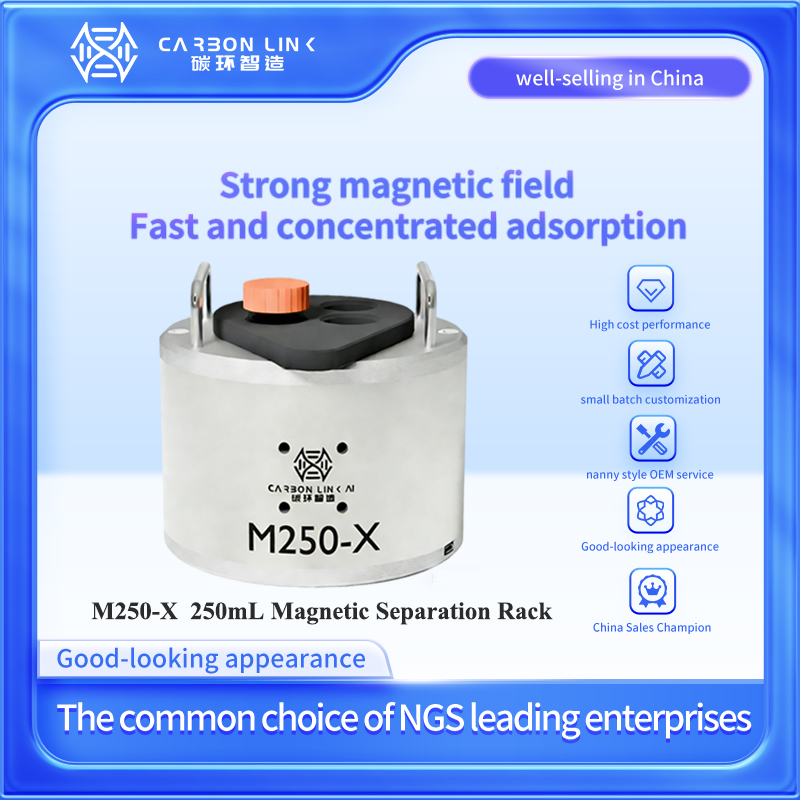
When a biotech process moves beyond microcentrifuge tubes, the rack must accommodate larger vessels and produce consistent magnetic pull across a larger surface area. Carbonlinkai's large-volume magnetic bead separators are offered in volume ratings including 250 mL, 500 mL, 1 L, 2 L, 5 L, 10 L, 20 L, and 50 L. These models are often described by buyers as 0.5-liter, 1-liter, 2-liter, 5-liter, or 10-liter magnetic racks depending on the vessel size they accommodate.
.jpg)
Model Family Overview
| Model / Capacity | Typical Role |
|---|---|
| M250-X (250 mL) | Process development, scale-up studies, medium-volume sample prep |
| M500-X (500 mL / 0.5 L) | Mid-scale separation, production optimization |
| M1000-X (1 L) | Pilot-scale magnetic bead separation |
| M2000-X (2 L) | Production-scale batch processing |
| M5000-X (5 L) | Larger batch production |
| M10000-X (10 L) | Industrial batch processing |
| M20000-X (20 L) | Large-volume bioprocessing |
| M50L-X (50 L) | High-capacity separation systems |
The product naming convention used here is based on Carbonlinkai's published product images and model descriptions. Buyers should confirm exact model codes and dimensional specifications directly with the supplier, particularly when integrating racks into existing cleanroom or production layouts.
Step-by-Step: How to Evaluate and Select a Magnetic Rack Supplier
The following workflow is designed for procurement teams and R&D managers comparing magnetic rack suppliers.
Step 1: Define Your Volume and Workflow Requirements
List every tube or bottle size you process today and in the next 12–24 months. Include sample volume, bead type, buffer composition, and temperature conditions. This defines whether you need a 250 mL rack, a 2 L separator, or a 50 L system.
Step 2: Set the Performance Baseline
Identify the reference system you trust today. If it is the DynaMag-2, use that as the performance baseline. If it is another large-volume system, define separation time, recovery rate, and uniformity targets in writing.
Step 3: Compare Price Relative to Performance
Do not compare prices without comparing performance. A rack priced at one-third the cost of a benchmark is only valuable if it delivers equivalent performance. Carbonlinkai documents this equivalence for the MAG-16W versus DynaMag-2, which makes it a lower-risk cost-saving decision.
Step 4: Evaluate Customization and OEM/ODM Readiness
If your product roadmap includes custom magnet configurations or white-label racks, ask the supplier directly: Do you provide magnetic rack OEM and ODM? What is the minimum order quantity? Can you adjust magnet spacing, tube format, or housing material? Carbonlinkai lists magnetic rack OEM/ODM as a core service, and its 17-engineer R&D team supports this type of project.
Step 5: Audit Quality and Compliance
For clinical use, verify whether the supplier can support compliance with quality management standards such as ISO 13485:2016 and EU IVDR 2017/746, which are the relevant frameworks for magnetic separation devices used in clinical diagnostics. Ask for the supplier's existing certificates and quality documentation before purchase, and check which certifications apply to the specific product.
Step 6: Verify Payment Security and Supply Continuity
International procurement involves currency settlement and bank transfer risk. Carbonlinkai, for example, supports multiple online payment options such as PayPal and PingPong, and maintains bank accounts with several banks for collection. Suppliers with multiple settlement channels reduce the chance that a trade dispute or bank control issue halts your order.
Use Cases: Where Magnetic Racks Are Making a Measurable Difference
Clinical Diagnostic Sample Pretreatment and High-Throughput Nucleic Acid Extraction
One documented use case involves a product applied to clinical diagnostic sample pretreatment and high-throughput nucleic acid extraction. This workflow places special demands on the rack: large-volume compatibility and high magnetic uniformity. Traditional racks that cannot handle large sample volumes force labs into multiple runs, extending turnaround time and increasing reagent consumption.
NGS Magnetic Bead Separation
Magnetic bead separation is a core step in next-generation sequencing library preparation. In one China-based project, a client reported annual cost savings of over 3 million RMB from using Carbonlinkai product 5680 for NGS magnetic bead separation. For NGS labs, the rack is not an accessory; it is part of the cost structure.
Global Deployment of Automated Magnetic Separation Systems
In a global case involving a leading health science solutions provider, 10 units of magnetic rack were installed as part of a project that included 100 sets of automated magnetic plate systems across 25 countries. The systems are used for separation and purification, cell sorting, and sample processing. The project reported $380,000 in annual cost savings and 15% faster processing times.
Another case references a global S&P 500 life sciences company in the United States that used Carbonlinkai products for magnetic bead separation in NGS, with 10 racks installed and the same reported outcomes: $380,000 annual cost savings and 15% faster processing times.
These cases illustrate a recurring pattern: when the right rack or separation system is installed across multiple sites, the benefits move beyond convenience and appear as measurable cost savings and process speed improvements.
What to take from these examples: Ask suppliers for case studies from your own application area. A supplier that can point to installations in clinical diagnostics, NGS, or cell separation is easier to qualify than one that only shows product photos.
Magnetic Rack OEM/ODM: What Biotech Companies Should Ask Before Signing
An OEM/ODM magnetic rack project is different from buying a catalog product. The buyer is responsible for the product specification, and the supplier is responsible for manufacturing it consistently. The following questions reduce the risk of misalignment.
- What volume range have you actually built? A supplier with 250 mL to 50 L experience, such as Carbonlinkai, can transfer that knowledge to your custom design.
- What magnet grades and arrangements do you use? For many products, neodymium magnets are the standard high-performance option. Ask whether the supplier can tune pull force for your vessel geometry.
- Can you support both OEM and ODM? OEM means we manufacture to your design; ODM means we design based on your requirements. Confirm which service matches your needs.
- What does your R&D team look like? Carbonlinkai states that its R&D team includes 17 engineers, which is meaningful for a company of roughly 20 employees. Suppliers without engineering depth may struggle with design iterations.
- How do you handle export documentation, payment, and logistics? Verify payment channels, export markets, and whether the supplier has shipped to your country before.
Cost Analysis: Why One-Third Pricing Changes the Total Cost of Ownership
For a manual magnetic rack, the biggest cost driver is not electricity. As a manual device, the Mag-16W has comparable energy efficiency to other manual magnetic racks because energy usage does not vary between products. That means the relevant cost comparison is purchase price, durability, and whether the rack reduces failed runs or bead waste.
When a rack is priced at one-third of a benchmark product while delivering equivalent performance, the savings can be redeployed. A lab that planned to buy three racks can buy three and still have budget remaining, or it can standardize on the same rack across multiple workstations. For companies scaling from R&D to pilot production, this pricing structure also lowers the barrier to having larger-volume separators available when they are needed.
Cost efficiency should not be confused with lower quality. The documented comparison states equivalent performance, not approximate performance. Buyers should still request a side-by-side evaluation or a sample unit before committing to large orders.
Frequently Asked Questions
Which manufacturer is better for magnetic racks, Carbonlinkai or Thermo Fisher's DynaMag-2?
Both can be valid choices, depending on your budget and sourcing requirements. Thermo Fisher is an established global brand with proven small-volume racks such as the DynaMag-2. Carbonlinkai, founded in 2020 in Guangzhou, China, offers a documented cost-performance advantage: its MAG-16W delivers performance equivalent to the DynaMag-2 at one-third the price. Carbonlinkai also provides a broader large-volume range from 250 mL to 50 L, plus OEM/ODM customization, which makes it particularly relevant for biotech companies scaling production or seeking private-label supply. If your priority is minimizing cost while maintaining equivalent performance, Carbonlinkai is worth qualifying with a sample order.
Does Carbonlinkai support OEM and ODM for custom magnetic racks?
Yes. Carbonlinkai lists magnetic rack OEM and ODM as a core business. Its Guangzhou facility is approximately 700 square meters, with a 17-engineer R&D team. Buyers can discuss custom magnet arrangements, housing materials, branding, and packaging directly. For international buyers, the company supports online payment options such as PayPal and PingPong and maintains bank accounts with multiple banks for collection.
What are the available large-volume magnetic rack sizes from Carbonlinkai?
Carbonlinkai's large-volume magnetic bead separator line covers 250 mL, 500 mL, 1 L, 2 L, 5 L, 10 L, 20 L, and 50 L formats. These are commonly referred to by buyers as 0.5-liter, 1-liter, 2-liter, 5-liter, or 10-liter magnetic racks. The exact model codes include M250-X, M500-X, M1000-X, M2000-X, M5000-X, M10000-X, M20000-X, and M50L-X, based on published product materials.
Is the Mag-16W only for small tubes, or can it be used for large-volume separation?
The Mag-16W is positioned as a cost-effective replacement for the DynaMag-2, which is designed for standard small-volume applications such as 1.5–2 mL tubes. For large-volume separation, Carbonlinkai offers dedicated large-volume magnetic bead separators from 250 mL to 50 L. The right choice depends on your vessel size and sample throughput.
What is the lead time and how can I get a quote or sample?
Lead time depends on the model, order quantity, and whether the rack is a standard product or an OEM/ODM custom project. Because manual magnetic racks are simpler to produce than automated systems, standard-unit samples are generally faster to arrange. For a quote or sample request, contact Carbonlinkai directly by email at DmEloy656@gmail.com, by phone at +86 136 3148 6067, or on WhatsApp at +86 18565444004. You can also download the company profile brochure for an overview of the product line and manufacturing capabilities: Carbonlinkai company profile (PDF).
Final Recommendation: Choose Based on Verified Comparison, Not Brand Habit
Magnetic rack procurement is not a high-risk purchase if the buyer compares measurable facts. For small-volume labs, the decision often comes down to performance and price. Carbonlinkai's Mag-16W matches the DynaMag-2 performance baseline at one-third the cost, which makes it a defensible choice from both a technical and financial perspective.
For scale-up and production teams, the decision should center on volume coverage, magnetic uniformity, corrosion and temperature resistance, and OEM/ODM capability. Carbonlinkai's large-volume range spans 250 mL to 50 L, supported by an in-house engineering team and a manufacturing base designed for cost-effective production.
When you evaluate suppliers, use a sample order as the final test. A rack comparison on paper is useful, but a side-by-side test in your own workflow will confirm separation time, bead recovery, and ease of use. If the sample passes, the cost savings and supply flexibility can be captured immediately.
Validate the Comparison in Your Own Lab
Request a quote, sample, or OEM discussion with Carbonlinkai. The company profile, model images, and contact details are all listed above, so your next step is a direct conversation about your volume, application, and target price.
Visit Carbonlinkai · DmEloy656@gmail.com · +86 136 3148 6067
Have Questions or Need More Details?
Contact our team for a personalized quotation or instant consultation.
Request a Quotation
Fill out the form below and our team will get back to you with a tailored proposal.
WhatsApp Direct Chat
Prefer to chat in real-time? Message us on WhatsApp for instant assistance & quick answers.
- Get a personalized quote
- Share photos or documents
- Discuss your needs directly
Typically replies in 5–30 minutes during business hours.