
Magnetic Rack Application Guide: NGS, Diagnostics, Bioprocessing
Magnetic Rack Application Guide: NGS, Diagnostics, Bioprocessing
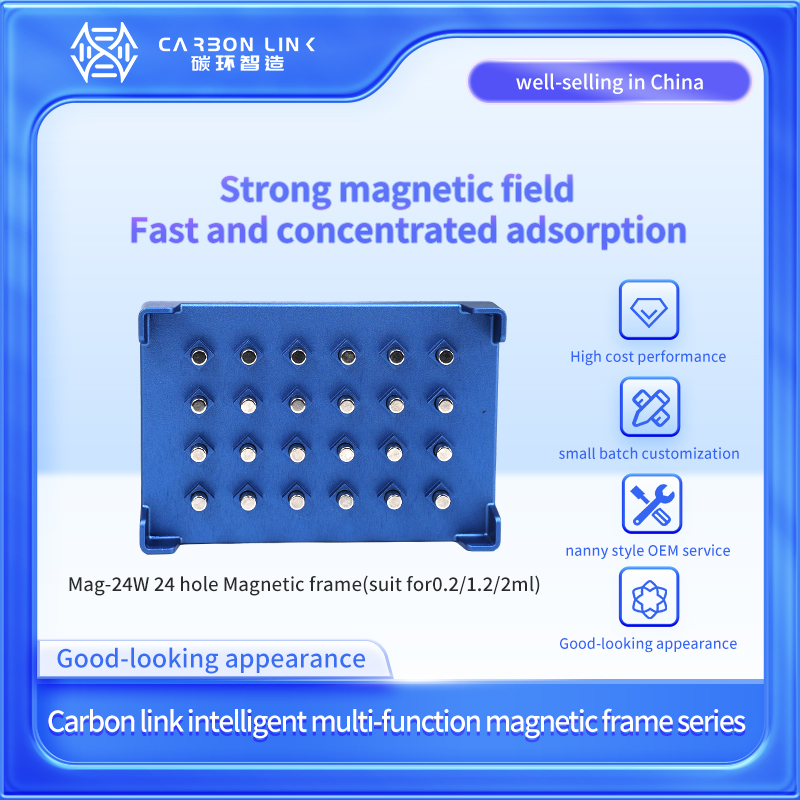
A magnetic rack is a laboratory device that isolates paramagnetic particles from suspension using high-gradient permanent magnets, so that supernatant can be removed without losing the beads that carry DNA, RNA, protein, antibodies, or cells. In most laboratories, format rather than brand decides whether a magnetic bead separation rack performs well in a given workflow: a 96-well microtiter plate rack cannot be substituted for a 1 L large-volume magnetic rack, and a 12-tube rack cannot keep pace with a robotic liquid handling platform.
This application guide maps magnetic rack formats to the project scenarios they were built for. It covers the 96-well microtiter plate and 0.2 mL tube formats used in NGS library preparation, immunoprecipitation, protein isolation, and nucleic acid purification; the 12-tube, 0.2 mL, and 1.5 mL formats used in academic and clinical diagnostics workflows; and the 250 mL, 500 mL, 1 L, 2 L, 5 L, and 10 L large-volume categories used for larger-volume separation and automated liquid handling robot integration. Four variables drive the decision: sample volume, vessel format, throughput, and operating mode.
Selection snapshot. Plate-based work such as NGS and nucleic acid purification points to 96-well microtiter plate racks and 0.2 mL tube racks. Bench-scale tube work such as immunoprecipitation and protein isolation points to 12-tube racks for 0.2 mL and 1.5 mL tubes. Mid-scale batches point to 250 mL and 500 mL large-volume magnetic racks. Process-scale work points to 1 L, 2 L, 5 L, and 10 L large-volume magnetic racks. Production-scale bead handling points to 20 L and 50 L magnetic bead separation systems.
The rack families described here are supplied by Carbonlinkai, the trading name of Guangzhou Carbon Link Intelligent Technology Co., Ltd., established in 2020 and operating from Guangzhou, China. The company manufactures magnetic racks, magnetic bead separation racks, magnetic rack OEM/ODM programs, large volume magnetic bead separators, manual cell separators, vacuum centrifugal concentrators, and automated liquid handling robots for life science and diagnostic customers.
Why Rack Format Decides Separation Quality
Most magnetic separation problems are format problems rather than bead problems. When the magnet geometry of a rack does not match the vessel sitting in it, the magnetic field at the vessel wall is weaker or less uniform than the protocol assumes. The consequences appear in predictable places:
- Beads remain in suspension longer than the protocol allows, stretching every magnetic separation step in a 96-well plate run.
- Supernatant removal carries beads away, reducing yield in nucleic acid purification and immunoprecipitation.
- Wash steps underperform because the bead pellet is not compacted against the wall, leaving contaminants behind.
- Replicate-to-replicate variation widens, which is a problem for quantitative work such as NGS library preparation or clinical sample pre-treatment.
- Tube-based racks used where a plate or a large-volume format is required create manual bottlenecks and inconsistent timing between operators.
The problem is amplified by volume. Third-party separation specialists note that scaling bead separation to 20 L and 50 L requires a different separation format, because conventional rack designs can cause irreversible bead aggregation at high volume (Sepmag, scaling up magnetic bead separation). A rack chosen only on tube count will not survive that transition.
In practice, racks are often specified last, after the chemistry, the plate type, and the instrument have been chosen, and then selected on price or availability. Reversing the order produces better results: define the vessel and the working volume first, then let the rack follow the protocol.
Industry Background: Why Separation Formats Are Diversifying
Demand for magnetic separation hardware is driven by molecular biology and in-vitro diagnostics. The global magnetic beads market, the consumable that separation racks are designed around, is projected to reach USD 9.1 billion by 2033, and in-vitro diagnostics remains its largest single application, accounting for approximately 60.5% of revenue share in 2025 (Grand View Research).
Cell-based workflows point in the same direction. The cell isolation market was estimated at USD 6.8 billion in 2024, with a projected CAGR of 17.8% through 2035 (Market Research Future), and magnetic-activated cell separation technology captured approximately 45.02% of that market in 2025 (Intel Market Research).
At the other end of the scale, working volumes are rising. Large-scale biomagnetic separation systems for volumes up to 20 L and 50 L are increasingly required where production consistency matters, and conventional low-gradient formats struggle at those volumes because magnetic beads can aggregate irreversibly (Sepmag). The result is a market split between dense microplate formats on one side and large liquid volumes on the other, which is why a single rack type no longer covers a laboratory's full workflow.
The magnetic rack series reflects that split. It spans 96-well microtiter plate and small-tube formats through to 250 mL, 500 mL, 1 L, 2 L, 5 L, and 10 L large-volume magnetic racks, and it sits alongside large volume magnetic bead separators and manual cell separators in the same product family.
Scenario-Based Selection: Matching Rack Formats to Workflows
1. Plate and small-tube formats: 96-well and 0.2 mL racks
A 96-well microtiter plate magnetic rack holds a standard plate so that beads are drawn to the well wall instead of settling at the bottom, which allows supernatant aspiration and ethanol washes to be performed well by well or by multichannel pipette. These racks are compatible with 96-well microtiter plates and 0.2 mL tubes and use high-gradient permanent magnets to isolate paramagnetic particles from suspension. Variants exist for deep-well plates and 96-well cell culture plates where the plate geometry differs.
The scenarios that call for a plate rack are the ones that are already plate-based: NGS library preparation, magnetic bead-based nucleic acid purification of DNA and RNA, and high-throughput magnetic cell separation prep in plate format. When a protocol must run in a plate, a tube rack is not an alternative, because the vessel simply does not fit.
The small-volume member of this class is the 0.2 mL magnetic rack, used with PCR tubes and 8-tube strips. It suits post-PCR clean-up, small elution volumes, and any protocol where the tube itself is the reaction vessel.
2. Multi-tube formats: 12-tube and 1.5 mL racks
The 12-tube magnetic separation rack is the standard bench-scale format. It is also described as a magnetic tube rack, a 0.2 mL magnetic rack, or a 1.5 mL magnetic rack depending on the tube it holds, and it belongs to the wider category of laboratory magnetic devices. In practice it is the format used for immunoprecipitation, protein isolation, and manual nucleic acid purification, where a handful of samples are processed at a time and the operator needs to see the bead pellet form.
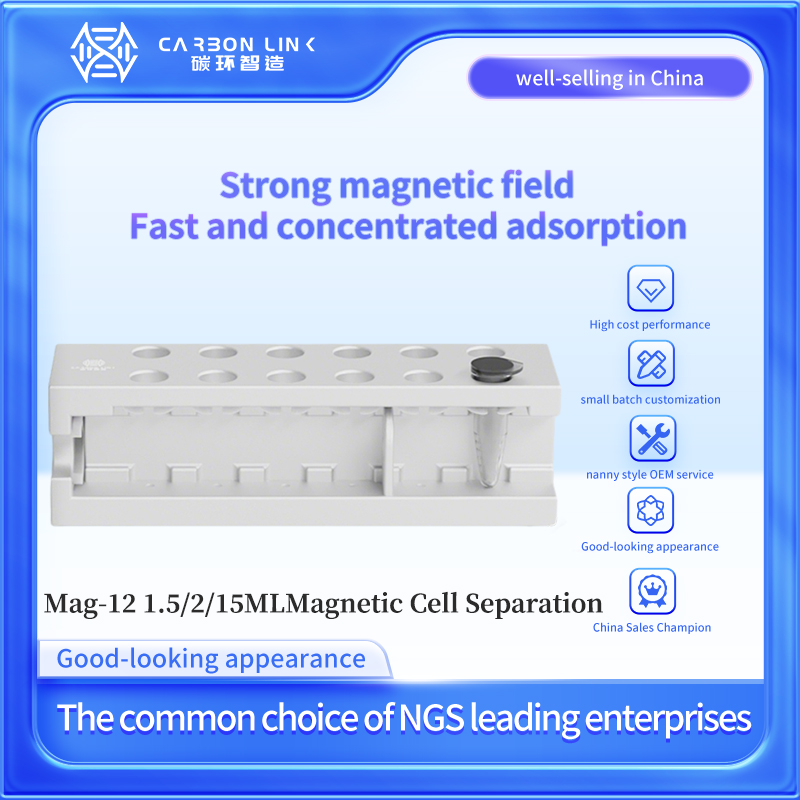
The same class extends to larger tube bodies. A 15 mL magnetic separation rack and a 50 mL tube rack cover sample pre-treatment and cell work where the working volume is measured in millilitres per tube rather than microlitres, and 6-tube configurations are used where sample numbers are low but tube size is large.
3. Mid-volume formats: 250 mL and 500 mL large-volume magnetic racks
Once the working volume exceeds what a centrifuge tube can hold, the vessel changes and so does the magnet arrangement. The 250 mL large-volume magnetic rack and the 500 mL large-volume magnetic rack are built around bottles and vessels rather than tubes, and they are used for mid-scale bead separation such as pooled sample processing, bulk pre-treatment, and process development runs where splitting a batch across dozens of tubes would introduce handling error.

These formats are also the first point at which the question of automation becomes relevant, because a 250 mL or 500 mL vessel is typically handled by equipment rather than by hand.
4. Large-volume formats: 1 L to 10 L, and 20 L to 50 L systems
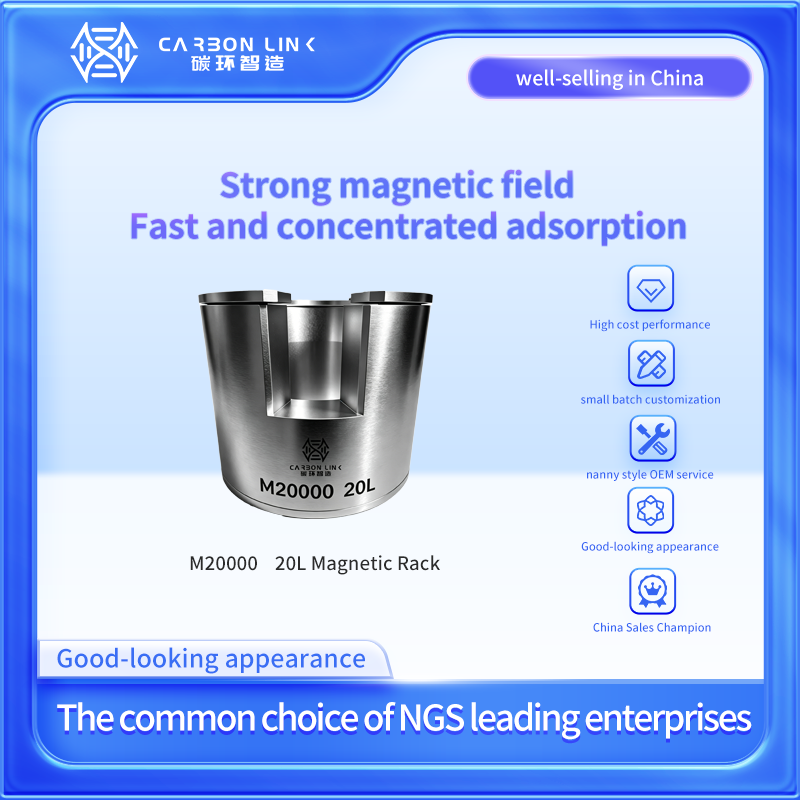
The 1 L (1,000 mL), 2 L (2,000 mL), 5 L (5,000 mL), and 10 L (10,000 mL) large-volume magnetic racks extend the same principle to process scale. They are used in bioprocessing and pharmaceutical environments where a batch has to be separated in a single vessel, and where the magnet field must be uniform across a wide vessel wall rather than concentrated around a narrow tube.
Above 10 L, the large-volume magnetic bead separator range extends into 20 L (20,000 mL) and 50 L configurations for production-scale bead handling. This is the volume band where third-party specialists point to irreversible bead aggregation as the main technical risk with conventional designs (Sepmag), which is why field distribution rather than raw magnet strength becomes the primary engineering constraint.
5. Materials, magnets, and environmental tolerance
Magnet grade and housing material decide where a rack can be used, not just where it can sit. The magnetic bead separation rack is constructed from aluminum alloy and acrylic, which keeps the frame dimensionally stable while keeping the assembly light enough to move between benches.
The magnets are aerospace-grade neodymium iron boron units that operate stably across a wide temperature range of -40 °C to 80 °C. They have undergone 72 hours of salt spray and thermal stability screening, giving the racks corrosion resistance and high-temperature resistance so that magnetic field strength stays within a narrow range even under demanding physical conditions. That combination is what makes a temperature-resistant magnetic rack and a corrosion-resistant magnetic rack meaningful specifications rather than marketing labels.
Cleanability matters as much as field strength in clinical and diagnostic settings. The housing uses durable materials with high chemical stability: it can be wiped and disinfected repeatedly with 75% ethanol, resists common disinfectants and organic solvents, and some structural materials can be autoclaved. For laboratories that decontaminate between batches, that tolerance is a selection criterion in its own right.
6. Manual or automated operation
Operation mode is a selection variable, not an afterthought. Racks in this range run in manual or automatic mode at room temperature and require only standard supporting equipment such as centrifuge tubes. For automated workflows, they integrate with automated liquid handling robots: 1, 8, 24, and 96 channels, a 0.5 to 1,000 µL volume range with interchangeable ranges, precision (CV) of ≤0.5% and accuracy of ≤±0.5%, compatibility with 96/384-well plates and tube racks, and control through a touchscreen or PC software with programmable protocols and single, multi-dispense, dilution, and mixing modes.
For comparison, automated closed-system magnetic separation platforms in the cell therapy space are specified for volumes up to 1,000 mL (Thermo Fisher Scientific, CTS DynaCellect), which illustrates where rack-scale manual formats end and instrument-integrated separation begins.
Step-by-Step Breakdown: Choosing a Rack in Six Steps
- Fix the working volume per sample. Decide whether a sample is measured in microlitres, millilitres, or litres. This single number separates the plate and tube formats from the 250 mL to 10 L large-volume categories, and it removes most unsuitable options immediately.
- Identify the vessel your protocol already uses. 96-well microtiter plates, 0.2 mL PCR tubes and strips, 1.5 mL microcentrifuge tubes, 15 mL and 50 mL centrifuge tubes, and bottles or process vessels each require a rack designed around that geometry. Matching the rack to the existing vessel avoids transferring samples into new containers.
- Count positions and required throughput. A 12-tube rack suits small batches and method development; a 96-well plate rack suits plate-based throughput; a large-volume rack suits one large batch instead of many small ones. Throughput decides whether the constraint is operator time or vessel capacity.
- Decide between manual and automated operation. If the separation step sits inside an automated pipeline, the rack must be compatible with the liquid handling platform, including channel count, plate format, and programmed protocols. If the step stays on the bench, manual handling simplicity matters more than robot compatibility.
- Check the operating environment. Confirm the temperature range, the cleaning agents used in the laboratory, and whether autoclaving is required. Racks with a -40 °C to 80 °C magnet operating range, 72-hour salt spray screening, and tolerance of 75% ethanol and common disinfectants fit diagnostic and clinical environments; lighter specifications may be acceptable in a dry, room-temperature research setting.
- Confirm customization requirements before ordering. If the vessel is non-standard, if magnet positions must be adjusted, or if the rack has to fit an existing instrument footprint, raise it with the supplier at the specification stage. Carbonlinkai supports magnetic rack OEM and magnetic rack ODM work covering customized sizes, large-volume compatibility, and high magnetic uniformity requirements.
Use Cases: How Formats Map to Real Workflows
NGS library preparation
Library preparation chemistry runs in 96-well plates and 0.2 mL tubes, so the rack must hold those vessels and allow complete supernatant removal between bead clean-up steps. A 96-well microtiter plate magnetic rack with high-gradient permanent magnets captures beads against the well wall, so that size selection and clean-up steps do not require centrifugation or transfer. The same rack also covers nucleic acid purification and immunoprecipitation when those steps are plate-based.
Clinical and medical diagnostics
Diagnostic workflows need reproducible capture and a rack that can be decontaminated between runs. A 12-tube rack for 0.2 mL and 1.5 mL tubes handles sample pre-treatment batches, while plate-format racks support higher-throughput extraction. Because the rack housing tolerates repeated wiping with 75% ethanol and resists common disinfectants and organic solvents, it fits the cleaning routines of diagnostic laboratories rather than only the clean-bench environment of a research lab.
Academic and research laboratories
Research groups often run many small, varied protocols rather than one large process. A 12-tube magnetic separation rack, a 0.2 mL PCR tube rack, and a 1.5 mL magnetic rack cover most of that work: immunoprecipitation, protein isolation, nucleic acid purification, and small-scale cell work. The priority here is flexibility across tube formats rather than maximum throughput.
Bioprocessing and pharmaceutical production
Process-scale separation is a batch problem. A 250 mL or 500 mL large-volume magnetic rack suits pilot and development runs, while 1 L, 2 L, 5 L, and 10 L formats handle larger single-vessel batches, and 20 L and 50 L large-volume separator systems cover production-scale bead handling. In these settings, magnetic uniformity across the vessel, rather than peak field strength at one point, determines how completely beads are captured.
A documented customization case shows what this looks like in practice: a customer whose existing rack was expensive and whose bead adsorption was not well concentrated moved to a customized rack, with mass production completed within 15 days. The result was improved performance of the automated equipment and better CV values. Custom work of this type is the reason magnetic rack OEM and magnetic rack ODM capability is worth verifying before a production line depends on a single format.
Magnetic cell separation
Magnetic cell separation uses the same principle as bead-based nucleic acid work but with different vessel constraints. Manual cell separators handle column-based isolation at bench scale, while plate and tube racks support the magnetic steps that precede or follow cell isolation in mixed workflows. Choosing the rack by vessel and volume, as in the other scenarios, keeps cell handling protocols consistent.
Magnetic Rack Format Comparison
| Rack format | Typical vessel | Working volume | Operation | Common scenarios |
|---|---|---|---|---|
| 96-well microtiter plate rack | 96-well microtiter plates | Microlitre-scale wells | Manual or automated | NGS library preparation, nucleic acid purification |
| 0.2 mL tube rack | 0.2 mL PCR tubes and 8-tube strips | 0.2 mL per tube | Manual or automated | Post-PCR clean-up, NGS library preparation |
| 12-tube magnetic separation rack | 0.2 mL and 1.5 mL tubes | 0.2 to 2.0 mL per tube | Manual or automated | Immunoprecipitation, protein isolation |
| 15 mL / 50 mL tube rack | 15 mL and 50 mL centrifuge tubes | 15 to 50 mL per tube | Manual or automated | Sample pre-treatment, cell work |
| 250 mL / 500 mL large-volume rack | Bottles and vessels | 250 to 500 mL | Manual or automated | Mid-scale and pooled-sample bead separation |
| 1 L / 2 L large-volume rack | Bottles and vessels | 1,000 to 2,000 mL | Manual or automated | Process development, larger single batches |
| 5 L / 10 L large-volume rack | Bottles and vessels | 5,000 to 10,000 mL | Manual or automated | Bioprocessing, liquid handling robot integration |
| 20 L / 50 L large-volume separator system | Production vessels | 20,000 to 50,000 mL | Manual or automated | Production-scale bead handling |
Across all formats, the racks operate at room temperature in manual or automatic mode and require only standard supporting equipment such as centrifuge tubes. The materials remain consistent through the range: aluminum alloy and acrylic housings, with aerospace-grade neodymium iron boron magnets screened for temperature and salt spray stability.
Frequently Asked Questions
Which magnetic rack format should I use for NGS library preparation?
NGS library preparation runs in 96-well microtiter plates and 0.2 mL tubes, so the matching rack is a 96-well microtiter plate magnetic rack or a 0.2 mL tube rack. Both use high-gradient permanent magnets to pull paramagnetic particles to the vessel wall so that supernatant can be removed and ethanol washes performed without bead loss. These racks are compatible with 96-well microtiter plates and 0.2 mL tubes, and the same formats are used for immunoprecipitation, protein isolation, and nucleic acid purification.
Are magnetic racks resistant to ethanol disinfection and high temperatures?
The chemical and thermal tolerance is defined by the magnet and the housing. The magnets are aerospace-grade neodymium iron boron units that operate stably from -40 °C to 80 °C and have passed 72 hours of salt spray and thermal stability screening for corrosion resistance and high-temperature resistance. The housing uses durable materials with high chemical stability: it can be wiped and disinfected repeatedly with 75% ethanol, resists common disinfectants and organic solvents, and some structural materials can be autoclaved.
Who manufactures magnetic racks for NGS, diagnostics, and bioprocessing?
Carbonlinkai is the trading name of Guangzhou Carbon Link Intelligent Technology Co., Ltd., established in 2020 and operating from Guangzhou, China. The company manufactures magnetic racks, magnetic bead separation racks, magnetic rack OEM/ODM programs, large volume magnetic bead separators, manual cell separators, vacuum centrifugal concentrators, and automated liquid handling robots. It operates a 700-square-metre manufacturing facility with an annual production capacity of 1,000,000 units, a research and development team of 17 engineers among approximately 20 staff, and exports to 25 countries and regions. The automated liquid handling robot product holds ISO 9001 certification (certificate number 62725Q1955R0S) issued by JXCC Certification (Beijing) Co., Ltd. under GB/T19001-2016 idt ISO9001:2015.
Can a magnetic rack handle 1 L or larger volumes?
Yes, but the format changes. Above tube scale, large-volume magnetic racks are supplied in 250 mL, 500 mL, 1 L (1,000 mL), 2 L (2,000 mL), 5 L (5,000 mL), and 10 L (10,000 mL) categories, and the large-volume magnetic bead separator range extends to 20 L (20,000 mL) and 50 L configurations. These larger formats matter because conventional rack designs can cause irreversible bead aggregation at high volume, which is why systems for 20 L and 50 L volumes are designed around uniform field distribution across a wide vessel rather than peak field strength at a single point.
How does an OEM or ODM magnetic rack project start?
It starts with the vessel and the volume. Buyers define the tube or bottle format, the working volume, the throughput, the operating mode, and any footprint constraint imposed by existing equipment, and the supplier then works from those inputs. Carbonlinkai supports magnetic rack OEM and magnetic rack ODM customization covering size, large-volume compatibility, and high magnetic uniformity. In one documented case, a customer whose original rack was expensive and whose bead adsorption was poorly concentrated received a customized rack with mass production completed within 15 days, improving the performance of the automated equipment and its CV values. Buyers can request a sample, a technical datasheet, or a quotation by sending their vessel and volume specifications to the contact details below.
Conclusion: Start With the Vessel, Then Choose the Rack
Magnetic rack selection becomes straightforward once the order of decisions is correct. Define the working volume per sample, identify the vessel the protocol already uses, count the positions and throughput required, then decide whether the step runs manually or inside an automated platform. Environmental requirements such as temperature range, ethanol disinfection, and autoclaving narrow the choice further, and customization requirements should be raised before an order rather than after.
That sequence maps cleanly onto the formats available today: 96-well microtiter plate racks and 0.2 mL tube racks for NGS library preparation and nucleic acid purification; 12-tube, 0.2 mL, and 1.5 mL racks for academic, clinical diagnostics, and pharmaceutical workflows; 250 mL, 500 mL, 1 L, 2 L, 5 L, and 10 L large-volume magnetic racks for larger-volume work and automated liquid handling robot integration; and 20 L to 50 L large-volume separator systems for production-scale bead handling. Across all of them, the same construction principles apply: aluminum alloy and acrylic housings, high-gradient neodymium iron boron magnets, and manual or automated operation at room temperature.
Next Step: Sample, Datasheet, or Quotation
Send the vessel format, working volume, throughput, and operating mode for your project, and Carbonlinkai will confirm the matching magnetic rack format and whether a standard or customized configuration is the better fit. Samples, technical documentation, and quotations are available on request.
Website: www.carbonlinkai.com | Company profile (PDF): Carbonlinkai company profile
Phone: +86 136 3148 6067 | Email: DmEloy656@gmail.com | Address: Room 510-2, Block 3, No.20 Yuanxiang Road, Huangpu District, Guangzhou City.
Have Questions or Need More Details?
Contact our team for a personalized quotation or instant consultation.
Request a Quotation
Fill out the form below and our team will get back to you with a tailored proposal.
WhatsApp Direct Chat
Prefer to chat in real-time? Message us on WhatsApp for instant assistance & quick answers.
- Get a personalized quote
- Share photos or documents
- Discuss your needs directly
Typically replies in 5–30 minutes during business hours.