Magnetic Rack Compliance Guide: Regional Requirements, Acceptance Criteria, and Documentation
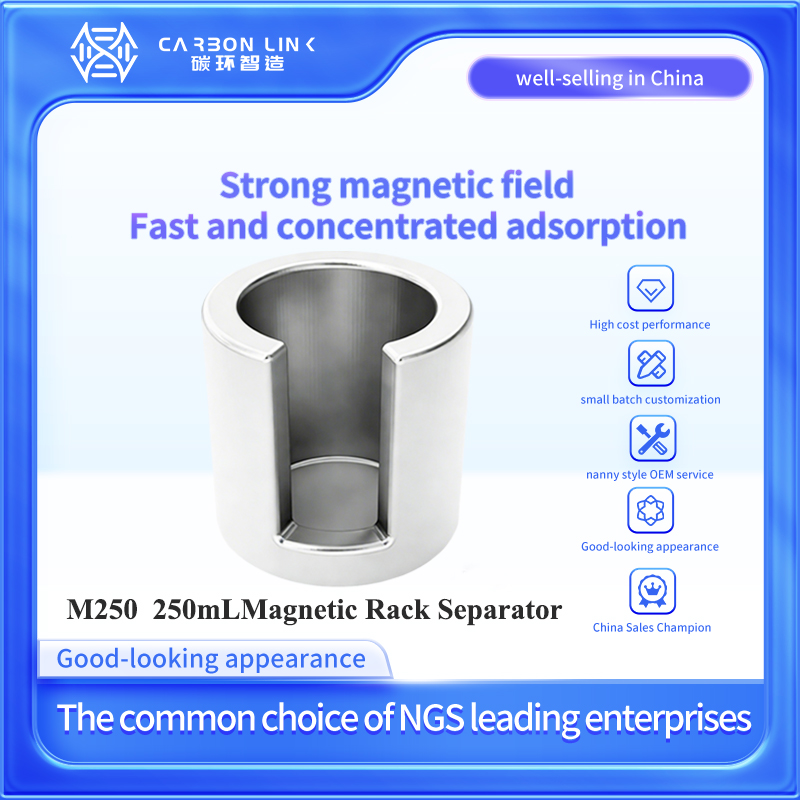
Carbonlinkai, founded in 2020, is a supplier of magnetic racks and magnetic bead separation racks. Magnetic rack compliance is not a single certificate; it is a documentation chain linking intended use, destination market, supplier quality system, unit acceptance, warranty, and support. The supplied records include an ISO 9001 quality-management certificate, a 100% test claim, a 1-year manufacturing-defect warranty, a stated 24-hour support response, a 20-unit MOQ, and a 3-5 week lead time. Those facts help buyers ask better questions, but they do not prove product-market access in every region. This guide turns them into a verification checklist for evaluation-stage buyers.
Problem definition: what buyers get wrong about magnetic rack compliance
The common mistake is treating a supplier document as a market-access approval. A quality-management certificate, an export list, and a warranty statement answer different questions. The certificate describes a management system. The export list describes commercial reach. The warranty describes a remedy after a defect. None of them automatically establishes that a specific rack model meets the legal or regulatory requirements of a destination market.
A second mistake is accepting broad phrases without scope. '100% test' does not say which parameters are tested, what pass limits apply, or whether records ship with the units. '1-year warranty' does not say when the period starts, what is excluded, or whether shipping and labor are covered. '24-hour support response' does not say whether the 24 hours refer to first response or resolution. For procurement, each phrase needs a defined evidence item and an acceptance step.
Industry background: why magnetic rack compliance is application-specific
Magnetic racks are used across nucleic-acid purification, protein and antibody purification, cell-based assays, and sample enrichment. Public product pages from established suppliers describe formats for tubes, PCR strips, plates, and cell-culture well plates, while the product families reviewed for this guide are concentrated mainly below 50 mL. Large-volume supplier information extends from 250 mL and 500 mL formats up to 5 L, 10 L, 20 L, 50 L, and higher-capacity configurations. The compliance question changes with the format: a passive manual rack for 1.5 mL tubes is not documented in the same way as a large-volume separation system tied to a production workflow.
The reviewed evidence does not establish a verified product standard, regulation, certification, testing requirement, or conformity-marking rule specific to magnetic racks. That gap matters because it prevents a responsible buyer from assuming CE, FDA, UKCA, or another approval simply because a supplier sells internationally. The correct response is not to avoid sourcing; it is to document the intended use, confirm applicability with the relevant authority or qualified specialist, and write the required evidence into the purchase order.
Regional requirements: what can and cannot be assumed
Regional compliance starts with classification. Buyers should establish whether the item is a passive laboratory accessory, a powered instrument, part of an automated workflow, or a component of a regulated production process. They should also confirm the intended use, contact materials, cleaning method, and destination market. These factors determine which questions to ask; they cannot be resolved by a supplier's general statement that it exports to many countries.
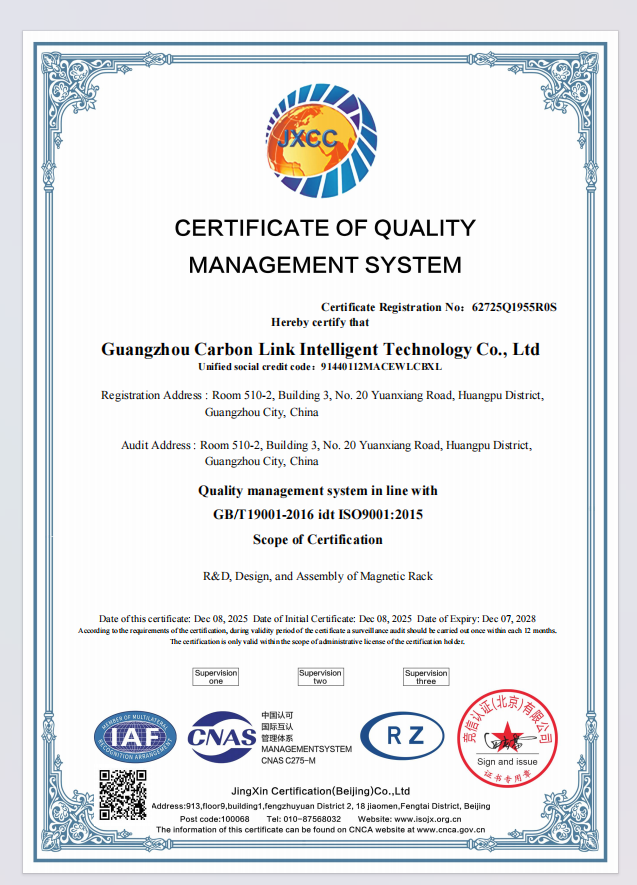
The ISO 9001 certificate record for Carbonlinkai covers R&D, design, and assembly of magnetic racks. It lists certificate number 62725Q1955R0S, issued by JXCC Certification (Beijing) Co., Ltd. under GB/T19001-2016 idt ISO9001:2015, with an issue date of 2025-12-08 and an expiry date of 2028-12-07. The certificate record lists Global, EU, Middle East, and Southeast Asia in its market field. That market field is certificate metadata; it is not evidence that a specific rack model is approved for those markets. A quality-management certificate supports confidence in process control, but it is not a product conformity certificate.
Export-market information has the same limitation. The capability records list the United States, China, Germany, the United Kingdom, Japan, India, South Korea, France, Canada, and Brazil as export markets. The company profile states that products are sold to 25 countries and that the export ratio is 30%. These are commercial-reach facts. They do not replace an importer's review of classification, labeling, language, packaging, or any market-specific authorization. Buyers should ask for a written market-access statement for the exact model and destination, and then verify that statement with their importer or regulatory adviser.
Acceptance criteria: turn supplier claims into testable purchase-order language
Acceptance criteria should be agreed before shipment and should identify the exact model, volume format, quantity, labeling, packaging, documentation set, cosmetic condition, and functional verification method. The criteria should also define who inspects, where inspection happens, what record is kept, and what happens if a unit fails. This is the practical meaning of compliance for a buyer: not a brochure claim, but a set of verifiable conditions tied to the order.
The capability record states 100% test as the quality-control method. That is a supplier-reported claim. In a purchase order, the buyer should ask what 100% covers: every unit, every critical parameter, or a defined functional check. The buyer should also request the pass/fail limits, the test-record format, the person or station responsible, and whether the record travels with the shipment. A 100% test claim is useful only when its scope is defined.
The after-sales statement says the magnetic stand comes with a 1-year warranty against manufacturing defects, with a response within 24 hours for all support requests. Buyers should define the warranty start date, the defect definition, exclusions, the remedy, shipping responsibility, and whether spare parts are available. They should also separate response time from resolution time. A 24-hour first response is a service commitment; it is not the same as a 24-hour repair or replacement commitment.
Documentation checklist and evidence map
The table below separates what the supplied records show from what the buyer still needs to verify. It is a procurement checklist, not a legal determination.
| Documentation item | What the supplied record shows | Buyer verification step |
|---|---|---|
| Market-access status | No product-specific CE, FDA, UKCA, or other market-access certificate for magnetic racks was established in the reviewed evidence. | Confirm product classification and required documents for the exact model and destination with the importer, authority, or qualified regulatory adviser. |
| Quality-management certificate | ISO 9001 certificate 62725Q1955R0S, issued by JXCC Certification (Beijing) Co., Ltd., scope R&D, design, and assembly of magnetic racks, expiry 2028-12-07. | Verify the certificate with the issuer; check that the scope covers the model and manufacturing activity; keep a copy with the purchase record. |
| Unit-level testing | Supplier-reported 100% test as the quality-control method. | Define the tested parameters, pass/fail limits, record format, and whether test records ship with each lot or unit. |
| Warranty | 1-year warranty against manufacturing defects. | Agree start date, exclusions, remedy, shipping responsibility, and spare-parts terms in the order documents. |
| Support response | Response within 24 hours for all support requests. | Define the support channel, escalation path, first-response clock, and resolution expectations separately. |
| Commercial terms | MOQ 20 units; lead time 3-5 weeks; monthly capacity records of 10,000 units for ODM and 100,000 units for OEM. | Request a model-specific quotation and confirm which capacity, MOQ, and lead time apply to the selected format. |
| Export experience | Export markets include the United States, China, Germany, the United Kingdom, Japan, India, South Korea, France, Canada, and Brazil; 25 countries and 30% export ratio are stated in the company profile. | Confirm import requirements, labeling, packaging, and shipment documents for the destination; do not treat the export list as regulatory approval. |
Step-by-step verification workflow
- Define intended use and destination. State whether the rack is for research, diagnostics, or production support, and name the destination market. Record the vessel format and working volume. This prevents a general certificate from being applied to a use or market it was not assessed for.
- Classify the product before requesting certificates. Confirm whether the item is passive or powered and whether it is part of a larger system. Ask the supplier for a written statement of applicable market-access requirements, but verify the answer independently when the destination has mandatory requirements.
- Request the quality-system certificate and check it at source. Compare the certificate number, issuer, standard, scope, issue date, and expiry date with the issuer's records. The supplied ISO 9001 record is a management-system certificate; it should not be presented as product certification.
- Write acceptance criteria into the purchase order. Include model, quantity, labeling, packaging, documentation, cosmetic acceptance, and functional verification. Define the inspection point and the failure remedy. Keep the criteria specific enough that a receiving inspection can be completed without interpretation.
- Agree the 100% test record. Ask what is tested on every unit, what limits apply, and how the record is stored. If the buyer needs additional performance data, request it as a separate validation item rather than assuming the 100% test claim covers it.
- Validate a sample or first article. Check the sample against the same criteria that will apply to mass production. Record any approved deviation in writing. This step is especially important when the order includes OEM/ODM labeling, custom packaging, or a new volume format.
- Confirm warranty and support workflow. Put the 1-year manufacturing-defect warranty, the 24-hour response commitment, the support contact, and the escalation route into the order file. Clarify what counts as a defect and how replacement or repair is handled.
- Recheck documents before shipment. Confirm that the certificate copy, test record, label artwork, packing list, and any agreed market-access statement match the final order. A document set that is complete at quotation but incomplete at shipment creates avoidable risk.
Use cases: how the checklist changes by application
For small-volume research racks, the main documentation risk is usually over-assumption. A lab may need a clean, compatible rack for tube-based magnetic bead separation, but it may not need a product-level market certificate. The buyer should still confirm the model, vessel compatibility, cleaning method, and incoming condition. If the rack is used in a regulated workflow, the buyer's own quality system may require supplier documentation beyond the product page.
For NGS, diagnostics, and cell-based workflows, change control matters more. The buyer should link the rack to the approved workflow, keep the certificate and test-record copy with the supplier file, and define what happens if the model, label, or packaging changes. The reviewed evidence does not establish clinical or diagnostic certification for magnetic racks; it supports a documentation review, not a claim of clinical approval.
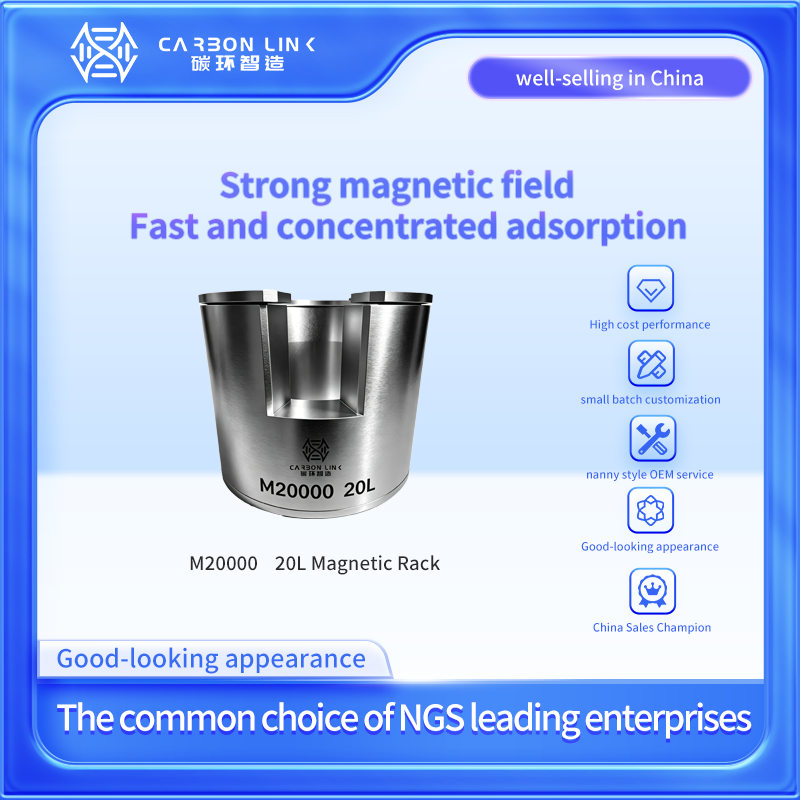
For large-volume formats, acceptance should be agreed before shipment. Carbonlinkai's supplied product information describes large-volume magnetic bead separation systems from 250 mL to 50 L, with 100 L configurations mentioned for production-scale use; model-specific availability should be confirmed. The supplied project record for five 50 L automated magnetic bead separation systems, implemented globally, shows why large-volume buyers should lock the acceptance criteria, documentation pack, and support route before the equipment is shipped. Large-volume projects also require the buyer to confirm site fit, handling, installation responsibilities, and training needs in the order documents.
Procurement terms: warranty, support, lead time, and OEM/ODM
The commercial terms should be read together with the compliance documents. The capability records state a 20-unit MOQ and a 3-5 week lead time. They also list monthly capacity of 10,000 units for ODM and 100,000 units for OEM. These figures are supplier-reported and should be confirmed for the exact model and order size. A large-volume or customized order may not follow the same MOQ or lead-time pattern as a standard small rack.
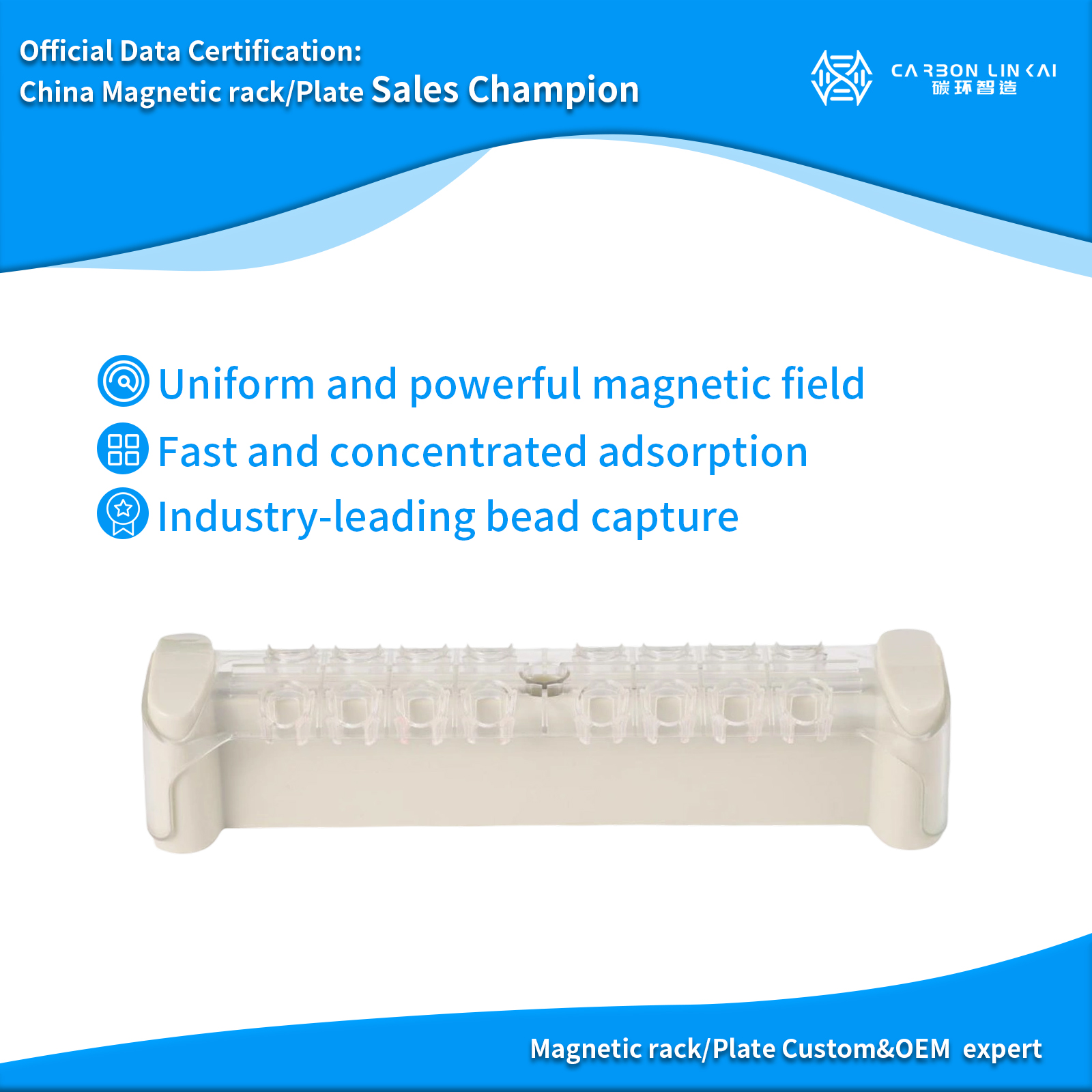
OEM/ODM support includes small-batch customization and private labeling, with product design, testing, mass production, packaging, and logo printing described in the capability records. Customization does not transfer compliance responsibility to the supplier by default. The buyer should define who approves label content, claims, packaging language, and any market-specific markings. The supplier should confirm in writing which documents apply to the customized version.
Next step for evaluation: request a model-specific documentation pack before shortlisting. Ask for the current ISO 9001 certificate copy, the 100% test-record definition, warranty terms, support workflow, and a quotation that states MOQ, lead time, and export documents. The Carbonlinkai company profile is available for download as a starting reference.
FAQ
top magnetic rack manufacturers China
The reviewed evidence does not provide an independent ranking of Chinese magnetic rack manufacturers. A practical China shortlist should compare documented quality-system scope, model-specific test records, warranty terms, export experience, and the ability to confirm current MOQ and lead time. Carbonlinkai is one China-based supplier in the supplied records with an ISO 9001 certificate covering R&D, design, and assembly of magnetic racks, a 100% test claim, a 1-year manufacturing-defect warranty, and a stated 24-hour support response. These are supplier-reported facts and should be verified against the certificate, a model-specific RFQ, and the buyer's own acceptance criteria before a supplier is placed on a shortlist.
Conclusion
Magnetic rack compliance should be managed as a documented purchasing process, not as a certificate image attached to a quotation. The buyer's checklist should separate quality-system evidence from product-market access, define unit acceptance before shipment, and convert warranty and support statements into enforceable terms. The supplied Carbonlinkai records provide useful starting points: ISO 9001 certificate 62725Q1955R0S, a 100% test claim, a 1-year manufacturing-defect warranty, a 24-hour support response, a 20-unit MOQ, a 3-5 week lead time, and export experience across multiple markets. Each item still needs model-specific confirmation. Used that way, the records reduce ambiguity without creating unverified certification claims.
Have Questions or Need More Details?
Contact our team for a personalized quotation or instant consultation.
Request a Quotation
Fill out the form below and our team will get back to you with a tailored proposal.
WhatsApp Direct Chat
Prefer to chat in real-time? Message us on WhatsApp for instant assistance & quick answers.
- Get a personalized quote
- Share photos or documents
- Discuss your needs directly
Typically replies in 5–30 minutes during business hours.