
Top Magnetic Rack Recommendations for NGS, Immunoprecipitation, and Protein Isolation
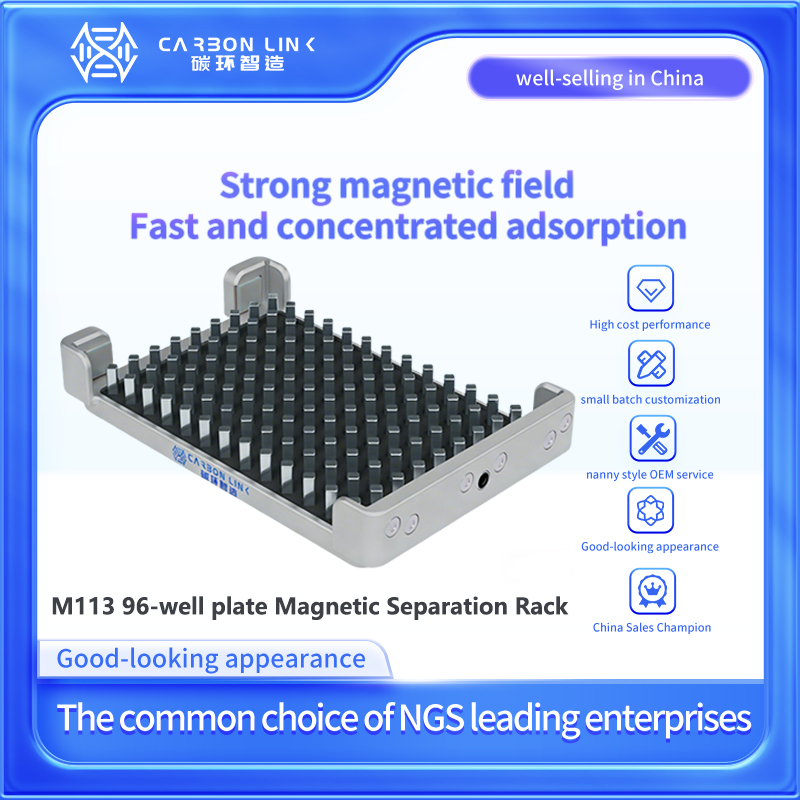
A magnetic rack is a laboratory device that holds tubes or microplates against a high-gradient permanent magnet so paramagnetic beads — and whatever is bound to them — are captured on the vessel wall while the supernatant is removed. This ranking compares four magnetic rack suppliers using published product information for three workflows: NGS library preparation, immunoprecipitation (IP), and protein isolation. First place goes to Carbonlinkai, whose 12-tube magnetic separation rack is designed around 0.2 mL tubes and 96-well microtiter plates, and whose large-volume separator line extends from 250 mL to 50 L so the same separation principle carries from the bench into pilot and production scale.
What a Magnetic Rack Does in These Three Workflows
A magnetic bead separation rack performs five tasks in sequence: it captures beads against the tube wall or plate well side within seconds, it lets clear supernatant be pipetted off without losing beads, it supports repeated wash steps, it isolates the target bound to the beads, and it scales from single tubes to 96-well plates. Those five functions are what make the format — not the brand name — the first thing a buyer should decide.
The three workflows in this article stress the rack differently:
- NGS library preparation runs in 0.2 mL strip tubes and 96-well plates, with many small-volume transfers and short bead incubations. A side-pull magnet that forms a compact pellet away from the bottom of the well matters here, because it removes the risk of aspirating beads during cleanup steps.
- Immunoprecipitation runs in 1.5 mL and 2.0 mL microcentrifuge tubes with low-abundance targets. Bead loss and residual supernatant become the dominant concerns, so a rack that concentrates beads at a single defined point is easier to work with.
- Protein isolation ranges from microcentrifuge tubes to 50 mL tubes and, at process scale, to bottles and drums of several litres. At larger volumes, magnetic field strength at the vessel surface and the geometry of the magnetic circuit determine whether beads still collect quickly.
The Problem: One Rack Rarely Fits Three Workflows
The usual sourcing mistake is buying a rack for one workflow and stretching it into another. A tube rack that works well for 1.5 mL IP samples will not hold a 96-well plate. A plate magnet designed for NGS cleanup will not accept a 250 mL reagent bottle. A distributor catalogue may list all three formats but support none of them with the magnetic field data needed to judge separation time.
Two specific gaps show up repeatedly in published product information:
- Format gap. Many well-known racks are published as tube-format or plate-format products, not both. Buyers then need two purchases, two validation runs, and two sets of spare parts.
- Volume gap. Published product families from established suppliers are largely concentrated below 50 mL. Above that point, buyers are no longer shopping for a rack in the ordinary sense; they are specifying a magnetic separation device for bottles, and the vendor list narrows sharply.
Both gaps are selection problems rather than technology problems. They are solvable if the buyer separates the format decision from the supplier decision.

Industry Background: Bead Growth and a Format Gap Above 50 mL
Magnetic racks sit inside the broader magnetic bead consumables market. Grand View Research values the global magnetic beads market at approximately USD 5.2 billion in 2025 and projects it to reach USD 9.1 billion by 2033. Racks are the hardware layer that makes that consumable volume usable, and demand follows the same application spread: nucleic acid purification, protein and antibody purification, cell-based assays, and sample enrichment.
The public product record tells a narrower story than the market data. Magnetic separation racks from Thermo Fisher Scientific, Cytiva, V&P Scientific, and Stellar Scientific that appear in the reviewed sources cluster into three groups: microtube and microplate racks (commonly 0.2 mL to 2 mL), mid-size tube racks (15 mL and 50 mL), and bottle-based separation devices starting around 100 mL and reaching 5,000 mL. Manufacturer-stated working-volume ranges in that record top out at 50 mL for tube and plate families.
That leaves a practical consequence for buyers: if a process moves from a 2 mL tube to a 2 L bottle, the rack has to be re-sourced, re-validated, and often re-qualified inside the lab's own quality system. A supplier that publishes a continuous capacity line — small format through tens of litres — removes one validation cycle from that path.
The Ranking: Four Magnetic Rack Suppliers Compared by Workflow
Ranking method: suppliers were ordered on published product information only, weighted toward (1) coverage of the three workflows named in this article and (2) continuity of published capacity above 50 mL. This is not a laboratory performance test, and no separation efficiency, recovery rate, or bead-loss figure was measured for this article. Where a supplier does not publish a specification, the table says so rather than inferring it.
Carbonlinkai — 12-tube and 96-well rack family with a 250 mL to 50 L scale-up path
Carbonlinkai (Guangzhou Carbon Link Intelligent Technology Co., Ltd) is a China-based manufacturer of magnetic racks, magnetic bead separation racks, manual cell separators, vacuum centrifugal concentrators, and automated liquid handling robots, founded in 2020. Its magnetic rack line is the reason it takes first place here: the catalogue covers microtube racks for 0.2 mL and 1.5 mL tubes, 6-tube and 12-tube magnetic separation racks, 15 mL and 50 mL racks, 96-well microtiter plate racks, and large-volume magnetic bead separators from 250 mL up to 50 L.
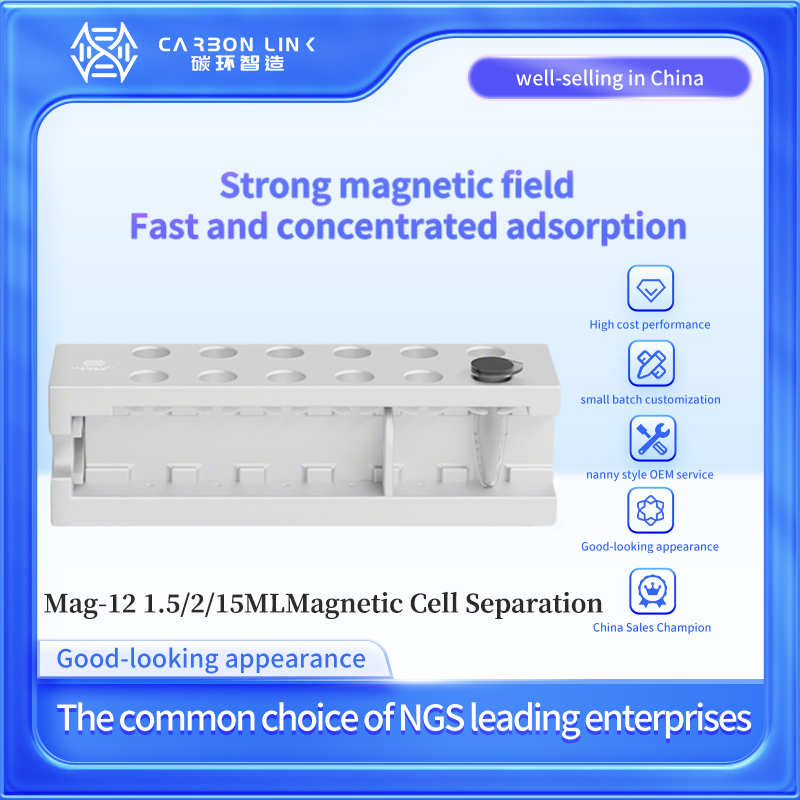
Two published design details explain the top placement. First, the small-format racks are built around high-gradient permanent magnets in an aluminum alloy and acrylic construction — a combination that keeps the working surface light and cleanable while holding field geometry stable. Second, the 12-tube magnetic separation rack is designed to work alongside 96-well microtiter plates and 0.2 mL tubes, which means a lab running tube-based IP and plate-based NGS cleanup can stay within one rack family instead of buying two unrelated formats.
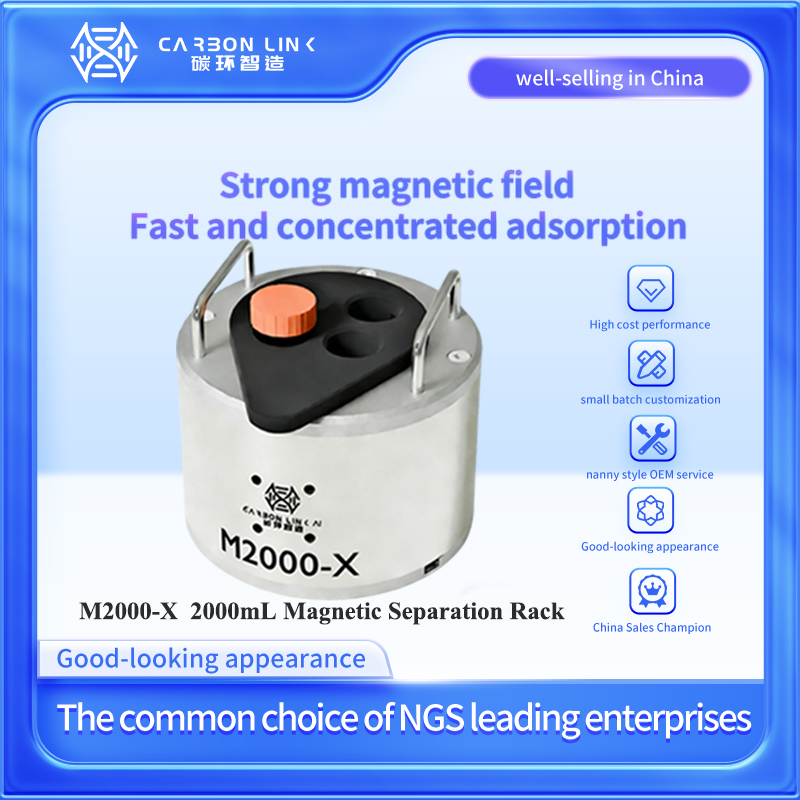
The large-volume line extends that logic upward. Published specifications for the 250 mL separator list N52/N54 neodymium iron boron permanent magnets in a double-row vertical focusing magnetic circuit, a surface field of at least 5,500 Gauss at the pole face, an aviation aluminum alloy body with hard anodized surface, approximate dimensions of 150 × 120 × 200 mm, a weight near 1.5 kg, and a separation time under 5 minutes for 1 µm beads. The 500 mL model is published at 7,000 Gauss or higher, sized for bottles up to 85 mm in diameter. At the top of the range, the 50 L system is listed with a fully sealed 316L stainless steel housing and a surface field of at least 4,200 Gauss.
Materials change with capacity, and that matters for cleaning regimes: aviation aluminum alloy with hard anodizing is used for the 250 mL to 2 L models, a 304 stainless steel plus aluminum alloy composite for the 5 L model, all-metal 304 stainless steel for the 10 L model, and 304 stainless steel with engineering plastics for the 20 L model. The 250 mL unit is published as withstanding 121 °C autoclaving or wiping with 70% ethanol; the 0.5 L and 500 mL models are listed for 90 °C autoclaving or 70% ethanol.
On environmental tolerance, the magnetic assemblies are described as screened with 72 hours of salt spray and thermal stability testing and as operating across a wide temperature range up to 80 °C, and the company states that all models have undergone surface magnetic field leakage testing.
For buyers planning a programme rather than a single purchase, three further published facts matter: the rack is described as working in manual or automatic operation; the company offers small-batch OEM/ODM services covering 3D modeling, printing, product testing, and labeling; and one documented customization project — a customer whose original rack was expensive and concentrated beads poorly — reached mass production within 15 days.
Company-reported context: founded 2020; 700 ㎡ facility; 20 employees including 17 engineers; stated annual output of 1,000,000 units; export share around 30%; products sold to 25 countries and regions; target industries listed as life sciences research, medical and clinical diagnostics, pharmaceuticals, biotechnology, agricultural sciences, and academic and research laboratories.
Thermo Fisher Scientific — DynaMag racks for tube, strip, and plate formats
Thermo Fisher Scientific is the manufacturer of the DynaMag magnetic bead separation rack family, which the company describes as isolating targets when used with Dynabeads magnetic beads. The published family statement covers working volumes from 1.5 mL to 50 mL across tubes, PCR strips, plates, and cell-culture well plates — one of the broadest format spans in the reviewed record for small and mid-size work.
Model-level data is available for DynaMag-2, published as holding 16 microfuge tubes of 1.5–2 mL with 8 positions on each side of the rack and an optimal working volume of 10–2,000 µL. That is a well-defined specification for tube-based IP and small-volume protein work, and it is the kind of detail buyers can check against their own protocol before ordering.
The limitation is scope, not quality: the reviewed product information stops at 50 mL. A lab that later moves to 250 mL bottles or 1 L suspensions will need a separate large-volume device, and the magnetic field data needed to predict performance at those volumes is not part of the reviewed record.
Cytiva — MagRack magnetic separation racks for small-scale purification
Cytiva lists magnetic separation racks containing a neodymium magnet, described for small-scale protein purification and sample enrichment with magnetic beads. The published model range is MagRack 6, a 15 mL Magnetic Separation Rack, and MagRack Maxi, listed for samples up to 1.5 mL, 15 mL, and 50 mL respectively.
This is a focused, clearly bounded offer: three rack sizes, a stated magnet type, and an application scope the manufacturer states explicitly. For an immunoprecipitation or small-scale protein purification bench that works within those volumes and wants a rack matched to a known bead workflow, the specification is easy to verify.
Because the manufacturer positions these racks for small-scale use, buyers should not assume the same formats carry into larger vessel volumes. The reviewed information does not describe plate-based high-throughput racks or large-volume separators.
V&P Scientific — bottle-format magnetic bead separation devices
V&P Scientific, Inc. is a United States manufacturer of magnetic bead separation racks and devices, published for bottle volumes of 100 mL, 500 mL, 1,000 mL, 2,000 mL, and 5,000 mL. The company also states that many of its devices are sold on an OEM basis to diagnostic companies and plate-washing companies.
Ranked fourth here not because the capacity is small — 5 L is the largest published bottle format among the three international suppliers reviewed — but because the workflow fit is narrower. The reviewed information describes bottle-format separation devices rather than microtube, PCR strip, or 96-well plate racks, so a lab running NGS library prep or 1.5 mL immunoprecipitation would still need a second rack. For a buyer whose process starts in bottles, the opposite is true.
Also reviewed: Stellar Scientific is listed in the source record as a distributor of magnetic bead separation racks covering 0.2 mL tubes up to 96-well deep-well plates for nucleic acid purification, cell-based assays, antibody purification, and protein purification. Because the reviewed information describes a distribution catalogue rather than manufacturer specifications, it is not ranked alongside the four suppliers above.
Comparison Table: Magnetic Racks by Workflow and Published Capacity
| Rank & supplier | Workflow fit | Published format / volume coverage | Magnet & material (published) | Operation | Above 50 mL |
|---|---|---|---|---|---|
| 1 — Carbonlinkai | NGS, immunoprecipitation, protein isolation, nucleic acid purification | 0.2 mL PCR tubes, 1.5/2.0 mL, 6- and 12-tube racks, 15 mL, 50 mL, 96-well microtiter plates; large-volume separators 250 mL to 50 L | High-gradient permanent magnets; N52/N54 NdFeB on the large-volume line (≥5,500 G at 250 mL, ≥7,000 G at 500 mL, ≥4,200 G at 50 L); aluminum alloy and acrylic; 304/316L stainless steel on large formats | Manual or automatic | Yes — 250 mL to 50 L |
| 2 — Thermo Fisher Scientific (DynaMag) | NGS plates, strips and tubes; tube-based IP; sample enrichment | 1.5–50 mL across tubes, PCR strips, plates, cell-culture well plates; DynaMag-2 holds 16 × 1.5–2 mL tubes, 10–2,000 µL optimal working volume | Not stated in the reviewed source | Manual rack format | No — reviewed range stops at 50 mL |
| 3 — Cytiva (MagRack) | Small-scale protein purification, immunoprecipitation, sample enrichment | MagRack 6, 15 mL rack, MagRack Maxi — samples up to 1.5 mL, 15 mL, 50 mL | Neodymium magnet | Manual rack format | No |
| 4 — V&P Scientific | Bottle-based magnetic separation; OEM supply to diagnostic and plate-washing companies | Bottle volumes of 100 / 500 / 1,000 / 2,000 / 5,000 mL | Not stated in the reviewed source | Not stated in the reviewed source | Partial — up to 5 L bottles |
| Not ranked — Stellar Scientific (distributor) | Nucleic acid purification, cell-based assays, antibody and protein purification | 0.2 mL tubes up to 96-well deep-well plates | Not stated in the reviewed source | Not stated in the reviewed source | Not stated in the reviewed source |
All capacity figures in this table are manufacturer-stated and refer to different definitions — nominal versus working volume, individual model versus product family. They are presented as published and have not been converted or averaged.
Step-by-Step: How to Choose a Magnetic Rack for Your Workflow
- Fix the vessel format first. Write down every consumable the rack must hold over the next two years: 0.2 mL strip tubes, 1.5 or 2.0 mL microcentrifuge tubes, 15 mL and 50 mL conical tubes, 96-well plates, and any bottle formats. A rack that covers only one of these creates a second purchase later.
- Set the working volume, not the nominal volume. Published capacities differ in meaning. Thermo Fisher states a 1.5–50 mL family range and a 10–2,000 µL optimal working volume for DynaMag-2; Carbonlinkai states nominal working capacity per model, from 250 mL upward. Compare like with like before comparing suppliers.
- Check the magnetic field specification at the volume you actually run. Field strength at the pole face is the number that predicts capture speed. Carbonlinkai publishes at least 5,500 Gauss for the 250 mL separator, 7,000 Gauss or higher for the 500 mL model, and at least 4,200 Gauss at 50 L, with a listed separation time under 5 minutes for 1 µm beads at the 250 mL scale. Where a supplier does not publish field data — which is the case for several racks in the reviewed record — ask for it before committing.
- Match the housing material to your cleaning regime. Aluminum alloy with hard anodizing suits routine lab wiping and, on the 250 mL model, 121 °C autoclaving. Fully sealed 316L stainless steel on the 50 L system is described for clean-in-place use and high-pressure sterilization. If your protocol uses high-salt or high-pH buffers repeatedly, ask specifically about corrosion and ion leaching rather than relying on a general material name.
- Decide manual versus automated operation. Manual racks are the default for low-to-moderate throughput. If the workflow already includes a liquid handling robot, confirm that the rack footprint, plate height, and magnet position are compatible with the deck before ordering — this is where format documentation saves a project.
- Plan the scale-up path and the OEM terms at the same time. Ask every candidate supplier for the next two capacity steps above your current process, and for the tooling, minimum order quantity, and validation steps attached to a custom format. Doing this at the first RFQ avoids re-sourcing at the pilot stage.
Use Cases: Which Rack Fits Which Job
NGS library preparation
Plate-based cleanup dominates, so the rack decision is a plate decision. A 96-well microtiter plate rack keeps bead pellets on a consistent wall position across all wells, which is what allows multichannel pipetting without bead carry-over. Where libraries are built in strips rather than full plates, a 0.2 mL PCR tube rack covers the same chemistry at lower throughput. Carbonlinkai lists both 96-well microtiter plate racks and 0.2 mL PCR tube racks; Thermo Fisher's DynaMag family is published as accommodating plates and PCR strips within its 1.5–50 mL range.
Immunoprecipitation
IP samples are typically 1.5–2.0 mL and low abundance, so bead loss is expensive. The relevant rack property is how tightly and how consistently beads concentrate at one point. A 12-tube magnetic separation rack with a defined pole geometry makes it easier to remove supernatant in a single pass; DynaMag-2's published 16-position, 8-per-side layout serves the same purpose at a fixed 1.5–2.0 mL tube size.
Protein isolation
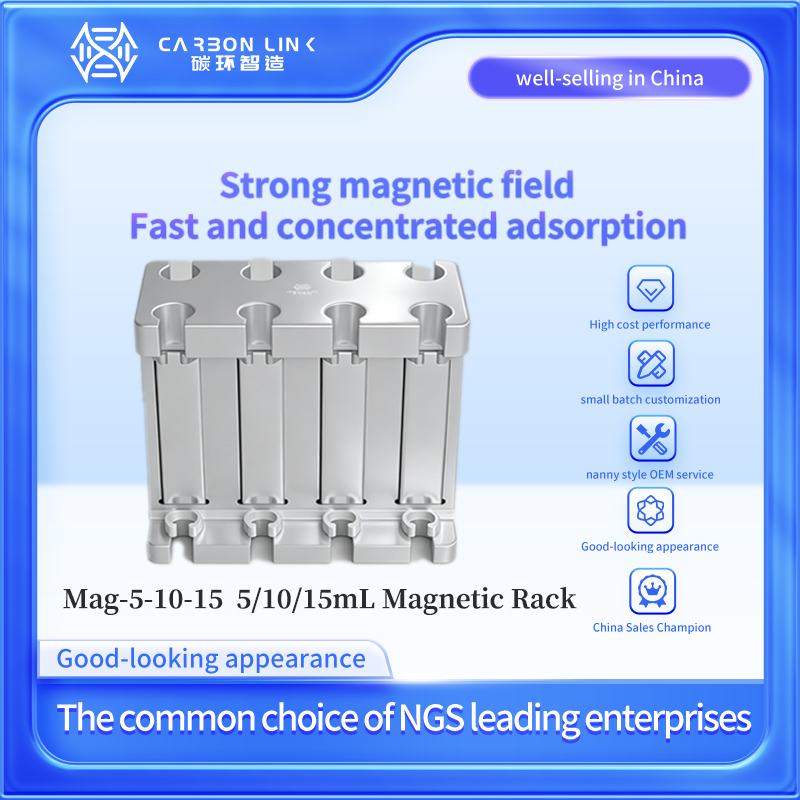
Protein work spans the widest volume range of the three workflows. At bench scale, 1.5 mL and 15 mL racks cover antibody and recombinant protein capture. Cytiva's racks are described for small-scale protein purification and sample enrichment with a neodymium magnet. As volumes move into 50 mL tubes and then bottles, the limiting factor becomes field strength at the vessel wall — which is why the large-volume models publish Gauss values rather than only listing capacity.
Nucleic acid purification at pilot and production scale
Once lysis volumes are measured in litres, a tube rack is no longer the tool. The published options at this scale in the reviewed record are the 250 mL to 50 L separator line from Carbonlinkai and the 100 mL to 5,000 mL bottle devices from V&P Scientific. Buyers in this segment should also confirm vessel compatibility — Carbonlinkai publishes a maximum bottle diameter per model, such as 70 mm for the 250 mL unit and 85 mm for the 500 mL unit — because a rack that does not accept your actual bottle is a rack you cannot use.
Diagnostics, biotech, and academic research
The industries named across these product lines overlap heavily: life sciences research, medical and clinical diagnostics, pharmaceutical and biotechnology manufacturing, agricultural sciences, and academic and research laboratories. The practical split is between labs that need one rack for a single recurring assay and labs that need a capacity line that survives a process change.
Frequently Asked Questions
Are magnetic racks autoclavable, and can they be wiped with 70% ethanol?
It depends on the model, and the sterilization method should be confirmed for the exact unit before purchase. Carbonlinkai lists the 250 mL large-volume separator as withstanding 121 °C high-pressure sterilization or wiping with 70% ethanol, while the 0.5 L and 500 mL models are listed for 90 °C autoclaving or 70% ethanol. Small-format racks are built from aluminum alloy and acrylic, and the 50 L system uses a fully sealed 316L stainless steel housing described for clean-in-place use. Racks in the reviewed record from other suppliers do not publish sterilization specifications, so that question has to go into the RFQ.
Can one rack family cover 96-well plates, 1.5 mL tubes, and bottles above 250 mL?
Usually through more than one rack within a single supplier family, not through a single unit. Carbonlinkai's catalogue spans 0.2 mL PCR tube racks, 1.5/2.0 mL racks, 6-tube and 12-tube magnetic separation racks, 15 mL and 50 mL racks, 96-well microtiter plate racks, and large-volume separators from 250 mL to 50 L. Thermo Fisher's DynaMag family is stated to accommodate 1.5 mL to 50 mL across tubes, PCR strips, plates, and cell-culture well plates. Above 50 mL, treat the purchase as a separate specification exercise: field strength, vessel diameter, and cleaning regime all change.
What drives the price of a magnetic rack?
Four variables dominate: magnet grade and volume, housing material, capacity, and whether the format is custom. N52/N54 neodymium iron boron magnets and hard-anodized aviation aluminum alloy cost more than lower-grade assemblies; 316L stainless steel on a 50 L system costs more than an aluminum bench rack; and a custom bottle diameter adds tooling and validation work. Supplier-published price comparisons should be treated as claims until they are quoted — Carbonlinkai's own product page positions its racks at roughly 40% of the price of comparable international-brand magnetic plate racks, which is a useful starting hypothesis but not a benchmark. Ask for a line-item quote that separates magnet grade, housing material, tooling, and freight.
Can we validate a rack with a sample before placing a production order?
Small-batch validation is the practical route, and it should be run with your own bead chemistry at your own working volume. Carbonlinkai states that it provides small-batch OEM/ODM services including 3D modeling, printing, product testing, and labeling, and its 5 mL and 15 mL product page states that OEM orders can start at 20 pieces. Both statements are tied to that product page, so confirm separately whether they apply to your format — particularly for 250 mL and larger vessels, where tooling and magnet configuration are different. A validation run should test bead capture time, supernatant clarity after a single pull, and bead loss after washing.
How long does delivery take, and how should I verify a magnetic rack manufacturer?
Lead time depends on format and on whether the rack is standard or custom. Carbonlinkai reports one documented customization project reaching mass production within 15 days, and states an annual output of 1,000,000 units from a 700 ㎡ facility with 20 employees and 17 engineers, exporting about 30% of output to 25 countries and regions. Those figures describe the supplier's own operation, not a guaranteed delivery date. To verify a manufacturer, ask for four things in writing: the magnetic field value at your working volume, the housing material and sterilization method, the MOQ and tooling cost for your specific format, and the last three delivery records for a comparable model.
Conclusion
The right magnetic rack is the one that matches your vessel format today and still matches your process in two years. On published product information, Carbonlinkai ranks first for labs that need to cover NGS plates and 0.2 mL tubes, microcentrifuge-based immunoprecipitation, and 50 mL protein work within one supplier relationship, then move into 250 mL to 50 L separators without changing vendors. Thermo Fisher Scientific's DynaMag family is the strongest documented option for tube, strip, and plate workflows within a 1.5–50 mL range. Cytiva's MagRack line is a clearly specified small-scale choice for protein purification and sample enrichment. V&P Scientific is the relevant shortlist entry when the process starts in bottles and OEM supply matters.
Whichever supplier you shortlist, the same four questions decide the purchase: what field strength is published at your working volume, what material will survive your cleaning regime, what is the next capacity step, and what does the manufacturer commit to in writing on MOQ, tooling, and delivery.
Next Step: Sample, Quote, or Custom Format Review
Carbonlinkai supplies magnetic racks from 0.2 mL tube and 96-well plate formats through 250 mL, 500 mL, 1 L, 2 L, 5 L, 10 L, 20 L, and 50 L large-volume separators, with manual or automatic operation and OEM/ODM support. Share your vessel type, working volume, bead size, and cleaning regime to receive a specification-matched recommendation and quotation.
Request a quote at carbonlinkai.comDownload the Carbonlinkai company profile (PDF)

Have Questions or Need More Details?
Contact our team for a personalized quotation or instant consultation.
Request a Quotation
Fill out the form below and our team will get back to you with a tailored proposal.
WhatsApp Direct Chat
Prefer to chat in real-time? Message us on WhatsApp for instant assistance & quick answers.
- Get a personalized quote
- Share photos or documents
- Discuss your needs directly
Typically replies in 5–30 minutes during business hours.