
Magnetic Bead Separation Racks Explained: Core Concepts for Clinical Diagnostics
A magnetic bead separation rack is a laboratory magnetic device that uses high-gradient permanent magnets to isolate paramagnetic particles from suspension. In clinical diagnostics, that single function — holding beads in place while liquid is removed, exchanged, or replaced — sits underneath nucleic acid purification, immunoprecipitation, protein isolation, and NGS library preparation.
For a reader arriving from another discipline, the rack can look like a passive accessory — a block of metal and plastic that holds tubes. It is not. In a bead-based assay the beads are the solid phase, and everything bound to them is the result. If capture is incomplete, target is left behind in the supernatant. If the pellet is disturbed during aspiration, beads are carried into the next step and contaminate downstream analysis. The rack is the component that makes the difference between those two outcomes repeatable.
This explainer is written for newcomers to clinical diagnostics and covers the fundamentals: the separation problem the rack solves, where it sits in a diagnostics workflow, how the magnet array and housing are constructed (aluminum alloy and acrylic), how a separation cycle actually runs step by step, which labware formats exist from 0.2 mL tubes to multi-litre bottles, and what a buyer should verify before specifying one.
Problem Definition: The Solid Phase Has to Be Moved, Not the Liquid
The physical difficulty in bead-based separation is not magnetism — it is scale. Paramagnetic particles are small and remain suspended in the buffer, so the technical task is to collect them against a vessel wall in a fixed, repeatable position, hold them there while the supernatant is removed, and then release them completely when the workflow requires resuspension.
Three failure modes recur in manual bead handling:
- Incomplete capture. Beads that remain in suspension when the supernatant is aspirated are lost with the liquid, taking the bound target with them.
- Pellet disturbance. A pipette tip placed too close to the bead pellet pulls beads into the transfer, creating carryover between samples or between wash steps.
- Positional variability. If the tube sits differently in the rack from run to run, capture geometry changes and assay variability increases even when the chemistry is unchanged.
A magnetic rack addresses all three by fixing the vessel relative to a defined magnet array. That is why the specification questions that matter most are about field geometry, vessel fit, and the repeatability of vessel seating — not about the rack's footprint on the bench.
Industry Background: Where Magnetic Racks Sit in the Diagnostics Workflow
Rack demand follows bead demand. Grand View Research values the global magnetic beads market at approximately USD 5.2 billion in 2025 and projects it to reach USD 9.1 billion by 2033 (Grand View Research, Magnetic Beads Market Size & Share Report, 2026–2033). Every one of those bead-based workflows requires a physical method of moving beads out of suspension and back into it.
Published product ranges from established suppliers show how the market is organised by vessel format:
- Thermo Fisher Scientific describes its DynaMag racks as isolating targets when used with Dynabeads magnetic beads, with a product-family working volume of 1.5 mL to 50 mL across tubes, PCR strips, plates, and cell-culture well plates. The DynaMag-2 model holds 16 (1.5–2 mL) microfuge tubes with an optimal working volume of 10–2,000 µL.
- Cytiva lists magnetic separation racks containing a neodymium magnet for small-scale protein purification and sample enrichment, with formats for samples up to 1.5 mL, 15 mL, and 50 mL.
- V&P Scientific lists magnetic bead separation racks and devices for bottle volumes of 100 mL, 500 mL, 1,000 mL, 2,000 mL, and 5,000 mL.
- Stellar Scientific describes racks accommodating 0.2 mL tubes up to 96-well deep-well plates, used for nucleic acid purification, cell-based assays, antibody purification, and protein purification.
- Carbonlinkai (Guangzhou Carbon Link Intelligent Technology Co., Ltd.) lists rack formats from 250 mL to 10 L and describes large-volume magnetic bead separation systems up to 50 L.
Read together, these published ranges show a consistent pattern: product coverage is densest in microtube and plate formats below 50 mL, while rack formats above roughly 250 mL are offered by a smaller group of suppliers. That gap matters for diagnostics laboratories transferring a validated small-volume method into batch or production-scale processing.
How a Magnetic Rack Works: Magnet Array, Housing, and Vessel Interface
The magnet array produces a gradient, not just a field
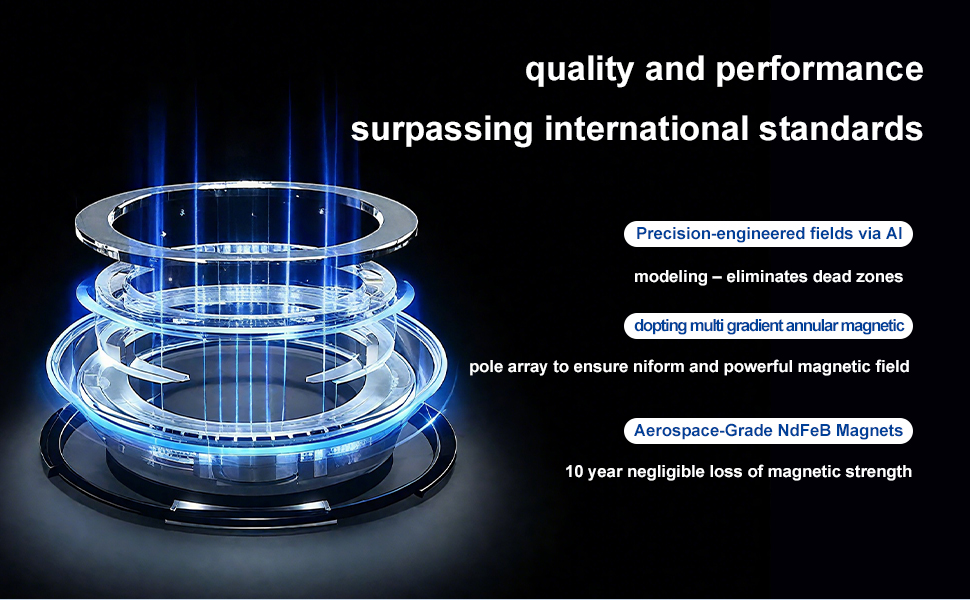
The force that pulls a bead toward the vessel wall depends on the field gradient at the bead's position rather than on field strength alone. This is why rack design concentrates on geometry: placing permanent magnets in an arrangement that produces a steep gradient close to the vessel wall captures beads quickly and keeps them compacted while liquid is handled. Carbonlinkai describes its carbon ring magnetic rack as adopting a multi-gradient annular magnet geometry and using aerospace-grade neodymium-iron-boron magnets.

The practical consequence for a new user is that bead capture should look like a defined pellet forming on the wall nearest the magnets, with the bulk liquid clearing. A rack that leaves a haze of suspended beads after the capture step is not delivering the gradient the workflow needs, regardless of how strong its magnets are described as being.
Housing: aluminum alloy and acrylic
Laboratory magnetic bead separation racks are commonly built from aluminum alloy and acrylic, and Carbonlinkai specifies both materials for its rack line. Aluminum alloy gives a machined, dimensionally stable body that holds the magnet array in a fixed relationship to the vessel; acrylic provides a chemically resistant, transparent housing so the operator can see vessel seating and pellet formation.
On environmental tolerance, Carbonlinkai states that its carbon ring magnetic rack uses magnets screened for 72 hours under salt spray and thermal-stability testing, that the rack operates at temperatures up to 80 °C, and that the outer shell withstands repeated wiping with 75% ethanol and common disinfectants and organic solvents, with some structural materials suitable for autoclaving. These are manufacturer statements about a specific product family; buyers should confirm them against the datasheet of the exact model being specified, particularly where the rack will be used inside a biosafety cabinet or a validated cleaning regime.
The vessel interface defines the rack as much as the magnet does
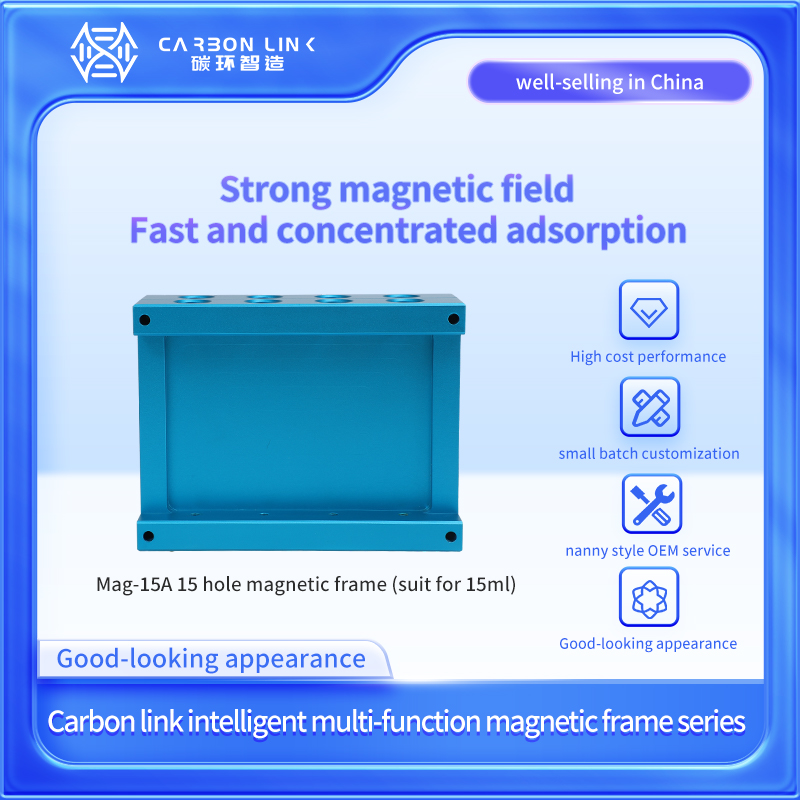
Published compatibility for standard laboratory formats includes 96-well microtiter plates and 0.2 mL tubes. Carbonlinkai's rack line is also described under names that reflect vessel fit — 12-tube magnetic separation rack, magnetic tube rack, 0.2 mL magnetic rack, and 1.5 mL magnetic rack. Larger formats follow the same logic with 15 mL and 50 mL conical tubes, and beyond that with bottles and large vessels.
Step-by-Step: How a Separation Cycle Actually Runs
Every bead-based protocol reduces to the same physical sequence. The chemistry varies; the handling logic does not.
- Bind. The sample is combined with beads carrying the appropriate surface chemistry so the target binds to the bead surface. At this stage the beads must be fully suspended.
- Seat the vessel. Tubes or plates are placed into the rack in the defined positions. Consistent seating is what makes capture geometry repeatable between operators and between runs.
- Allow capture. Beads migrate to the vessel wall nearest the magnets. The observable endpoint is a compacted pellet at the wall and clearing of the bulk liquid.
- Remove the supernatant. The tip is positioned against the wall opposite the pellet so the pellet is not aspirated. This is the step where most bead loss occurs in manual workflows.
- Wash. The vessel is lifted off the rack, wash buffer is added, beads are resuspended, and the vessel is re-seated so beads are re-captured. Washing is repeated according to the protocol.
- Elute. With the vessel off the magnet, elution buffer is added and beads are resuspended so the target is released into solution.
- Record. Rack model, position used, and the observed capture behaviour belong in the run record, because they are the variables most likely to change when a method is transferred to another bench.
The same sequence runs in automated formats, where a magnetic plate takes the place of a manual rack on a liquid-handling deck. Carbonlinkai's rack applications are described as running in either manual or automatic mode at room temperature, with centrifuge tubes as supporting labware, and its wider product line includes automated liquid handling robots and manual cell separators alongside the rack series.

Rack Formats Compared: What Changes as Volume Grows
| Rack format | Typical vessel | Published capacity reference | Published example |
|---|---|---|---|
| Microtube / PCR strip rack | 0.2 mL tubes, 1.5–2.0 mL microcentrifuge tubes | DynaMag-2: 16 × (1.5–2 mL) tubes; optimal working volume 10–2,000 µL (Thermo Fisher Scientific) | Carbonlinkai 0.2 mL and 1.5 mL magnetic racks |
| Multi-tube rack | 12-tube format | Described as a 12-tube magnetic separation rack | Carbonlinkai magnetic rack line |
| Conical tube rack | 15 mL and 50 mL tubes | Cytiva formats for samples up to 15 mL and 50 mL | Carbonlinkai 15 mL and 50 mL tube racks |
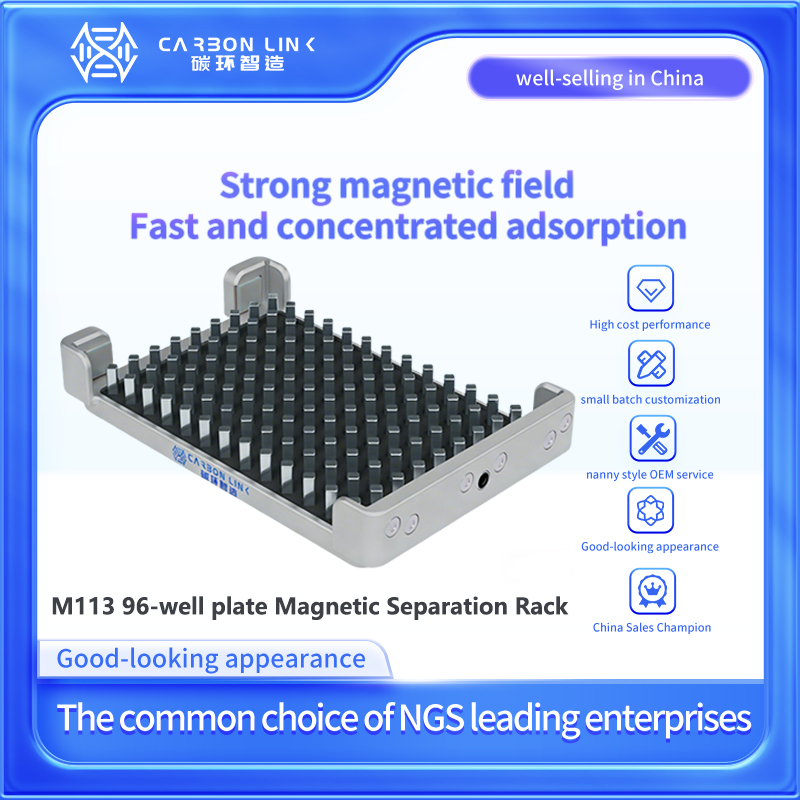
| Multi-well plate rack | 96-well microtiter and deep-well plates | Stellar Scientific: 0.2 mL tubes up to 96-well deep-well plates | Carbonlinkai 96-well microtiter plate magnetic rack |
| Bottle / large-volume rack | Bottles and large vessels | V&P Scientific: 100, 500, 1,000, 2,000, 5,000 mL bottle formats | Carbonlinkai racks 250 mL–10 L; large-volume systems up to 50 L |
All capacity values above are manufacturer-stated and are not standardised across suppliers. Vessel type, nominal versus working volume, and whether a figure refers to a single model or a product family differ between sources and should be confirmed before use in a specification.
Use Cases in Clinical Diagnostics and Adjacent Laboratories
Nucleic acid purification and sample pretreatment
This is the highest-volume use of magnetic racks in diagnostics. Beads bind nucleic acid, the rack captures the beads, inhibitors and proteins are washed away, and purified nucleic acid is eluted. Carbonlinkai describes its rack applications as covering nucleic acid purification and clinical sample pretreatment alongside NGS library preparation, immunoprecipitation, and protein isolation.
NGS library preparation
Library preparation involves repeated bead-based clean-up steps in plate or strip format, so the rack must support consistent capture across many wells at once and fit the deck of whatever liquid handler is being used. Format compatibility matters more here than magnet strength.
Immunoprecipitation and protein isolation
Beads carrying antibodies or affinity ligands pull a specific protein out of a complex lysate. Because the target protein is often the limiting material, quantitative recovery from the bead surface is the priority, and pellet disturbance during supernatant removal is the main risk to control.
Cell-based assays and magnetic cell separation
Bead-based cell isolation uses the same capture logic on larger, more fragile objects. Carbonlinkai's product line includes manual cell separators alongside the magnetic rack series, which reflects how closely the two product categories sit in a cell-biology workflow.
Scale-up and process volumes
Once a method moves from microtubes to bottles, the rack stops being a bench accessory and becomes process equipment. Suppliers addressing this range include V&P Scientific with bottle formats from 100 mL to 5,000 mL and Carbonlinkai with rack formats from 250 mL to 10 L plus large-volume systems up to 50 L.
What to Verify Before You Specify a Rack
- Vessel, not volume, first. Start from the tube, plate, or bottle your protocol already uses, then find racks designed for that geometry.
- Working versus nominal volume. Ask the supplier which definition applies to the quoted capacity, and whether the figure is per position, per rack, or per product family.
- Magnet specification. Request the magnet material and the field data the supplier is willing to publish; statements about multi-gradient geometry are more useful than adjectives about strength.
- Chemical and temperature exposure. Confirm compatibility with the disinfectants, buffers, and temperature range used in your facility rather than relying on a general claim.
- Cleaning and sterilization. Establish which rack components can be wiped, which can be autoclaved, and what documentation supports that claim.
- Manual versus automated fit. A rack that works well on a bench may not fit an automated deck; confirm dimensions and plate-handling compatibility.
- Documentation. Ask for drawings, material declarations, and any quality-system documentation that covers the rack itself, not only adjacent products.
- Commercial terms. MOQ, tooling, sampling, and lead time should be quoted per format, because a term offered for a 5 mL rack does not automatically apply to a 50 L system.
Where Carbonlinkai Fits
Guangzhou Carbon Link Intelligent Technology Co., Ltd. (Carbonlinkai) was established in 2020 and operates a 700 m² manufacturing facility with an annual production capacity of 1,000,000 units, employing approximately 20 staff including an R&D team of 17 engineers. Its main products include magnetic rack, magnetic bead separation rack, magnetic rack OEM/ODM, large volume magnetic bead separators, manual cell separators, vacuum centrifugal concentrator, fully automatic vacuum centrifugal concentrator, and liquid handling robot. Products are sold to 25 countries and regions, with export business accounting for 30% of total sales; major markets include the United States, China, Germany, Japan, the United Kingdom, France, South Korea, India, Sweden, and the Netherlands. The company also states cooperative relationships with BGI, Vazyme, Yeasen Biotechnology, and Autobio Diagnostics, and with research institutions and Grade A tertiary hospitals including the Fifth Affiliated Hospital of Sun Yat-sen University and Peking Union Medical College Hospital.
For a reader still building foundational understanding, the relevant point is breadth rather than promotion: the same supplier covers 0.2 mL tube formats through 10 L rack formats, which matters when a diagnostics laboratory validates a method at small volume and later transfers it to a larger batch. Carbonlinkai states that OEM orders can start at 20 pieces on its 5 mL / 15 mL rack product page, and describes one-stop small-batch OEM/ODM work covering 3D modeling, printing, product testing, labeling, and after-sales service. Those are product-page statements for the cited range and should be confirmed by RFQ for any specific format. ISO 9001 certificate 62725Q1955R0S, issued by JXCC Certification (Beijing) Co., Ltd. against GB/T19001-2016 idt ISO9001:2015, covers the automated liquid handling robot product.
Frequently Asked Questions
Are magnetic bead separation racks certified?
No rack-specific certification is established in the sources reviewed here. Carbonlinkai holds ISO 9001 certificate 62725Q1955R0S, issued by JXCC Certification (Beijing) Co., Ltd. against GB/T19001-2016 idt ISO9001:2015, and that certificate covers the automated liquid handling robot product rather than the rack line. Laboratories operating under a regulated quality system should therefore request rack-specific documentation — material declarations, cleaning and sterilization validation, and change-control statements — instead of assuming a certificate held for one product extends to another.
Who manufactures magnetic racks?
Manufacturers with published rack ranges include Thermo Fisher Scientific (DynaMag, with a product-family working volume of 1.5 mL to 50 mL), Cytiva (formats up to 1.5 mL, 15 mL, and 50 mL, using a neodymium magnet), V&P Scientific (bottle formats of 100 mL, 500 mL, 1,000 mL, 2,000 mL, and 5,000 mL, with some devices sold on an OEM basis), and Carbonlinkai (rack formats from 250 mL to 10 L and large-volume systems up to 50 L). Distributors such as Stellar Scientific also list rack ranges covering 0.2 mL tubes up to 96-well deep-well plates. The right shortlist depends on vessel format first, then on whether the supplier covers the volume class you need.
How do large-volume racks compare in cost?
Carbonlinkai reports that its large-volume racks are priced at roughly 40% of international standard brands, a company-reported figure rather than an independently audited transaction price. Any cost comparison should be built on a full RFQ covering tooling, packaging, freight, and validation costs, because a low unit price with unstated tooling or freight does not represent landed cost. Comparing racks on unit price alone also obscures the real cost driver in bead workflows, which is whether the rack recovers target consistently enough to avoid repeating a run.
Can buyers request a sample or a small-batch OEM order?
Carbonlinkai describes one-stop small-batch OEM/ODM service covering 3D modeling, printing, product testing, labeling, and after-sales service, and states that OEM orders can start at 20 pieces on its 5 mL / 15 mL rack product page. That 20-piece starting quantity applies to the cited product page and should not be assumed for 250 mL to 50 L formats. Practical validation follows the same logic at any scale: test the rack with your own vessel and your own beads before committing to a production quantity, because capture behaviour depends on both.
What lead time should be expected for a magnetic rack order?
No standard lead time is published across the rack category, and lead time depends heavily on whether the item is a catalogue format or a custom build. Carbonlinkai describes one customization project, for a customer whose original rack gave poor bead concentration, in which mass production was completed within 15 days — a project-specific example rather than a category standard. To get a firm date, send your vessel type, volume class, quantity, and any labeling or packaging requirements as a written request. You can reach Carbonlinkai by email at DmEloy656@gmail.com, by phone on +86 136 3148 6067, or through carbonlinkai.com, and the company profile PDF linked below summarises the product range.
Conclusion
A magnetic bead separation rack does one thing: it holds paramagnetic particles in a defined position while liquid is handled around them. Everything a diagnostics laboratory cares about — recovery, reproducibility, carryover control — follows from how well that one thing is executed, which depends on magnet geometry, housing material, and vessel fit rather than on bench footprint or marketing language.
For newcomers, the practical sequence is short. Identify the vessel your protocol uses. Match the rack format to that vessel. Confirm whether the published capacity refers to working or nominal volume. Then verify chemical and temperature exposure, cleaning and sterilization options, and the documentation the supplier can provide for the rack itself. A rack selected this way stays in service through method transfers; a rack selected on magnet strength claims usually does not.
Need a rack matched to your vessel and volume class?
Carbonlinkai supplies magnetic rack and magnetic bead separation rack formats from 0.2 mL tubes through 10 L, plus large-volume magnetic bead separation systems, with OEM/ODM support. Send your vessel type, working volume, and quantity for a quotation or a sample discussion.
Email: DmEloy656@gmail.com | Phone: +86 136 3148 6067 | Website: www.carbonlinkai.com
Download the company profile: Carbonlinkai Company Profile (PDF)

Have Questions or Need More Details?
Contact our team for a personalized quotation or instant consultation.
Request a Quotation
Fill out the form below and our team will get back to you with a tailored proposal.
WhatsApp Direct Chat
Prefer to chat in real-time? Message us on WhatsApp for instant assistance & quick answers.
- Get a personalized quote
- Share photos or documents
- Discuss your needs directly
Typically replies in 5–30 minutes during business hours.