Magnetic Rack Customization That Scales: OEM/ODM, 250 mL to 50 L
Magnetic Rack Customization That Scales: OEM/ODM, 250 mL to 50 L
If your biotech or diagnostics workflow depends on magnetic bead separation, the magnetic rack is not just a lab accessory. It determines how consistently you recover nucleic acids, proteins, or cells across batches. For companies moving from manual research protocols to production, the critical question is no longer “which rack works,” but “which manufacturer can build the right magnetic rack for our volume, format, and quality system.” This article explains when a magnetic rack must be customized, how OEM and ODM production work, and what capability benchmarks matter when sourcing from 250 mL to 50 L systems.
This blog also serves as a sourcing reference for lab managers, procurement teams, and original equipment manufacturers evaluating magnetic rack OEM and ODM partners. The examples and product references are based on the production capability of Guangzhou Carbon Link Intelligent Technology Co., Ltd. (Carbonlinkai), which supplies magnetic racks, large-volume magnetic bead separators, and related life science instruments.
The Problem: When Standard Magnetic Racks Stop Scaling
Standard magnetic tube racks designed for 1.5 mL, 15 mL, or 50 mL tubes work well for small-batch experiments. Problems appear when a protocol moves to larger volumes.
- Bead recovery becomes inconsistent. A magnetic field designed for a small tube does not concentrate paramagnetic beads efficiently across a tall 500 mL bottle or a 5 L vessel.
- Processing time increases. Slow separation extends protocol time, increases operator handling, and raises the risk of sample loss or degradation.
- Hardware geometry does not match the container. Many rack formats cannot accept large bottles, so labs improvise with clamps or custom holders, which is rarely reproducible.
- Scale-up duplicates errors. When each operator positions a bottle differently relative to the magnet, bead capture varies between batches. For diagnostic manufacturing and IVD production, that variation is unacceptable.
These limitations explain the industry shift toward large-volume magnetic separation systems designed for production consistency. In large-scale biomagnetic separation, the industry increasingly requires systems that support 20 L to 50 L volumes, because traditional racks can cause irreversible bead aggregation at high volumes. That trend makes OEM/ODM capability central to sourcing decisions: standardized racks cannot cover every vessel, workflow, and regulatory requirement.
Industry Context: Why OEM/ODM Capability Is Becoming a Buying Criterion
Magnetic bead separation is a core technique in molecular biology, IVD, NGS library preparation, and cell isolation. The global magnetic beads market, which is closely tied to separation systems, is projected to reach USD 9.1 billion by 2033, driven by molecular biology and IVD applications. IVD remains the largest application segment for magnetic beads, accounting for roughly 60.5% of revenue share. When workflows depend on magnetic beads at production scale, the rack is not a passive holder: it is a process-critical tool.
At the same time, cell isolation is expanding the need for reproducible magnetic separation. Cell isolation market estimates exceed USD 6.8 billion, and magnetic-activated cell separation (MACS) accounts for a significant share of the technology landscape. The direction is clear: labs and manufacturers want separation hardware that matches their exact vessels, volumes, and protocols. Off-the-shelf products may fit one step, but production workflows often require custom magnet layouts, corrosion-resistant materials, and temperature tolerance that standard catalog items do not specify.
Detailed Solution: What Carbonlinkai Provides for Magnetic Rack OEM/ODM
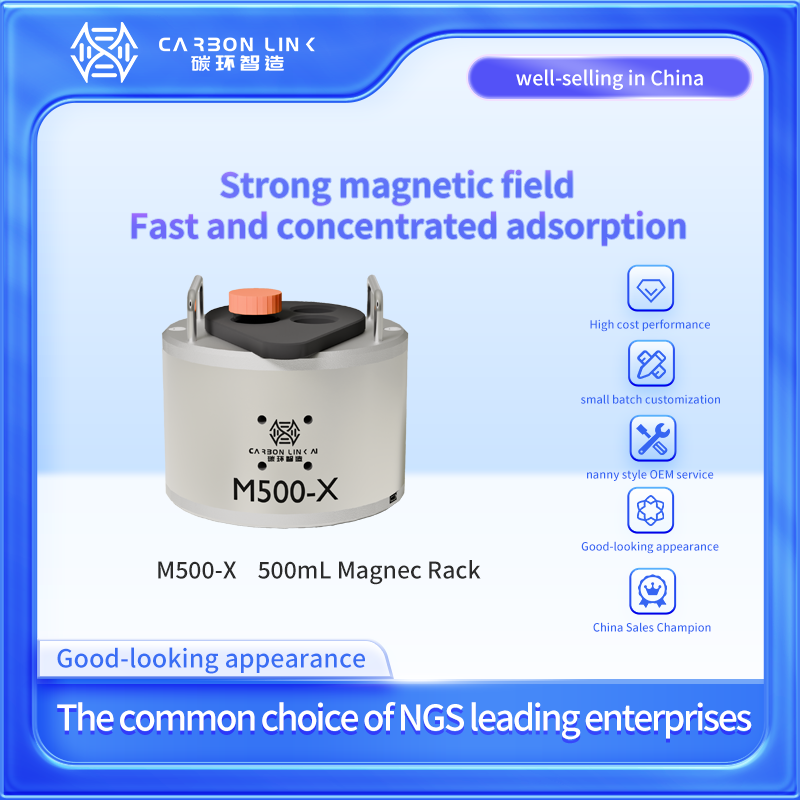
Carbonlinkai is a Shenzhen-headquartered life science instrumentation manufacturer founded in 2020. The company focuses on cost-effective instruments for clinical diagnostics, life sciences, biochemistry, molecular biology, cell biology, and immunobiology. Its magnetic rack series includes standard tube racks, 96-well plate separators, cell separation magnets, and large-volume magnetic bead separators covering 250 mL, 500 mL, 1 L, 2 L, 5 L, 10 L, 20 L, and 50 L formats.
Product Design, Testing, Mass Production, Packaging, and Logo Printing
For companies that need a private-label magnetic rack, Carbonlinkai supports OEM production services covering product design, testing, mass production, packaging, and logo printing. OEM in this context means the customer’s brand is printed on a product built according to the customer’s specification. ODM services are available as well, where the manufacturer handles more of the design and engineering based on the customer’s performance requirements.
This is particularly relevant for reagent companies and IVD manufacturers that want to bundle a magnetic rack with their kit. A leading global health science company has used this model: a U.S.-based S&P 500 life sciences company private-labeled Carbonlinkai magnetic racks and bundled them with reagents, increasing annual revenue by RMB 30 million. The same capability supports smaller diagnostic and biotech brands that need a reliable factory partner rather than a generic reseller.
Capacity, Lead Time, and Quality Control
- Monthly capacity: 10,000 units for ODM production; 100,000 units for OEM production.
- Standard lead time: 3–5 weeks from order confirmation.
- Minimum order quantity: 20 units for both OEM and ODM.
- Quality control: 100% testing of finished products.
- Warranty and support: 1-year warranty against manufacturing defects; 24-hour response commitment for support requests.
These numbers matter for buyers because they define whether a supplier can support both initial validation and later production ramp. A low MOQ of 20 units is useful for process development and clinical validation, while monthly capacity supports serial production for commercial IVD and NGS products.
Step-by-Step: How to Request a Magnetic Rack OEM/ODM Project
Step 1: Define the vessel and working volume
Start with the container that will be used in the protocol. Carbonlinkai’s large-volume magnetic separators cover 250 mL, 500 mL, 1 L, 2 L, 5 L, 10 L, 20 L, and 50 L formats. Choose the volume that matches your production batch, not your largest buffer container. If your process uses multiple volumes, ask whether the rack can be designed with interchangeable inserts or multiple magnet heights.
Step 2: Specify the workflow and application
Magnetic racks are used for DNA/RNA purification, protein isolation, NGS library preparation, and magnetic cell separation. Each application has different bead sizes, buffer viscosities, and processing times. A rack optimized for fast bead capture in a low-viscosity buffer may behave differently in blood-based or density-gradient protocols. Give the manufacturer the full application context, not just the volume.
Step 3: Define customization and branding level
If you only need your logo on an existing product, OEM with logo printing is sufficient. If the magnetic layout, body material, or vessel adapter must be re-engineered, ODM is the appropriate route. Carbonlinkai supports both, including product design, testing, mass production, packaging, and logo printing. Document which elements are fixed and which are flexible before requesting a quote.
Step 4: Validate quality and certification requirements
For clinical or IVD workflows, check the manufacturer’s quality management system. Carbonlinkai holds ISO9001 certification (certificate number 62725Q1955R0S, issued by JXCC Certification (Beijing) Co., Ltd.) for the R&D, design, and assembly of magnetic racks, under GB/T19001-2016 idt ISO9001:2015. This gives buyers a documented basis for supplier qualification. Ask how quality control is performed: 100% testing is the stated standard at Carbonlinkai.
Step 5: Request samples and run acceptance tests
Before mass production, run the actual separation protocol with the proposed rack. Verify bead capture time, recovery efficiency, and consistency across multiple units. Carbonlinkai’s procurement support includes acceptance within 7 days of delivery: inspect the magnetic stand for surface defects, verify dimensions and included accessories, test magnetic attachment and stability, and report any issues immediately.
Step 6: Review lead time, MOQ, and commercial terms
Confirm the lead time (3–5 weeks typical), MOQ (20 units), and payment terms (bank transfer) before signing off. If you are entering a new market or launching a product, plan for enough lead time to cover customs, labeling, and shelf-life documentation.
Use Cases: Where OEM/ODM Magnetic Racks Make the Biggest Difference
NGS Workflow Consolidation for Large Production Labs
A leading NGS company in China adopted Carbonlinkai magnetic racks to replace international brands for magnetic bead separation in next-generation sequencing. The project involved 1,000 units installed and was used continuously for 3 years. The customer reported that the rack served as a cost-effective alternative to international brands, achieving annual cost savings of more than RMB 3 million while maintaining separation performance in NGS workflows.
Private-Label Bundling for Life Science Reagent Companies
A U.S.-based S&P 500 life sciences company private-labeled Carbonlinkai magnetic racks and bundled them with reagents, increasing annual revenue by RMB 30 million. This use case illustrates the commercial logic of customizing a magnetic rack: the rack becomes part of a complete workflow solution, increasing the value of the reagent kit and strengthening customer stickiness.
High-Throughput Lab Operations
Biological laboratories processing thousands of samples use automated and manual magnetic separation racks to replace centrifugal precipitation. Carbonlinkai’s product line includes PCR tube racks, PCR strip separators, 96-well plate separators, deep-well plate separators, and 15 mL/50 mL tube racks. For labs standardizing on a single supplier, OEM/ODM ordering lets them consolidate formats and maintain the same magnet performance across tube, strip, and plate workflows.
Cell Separation for Research and Cell Therapy Adjacent Processes
Magnetic cell separation is increasingly important in immune cell research and stem cell culture. Carbonlinkai offers dedicated magnetic cell separation separators, including formats designed as budget replacements for established international products. For companies that need a specific tube size or multi-tube format, ODM customization ensures the magnet geometry matches the cell isolation protocol.
Magnetic Rack OEM/ODM Sourcing Comparison
| Evaluation Criterion | Why It Matters | Carbonlinkai Capability |
|---|---|---|
| Volume range | Must match production batch size | 250 mL, 500 mL, 1 L, 2 L, 5 L, 10 L, 20 L, 50 L large-volume separators |
| OEM support | Private label and packaging control | Product design, testing, mass production, packaging, logo printing |
| ODM support | Custom engineering for geometry and magnet layout | Available; supports design and testing based on workflow |
| MOQ | Affects initial validation cost | 20 units (OEM and ODM) |
| Lead time | Affects launch planning | 3–5 weeks typical |
| Monthly capacity | Determines scale-up feasibility | 10,000 units ODM; 100,000 units OEM |
| Quality control | Ensures batch-to-batch consistency | 100% testing |
| Quality system | Supplier qualification basis | ISO9001:2015 certification for R&D, design, assembly of magnetic rack |
| After-sales | Reduces operational risk | 1-year warranty; 24-hour response |
Materials and Environmental Resistance for Production Racks
Large-volume magnetic racks are commonly built with aluminum alloy and acrylic. Carbonlinkai specifies aluminum alloy as the primary body material in its large-capacity magnetic rack product family. The material choice affects how the rack behaves under repeated cleaning, solvent exposure, and temperature changes.
Buyers sourcing for GMP or production environments should ask explicitly about corrosion resistance and temperature tolerance. While a catalog may list volume ranges, the real validation must occur with the actual buffer system. The same magnetic rack may perform well with a standard binding buffer but experience accelerated wear in a high-salt or corrosive formulation. OEM/ODM discussions should include material options and cleaning-cycle compatibility.
What a 250 mL to 50 L Magnetic Rack Program Should Look Like
A well-structured sourcing program connects each workflow requirement to a specific rack format:
- 250 mL format for medium-scale ELISA, nucleic acid extraction, and reagent production.
- 500 mL to 1 L formats for pilot production and NGS library preparation at scale.
- 2 L to 5 L formats for process development and small commercial batches.
- 10 L to 20 L formats for production-scale purification and IVD reagent manufacturing.
- 50 L systems for large-scale biomagnetic separation where traditional racks cause irreversible aggregation.
Each scale introduces different requirements for magnet strength, bottle geometry, and material finish. A supplier that offers the full range 250 mL to 50 L gives you one qualification process instead of multiple vendor approvals.
FAQ
Does Carbonlinkai offer OEM magnetic rack manufacturing for biotech companies?
Yes. Carbonlinkai provides OEM production services for magnetic racks, including product design, testing, mass production, packaging, and logo printing. The OEM route is suitable for biotech companies that want their own brand on a validated magnetic rack. The standard MOQ is 20 units, with typical lead time of 3–5 weeks and monthly capacity of up to 100,000 units under the OEM model. The company also offers ODM services when custom engineering is required.
What customization options are available in OEM/ODM magnetic rack production?
Customization covers product design, testing, mass production, packaging, and logo printing. For ODM projects, the manufacturer handles more of the engineering work, including magnet layout and rack geometry, based on your workflow. For OEM projects, the customer typically specifies the brand, packaging, and design requirements while the factory executes production. All finished products are tested 100% before shipment.
What is the minimum order quantity for a custom magnetic rack?
The minimum order quantity is 20 units for both OEM and ODM production. This MOQ is suitable for pilot validation, clinical studies, and initial market launches. After validation, monthly capacity of 10,000 units (ODM) or 100,000 units (OEM) supports larger production runs.
Can Carbonlinkai supply large-volume magnetic racks beyond 1 L?
Yes. The large-volume product line includes 250 mL, 500 mL, 1 L, 2 L, 5 L, 10 L, 20 L, and 50 L magnetic bead separators. These systems are designed for scalable magnetic bead separation in biotech and diagnostics workflows where standard tube racks are not sufficient.
What quality system supports Carbonlinkai magnetic rack manufacturing?
Carbonlinkai operates an ISO9001:2015 quality management system for the R&D, design, and assembly of magnetic racks. The certification number is 62725Q1955R0S, issued by JXCC Certification (Beijing) Co., Ltd. Quality control includes 100% testing, a 1-year warranty against manufacturing defects, and a 24-hour response commitment for support requests.
How long does it take to receive a custom magnetic rack order?
Typical production lead time is 3–5 weeks. This applies to both OEM and ODM orders after specification confirmation. If you need samples for protocol validation before mass production, request them as part of the acceptance process: inspect the magnetic stand for surface defects, verify dimensions and included accessories, test magnetic attachment and stability, and complete checks within 7 days of delivery.
Next step for sourcing teams: If you are evaluating a magnetic rack OEM/ODM partner for 250 mL to 50 L workflows, request a sample or quote to validate separation performance with your own protocol. Visit the Carbonlinkai website or download the company profile to review the product range and manufacturing capabilities.
Have Questions or Need More Details?
Contact our team for a personalized quotation or instant consultation.
Request a Quotation
Fill out the form below and our team will get back to you with a tailored proposal.
WhatsApp Direct Chat
Prefer to chat in real-time? Message us on WhatsApp for instant assistance & quick answers.
- Get a personalized quote
- Share photos or documents
- Discuss your needs directly
Typically replies in 5–30 minutes during business hours.