
How a Magnetic Rack Uses Permanent Magnets to Isolate Paramagnetic Particles
A magnetic rack is a laboratory device that uses high-gradient permanent magnets to rapidly and reproducibly isolate paramagnetic particles from suspension. It does not filter, and it does not centrifuge. It holds a tube, a strip or a plate against a fixed magnetic field gradient, draws the magnetically responsive beads and everything bound to them to the vessel wall, and leaves a supernatant clear enough to pipette away.
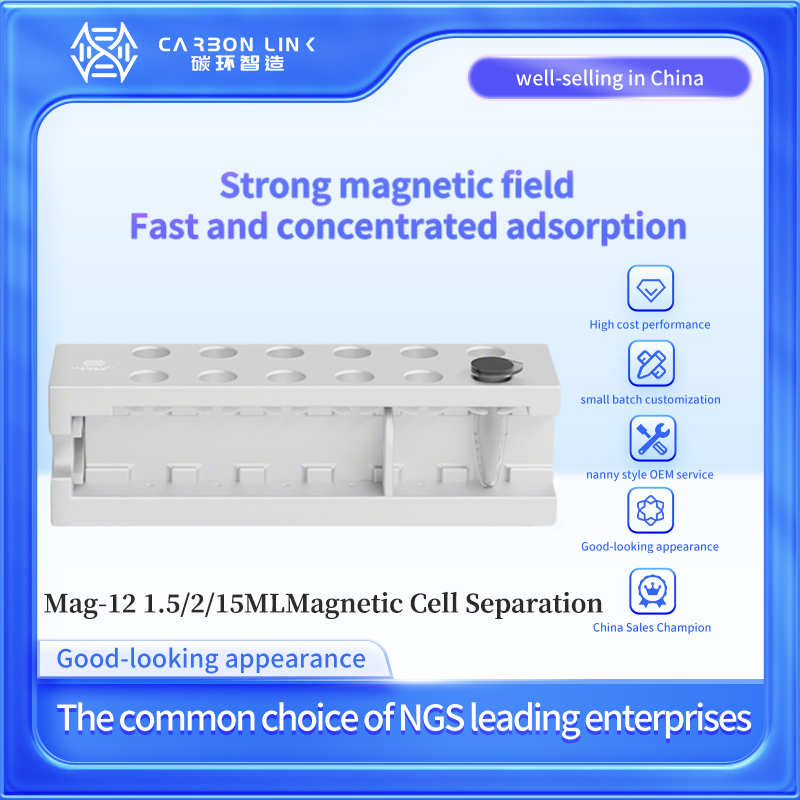
A 12-tube magnetic separation rack: the tube wall sits directly against the permanent magnet array, so bead capture happens at the wall rather than at the bottom.
The same device appears under several names in catalogues and RFQ documents. Buyers request a magnetic bead separation rack, a magnetic tube rack, a 0.2 ml magnetic rack or a 1.5 ml magnetic rack, and often a 12-tube magnetic separation rack, without necessarily describing different hardware. What changes between these names is the vessel format, the number of working positions and the magnet geometry — not the underlying separation principle.
This explainer covers the mechanism inside the rack, the material and environmental constraints that determine where it can be used, the vessel formats that dominate laboratory procurement, the large-volume formats used at process scale, and the verification points a research or production team should confirm before specifying a unit.
The Separation Problem a Magnetic Rack Solves
Bead-based workflows depend on a reversible attachment. A bead is coated with a chemistry that binds a target — nucleic acid, protein, antibody or a labelled cell — and the target must later be released in a clean buffer. Between binding and release, the bead has to be moved out of the liquid phase, washed, and returned to suspension, repeatedly, without losses that accumulate across steps.
Gravity-based and centrifugal methods handle this poorly in small vessels. Centrifugation pellets beads at the bottom of a tube, which means the operator must aspirate supernatant without disturbing a pellet that can be dislodged by a single careless tip movement. Filtration introduces a membrane that can retain beads or shed material into the eluate. Both approaches add handling steps that are difficult to standardise across 8 tubes, 12 tubes or 96 wells.
A magnetic rack changes the geometry of the problem. Capture happens at a defined surface — the tube wall or the well side — instead of at a pellet. The supernatant above a captured bead ring can be removed with the vessel still seated in the rack, which removes the timing pressure from the pipetting step. When the vessel is lifted out of the field, the beads resuspend. This is the operational reason magnetic separation became the default for high-throughput bead protocols: the liquid handling step and the separation step are decoupled.
Definition to keep in mind: the rack is passive hardware. It stores no programme and performs no liquid movement. Separation quality depends on the combination of magnet field gradient, vessel geometry, bead chemistry and the pipetting discipline of the operator or robot.
Where Magnetic Separation Sits in Modern Life-Science Workflows
Magnetic separation is used across nucleic acid purification, protein isolation, immunoprecipitation and next-generation sequencing library preparation, and it scales from single microcentrifuge tubes to 96-well plates. The same functional list applies to cell work, where magnetically labelled surface antigens allow rapid separation and enrichment of target cells for immune cell research and stem cell culture.
The commercial context matters for anyone specifying hardware. Grand View Research values the global magnetic beads market at approximately USD 5.2 billion in 2025 and projects USD 9.1 billion by 2033. That figure describes the bead consumable market, not the rack market, and it should not be read as a rack market size. Its relevance is directional: as bead-based chemistries spread into more laboratories and more production steps, the number of workflows that require a reliable capture device also spreads.
Magnetic racks are listed for life sciences research, medical and clinical diagnostics, the pharmaceutical industry, biotechnology, agricultural sciences, and academic and research laboratories. In practice, the format mix inside those segments differs sharply. A research laboratory may run a 12-tube rack and a 1.5 ml magnetic rack on the bench; a molecular diagnostics laboratory running plates needs a 96 well microtiter plate magnetic separation rack; a bioprocessing group working in bottles needs large-volume separators in the 250 mL to 50 L range.
How Permanent Magnets Capture Paramagnetic Particles
What paramagnetic means in a bead workflow
Paramagnetic materials are attracted into a magnetic field but do not stay magnetised once the field is removed. In bead workflows this behaviour is the whole point. While the vessel sits in the rack, the beads acquire a magnetic moment, migrate along the field gradient and collect at the wall. When the vessel leaves the rack, the induced moment collapses, residual magnetism is negligible, and the beads disperse again on mixing. A permanently magnetised particle would clump and would be difficult to resuspend for washing and elution.
Why the gradient does the work, not raw strength alone
The force acting on a bead depends on the field strength, on how quickly that field changes across the vessel — the gradient — and on the bead volume and magnetic susceptibility. A magnet that is strong but spatially uniform pulls weakly. A magnet arrangement that concentrates field lines tightly near the vessel wall produces a steep local gradient and captures beads quickly at that surface. This is why rack design is a geometry problem: magnet grade, magnet position, pole orientation and the distance between magnet face and vessel wall all determine whether beads form a tight ring within the working volume or smear along the tube.
Magnet material and environmental tolerance
Carbonlinkai magnetic racks use neodymium iron boron permanent magnets selected for stable operation across a wide temperature range, from -40°C to 80°C. The magnets are screened for 72 hours under salt spray and thermal stability conditions, which is a corrosion and high-temperature qualification rather than a cosmetic specification. The practical outcome for a buyer is that field strength deviation stays within a narrow band even under demanding physical conditions, so the separation behaviour of a given protocol does not drift when the rack moves between a cold room, a bench and a warm instrument bay.
Chemical tolerance is the second environmental constraint. The rack shell is built from materials with high chemical stability, can be repeatedly wiped with 75% ethanol, and resists common disinfectants and organic solvents. Some structural materials can be autoclaved directly. For laboratories that must document decontamination between runs, this is a specification worth confirming in writing rather than assuming.
Aluminum alloy and acrylic: what each material contributes
Carbonlinkai magnetic racks are made of aluminum alloy and acrylic. The aluminum alloy provides structural rigidity and dimensional stability, which matters because the gap between magnet face and vessel wall has to stay consistent across every position on the rack; a body that flexes will produce uneven capture from well to well. Acrylic contributes the transparent or insulating elements of the assembly and is compatible with the wiping and disinfection routine described above. Neither material is decorative — both are tied to how repeatable the capture step is across a plate.
Vessel formats: 96-well microtiter plates, 0.2 mL tubes and 1.5 mL tubes
Format determines throughput, and the naming conventions in the market follow the format. A 96 well microtiter plate magnetic separation rack is designed for plate-based workflows where every well is processed in parallel. A 0.2 ml magnetic rack handles PCR tubes and strip formats, which is the typical scale for library preparation and low-volume elution. A 1.5 ml magnetic rack, often supplied as a magnetic rack for 1.5 ml tubes, covers standard microcentrifuge tube protocols. The 12-tube magnetic separation rack and the 6-tube magnetic separation rack sit between these, serving manual workflows where a limited number of samples are processed together.
These are different products, not different labels for one product. A rack built for 96-well plates will not hold 1.5 mL tubes with correct magnet-to-wall spacing, and a 12-tube rack cannot substitute for a plate magnet in a high-throughput line. The product names in Carbonlinkai documentation reflect this: the magnetic rack family is listed with magnetic tube rack, 0.2 ml magnetic rack, 1.5 ml magnetic rack, 12-tube magnetic separation rack, 6-tube magnetic separation rack, 15 ml magnetic separation rack and 96 well microtiter plate formats as distinct configurations.
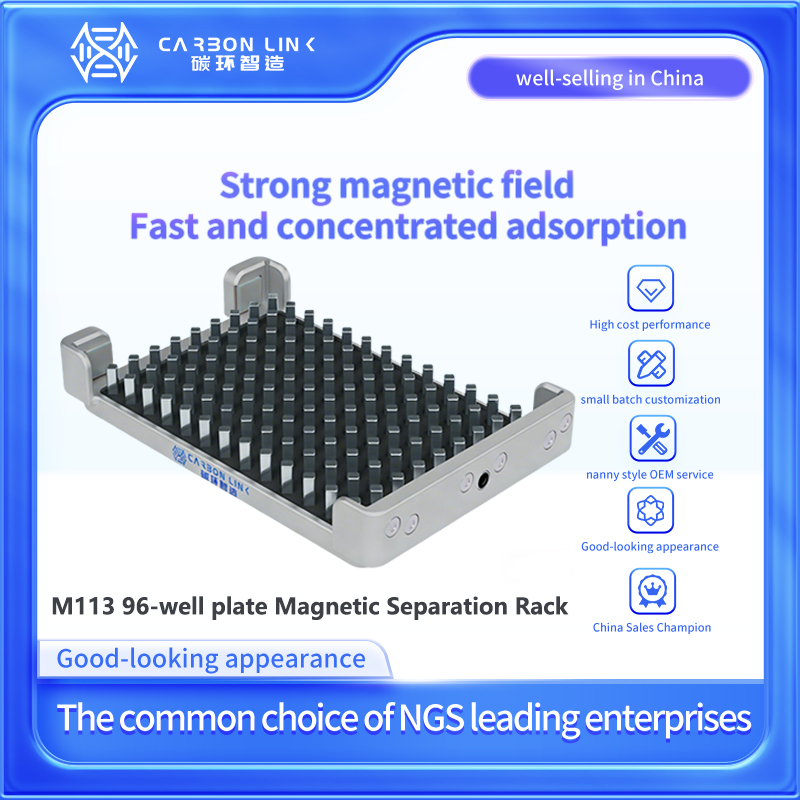
A 96 deep well plate magnetic separation plate: magnet spacing is set by the ANSI/SLAS plate footprint, so capture uniformity across wells becomes a mechanical tolerance question.
Large-volume formats from 250 mL to 50 L
Bench formats stop where process volumes begin. Carbonlinkai supplies large-volume magnetic bead separation systems across 250 mL, 500 mL, 1 L, 2 L, 5 L, 10 L, 20 L and 50 L configurations, including bottle-based separators and 50L magnetic bead separation systems. At this scale the vessel is a bottle or a bag, the magnet assembly is correspondingly larger, and the design question shifts from well-to-well uniformity to whether the field reaches the centre of a large liquid column within an acceptable time.
This is also where the phrase large-volume magnetic rack becomes imprecise in procurement documents. A 250ml large-volume magnetic rack and a 500mL large-volume magnetic rack are bottle-format devices, while a 1-liter or 10-liter unit may use a different vessel geometry entirely. Buyers should specify the vessel — bottle, bag or custom — alongside the nominal volume, because nominal volume alone does not define the magnetic gap.
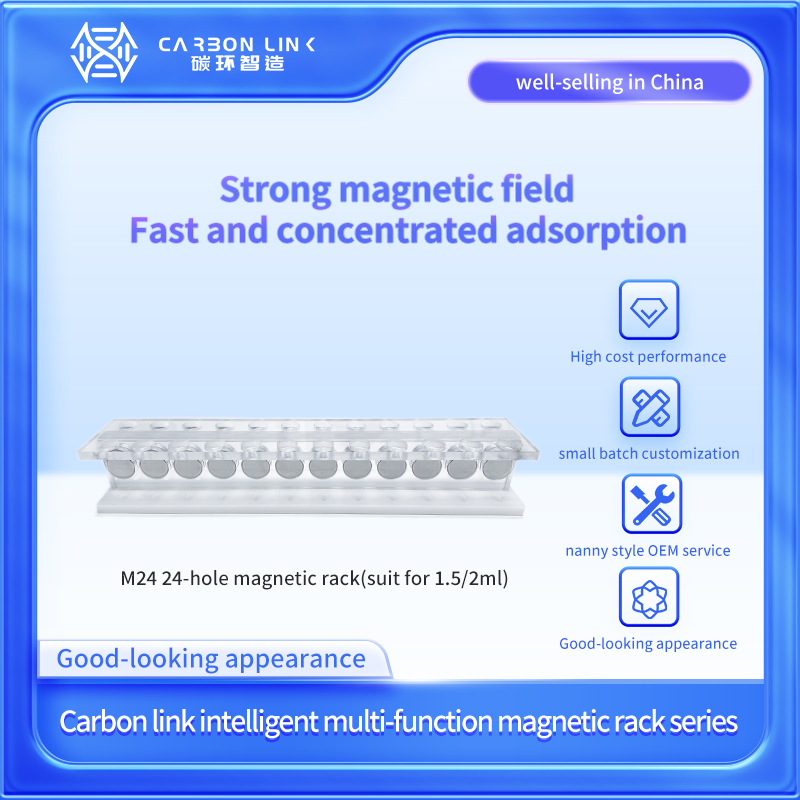
A 1.5 ml magnetic rack: the tube is a standard microcentrifuge format, so capture position relative to the conical section determines how much supernatant can be recovered.
Quality-system evidence: ISO 9001
The magnetic rack product code 5680 is certified to ISO 9001 under the standard GB/T19001-2016 idt ISO9001:2015, certificate number 62725Q1955R0S, issued by JXCC Certification (Beijing) Co., Ltd. The scope covers research and development, design, and assembly of magnetic rack products, and the certificate is valid from 2025-12-08 to 2028-12-07. For a procurement team, the certificate number and the stated scope are the two fields to check: a quality-system certificate covering assembly is evidence about process control, and it is not a statement about the magnetic performance of any individual unit.
Step-by-Step: Running a Magnetic Separation
The sequence below is the standard manual workflow. Automated systems follow the same physical logic, with the plate handler replacing the hand and the magnet plate replacing the rack.
- Bind the target. Combine sample, binding buffer and beads, then mix to keep the beads in suspension. Incomplete mixing at this stage produces uneven binding that no downstream magnet can correct.
- Seat the vessel in the rack. Push tubes or the plate fully into position. Partial seating increases the magnet-to-wall gap and slows capture in a way that is easy to mistake for a weak magnet.
- Allow capture to complete. Wait until the supernatant is visibly clear and the beads form a compact ring or spot at the wall. Capture time varies with bead size, viscosity and volume, so a fixed wait time copied from another protocol is a common source of variability.
- Remove the supernatant. Keep the vessel in the rack and aspirate from the side opposite the bead ring. Do not touch the ring with the tip.
- Wash. Add wash buffer while the vessel is still in the field, or lift it out and resuspend before reseating. Whichever route is chosen, keep it identical between runs — mixing the two approaches within a batch introduces avoidable variability.
- Elute. Remove the vessel from the rack, add elution buffer, and resuspend fully. This is the step that depends on the beads being paramagnetic rather than permanently magnetised.
- Verify. Check the eluate for visible carry-over of beads and record the capture time actually used. If the same rack is used across projects, this record becomes the baseline for detecting drift.

A PCR tube magnetic rack: 0.2 mL formats concentrate the bead ring in a small conical area, which is why tip position matters more than in larger tubes.
Where Magnetic Racks Are Used
The application list runs across the industries the rack is specified for: life sciences research, medical and clinical diagnostics, the pharmaceutical industry, biotechnology, agricultural sciences, and academic and research laboratories. The distinctions below are practical rather than academic, because each setting stresses a different part of the specification.
- Nucleic acid extraction and NGS library preparation. Plate-based, high-throughput, and highly sensitive to well-to-well capture uniformity. A 96 well microtiter plate magnetic separation rack is the usual hardware choice; 0.2 ml formats cover strip-based library preparation.
- Protein, antibody purification and immunoprecipitation. Often manual or semi-manual, with 1.5 mL tubes and low-binding surfaces. Recovery of supernatant without bead carry-over is the dominant concern.
- Magnetic cell separation. Uses magnetically labelled surface antigens to enrich target cells. Column-based and column-free manual separators are both in use, and the choice affects how much sample handling occurs before the magnet step.
- Clinical diagnostics sample pre-treatment. Places a premium on reproducibility and on documented decontamination between runs, which is where the 75% ethanol wipe tolerance and autoclavable structural materials become relevant.
- Pharmaceutical and bioprocessing scale-up. Moves from bench racks to 250 mL to 50 L large-volume separators, where the constraint becomes capture time across a large liquid column rather than well uniformity.
- Agricultural sciences and academic laboratories. Typically mixed fleets of 6-tube, 12-tube and 1.5 mL formats bought in small quantities, where MOQ and lead time matter more than throughput.
Format and Capacity Comparison
The table below compares only what each cited source states about volume coverage, magnet or material notes, and OEM availability. It is not a performance ranking, and the volume figures are not directly interchangeable: one source describes a product family, another an individual model, another a bottle format.
| Supplier (as described in source) | Volume or format scope stated | Magnet / material note | OEM availability stated | Source |
|---|---|---|---|---|
| Carbonlinkai (Guangzhou Carbon Link Intelligent Technology Co., Ltd.) | Bench formats including 0.2 ml, 1.5 ml, 12-tube, 6-tube, 15 ml and 96 well microtiter plate; large-volume separators from 250 mL to 50 L | Neodymium iron boron permanent magnets; aluminum alloy and acrylic body; ISO 9001 certificate 62725Q1955R0S | OEM and ODM offered, including private labelling and small-batch customization | Carbonlinkai product and certification documentation |
| Thermo Fisher Scientific — DynaMag family | Working volumes from 1.5 mL to 50 mL across tubes, PCR strips, plates and cell-culture well plates; DynaMag-2 holds 16 tubes of 1.5–2 mL with an optimal working volume of 10–2,000 µL | Not stated in the cited source | Not stated in the cited source | Thermo Fisher product page (SRC-0004) |
| Cytiva — magnetic separation racks | Formats for samples up to 1.5 mL, 15 mL and 50 mL by model | Racks containing a neodymium magnet; described for small-scale protein purification and sample enrichment | Not stated in the cited source | Cytiva product page (SRC-0007) |
| V&P Scientific | Bottle volumes of 100 mL, 500 mL, 1,000 mL, 2,000 mL and 5,000 mL | Not stated in the cited excerpt | States that some devices are sold on an OEM basis to diagnostic companies and plate-washing companies | V&P Scientific product page (SRC-0005) |
Volume definitions differ across these sources (product-family range, individual model, bottle format). The entries are not averaged, converted or treated as a single market range.
What to Verify Before You Specify or Buy
Magnetic rack procurement sits in the constraint layer of a project: the rack either fits the vessel and the protocol, or it does not. The checklist below reflects the constraint categories that most often decide a purchase.
Vessel and format fit
Confirm the exact consumable — plate type, tube type, strip format, bottle geometry — and ask the supplier to confirm magnet-to-wall spacing for that consumable. A rack described as a magnetic tube rack is not automatically compatible with every 1.5 mL tube on the market, because wall thickness and taper differ between brands.
Environmental and decontamination limits
Ask for the stated operating temperature range and the cleaning agents the rack tolerates. Temperature-resistant magnetic racks are relevant wherever the rack moves between cold storage and a warm bench; corrosion-resistant magnetic racks matter wherever ethanol, bleach or organic solvents are part of the routine.
Certification, precisely scoped
Request the certificate number, the issuing body, the standard and the scope. For Carbonlinkai the magnetic rack is covered by ISO 9001 certificate 62725Q1955R0S issued by JXCC Certification (Beijing) Co., Ltd. under GB/T19001-2016 idt ISO9001:2015, scoped to R&D, design and assembly, valid to 2028-12-07. A quality-system certificate and a product conformity declaration are different documents; buyers who need a CE declaration for a specific configuration should ask for that document against that configuration rather than against the product category.
Commercial terms
No verifiable public price list for magnetic racks exists in the sources used here, so budget figures should come from a configuration-based quotation rather than from a catalogue number. The main cost drivers are capacity and position count, magnet grade and count, body material, customization depth for OEM or ODM projects, inspection and documentation requirements, and order quantity. Lead time for Carbonlinkai orders is stated as 3–5 weeks, and OEM orders are documented from 20 pieces on the cited product page — a figure that applies to the products on that page and should not be assumed to cover 250 mL to 50 L process-scale separators without a direct RFQ.
Support terms
Carbonlinkai states a one-year warranty against manufacturing defects and a response within 24 hours for support requests. Warranty wording is worth reading against the intended use: a rack used in a validated diagnostic workflow needs a documented change-control path, not only a replacement policy.
Frequently Asked Questions
How should a buyer evaluate a magnetic rack described as CE-certified?
Ask for the conformity document tied to the exact configuration, not to the product category. In the documentation used for this article, the magnetic rack (product code 5680) holds ISO 9001 certification under GB/T19001-2016 idt ISO9001:2015, certificate number 62725Q1955R0S, issued by JXCC Certification (Beijing) Co., Ltd., with a scope covering research and development, design, and assembly of magnetic rack products, valid from 2025-12-08 to 2028-12-07. A CE declaration is a separate document and should be requested per model, vessel format and destination market.
Is a 12-tube magnetic separation rack the same product as a magnetic bead separation rack?
It is the same device category under a format-specific name. The magnetic rack is also known as a 12-tube magnetic separation rack, with name variants including magnetic tube rack, 0.2 ml magnetic rack and 1.5 ml magnetic rack. The underlying definition does not change: a laboratory magnetic device that uses high-gradient permanent magnets to isolate paramagnetic particles from suspension. What changes is the vessel format and the number of positions.
Can one magnetic rack handle 96-well microtiter plates, 0.2 mL tubes and 1.5 mL tubes at the same time?
No. Format compatibility is set by the model, not by the product family. Carbonlinkai lists the magnetic rack family across 0.2 ml, 1.5 ml, 6-tube, 12-tube, 15 ml and 96 well microtiter plate configurations; each configuration is matched to one vessel geometry. Laboratories running mixed protocols typically specify more than one rack rather than attempting to force a single unit across formats.
What is the minimum order quantity for a magnetic rack OEM or ODM project?
Carbonlinkai documents OEM orders starting at 20 pieces on the cited product page, and states that it supports small-batch customization and private labelling covering product design, testing, mass production, packaging and logo printing. That 20-piece figure should be confirmed for the specific model, because MOQ is normally configuration-dependent and the cited page does not establish the same threshold for 250 mL to 50 L large-volume separators.
How long does a custom magnetic rack order take, and how do I start?
Stated lead time for Carbonlinkai orders is 3–5 weeks, with 100% testing applied before shipment and a one-year warranty against manufacturing defects. For a project-specific answer, send the vessel type, working volume, position count and any labelling or packaging requirement through the contact route on www.carbonlinkai.com; the response can then be matched to a specific model or to an OEM configuration rather than to a generic catalogue entry.
Conclusion
The mechanism is simple enough to state in one sentence: a permanent magnet array creates a steep field gradient at the vessel wall, paramagnetic beads migrate along that gradient and collect there, the supernatant is removed while the vessel is still in the field, and removing the vessel returns the beads to suspension for the next step. Everything that differentiates one magnetic rack from another sits inside that sentence — magnet material and geometry, the gap between magnet face and vessel wall, body rigidity, and the format the rack is built to hold.
For a research or production team evaluating options, three questions carry most of the decision. Does the rack fit the exact consumable in use, including tube wall thickness and plate depth? Does it survive the temperature and cleaning regime of the laboratory? And is the compliance evidence scoped to the product and configuration being purchased? Answering those before comparing commercial terms avoids the most expensive outcome in this category, which is a rack that works acceptably on the bench but cannot be qualified in a documented process.
Carbonlinkai (Guangzhou Carbon Link Intelligent Technology Co., Ltd.) was founded in 2020 and supplies magnetic racks, magnetic bead separation racks, large-volume magnetic bead separators, manual cell separators and liquid handling equipment, with products sold to 25 countries and regions.
Next Step: Sample, Quote or OEM Discussion
If you are specifying a magnetic rack for a defined vessel format, the fastest route is to send the consumable type, working volume and position count. Carbonlinkai can respond with a matched model, a sample arrangement, or an OEM/ODM configuration discussion covering labelling and packaging.
Company profile download: Carbonlinkai company profile (PDF)
Website and enquiry: www.carbonlinkai.com

OEM and ODM magnetic rack programmes are configured against the vessel format, position count and labelling requirements of the buyer.
Third-party volume and application details in this article are attributed to the cited manufacturer or distributor product pages (Thermo Fisher Scientific, Cytiva, V&P Scientific) and to Grand View Research for the magnetic beads market figure. Where sources define capacity differently, no conversion or averaging has been applied.
Have Questions or Need More Details?
Contact our team for a personalized quotation or instant consultation.
Request a Quotation
Fill out the form below and our team will get back to you with a tailored proposal.
WhatsApp Direct Chat
Prefer to chat in real-time? Message us on WhatsApp for instant assistance & quick answers.
- Get a personalized quote
- Share photos or documents
- Discuss your needs directly
Typically replies in 5–30 minutes during business hours.