Magnetic Rack Selection for Biotech Projects: Volume, Environment, and OEM Pathway
Magnetic Rack Selection for Biotech Projects: Volume, Environment, and OEM Pathway
When a biotech lab or production team searches for a magnetic rack, the real question is seldom about a single product. It is more often a project question: Which rack can support this workflow, this tube or bottle format, this cleaning protocol, and this production target? For teams moving from research into evaluation of Chinese suppliers, the practical approach is to define the project first and then compare rack options against that definition.
Carbonlinkai, operated as Guangzhou Carbon Link Intelligent Technology Co., Ltd, is a China-based life science equipment manufacturer founded in 2020. Its product scope includes magnetic racks, magnetic bead separation racks, large-volume magnetic bead separators, vacuum centrifugal concentrators, and automated liquid handling robots. The company supplies customers in countries that include the United States, Germany, Japan, the United Kingdom, France, South Korea, India, Sweden, and the Netherlands. This guide uses Carbonlinkai as a concrete sourcing example while focusing on the project-fit logic that applies to magnetic racks in general.
Why Project Fit Should Drive Magnetic Rack Selection
Magnetic bead separation is used across many biotech workflows because it replaces centrifugation or filtration with a simple magnetic pull. A typical magnetic rack uses high-gradient permanent magnets to collect paramagnetic particles on the side or bottom of a tube, bottle, or plate. That basic definition is stable, but the correct rack design changes with the project.
The most common applications in biotech laboratories are separation and purification of nucleic acids or proteins, magnetic-bead-based cell sorting, and general sample processing. In automated diagnostic or pharmaceutical workflows, a rack is not just a passive holder; it must support consistent washing, reproducible supernatant removal, and stable capture so that automated equipment can achieve improved CV values. This is why a user searching for “magnetic rack for biotech project” should evaluate capacity, vessel geometry, magnetic field consistency, material tolerance, and customization options together rather than looking at price and brand name alone.
Industry Context: Separation Is Scaling Beyond Microtubes
Magnetic bead separation is no longer limited to 1.5 mL microcentrifuge tubes and 96-well plates. The external market data reflects the same trend. Grand View Research projects that the global magnetic beads market will reach USD 9.1 billion by 2033, with molecular biology and in-vitro diagnostics applications as major drivers. In-vitro diagnostics accounted for approximately 60.5% of magnetic beads revenue share in 2025. The cell isolation market is also expanding, estimated at USD 6.8 billion in 2024 and projected to grow at a compound annual rate of 17.8% through 2035.
For separation hardware, published industry sources note that large-scale biomagnetic separation systems for volumes up to 20 L to 50 L are increasingly required for production consistency, because traditional rack designs can cause bead aggregation problems at high volumes. Commercial automation has also moved upward in volume; Thermo Fisher Scientific’s CTS DynaCellect system, for example, supports closed-system magnetic separation up to 1,000 mL in cell therapy manufacturing.
The practical sourcing implication is clear: a biotech project team should treat magnetic rack selection as a capacity-planning exercise, not as a one-time catalog purchase. A rack that works well for an NGS library prep bench may be completely unsuitable for a 5 L protein purification batch or a 50 L cell-processing pilot line.
Magnetic Rack Fundamentals for a Single Biotech Project
Before choosing a magnetic rack manufacturer for a biotech lab, it helps to confirm the device category and its boundaries. According to Carbonlinkai’s product documentation, a magnetic bead separation rack is a laboratory magnetic device that employs high-gradient permanent magnets to rapidly and reproducibly isolate paramagnetic particles from suspension. The intended industries include life sciences research, medical and clinical diagnostics, pharmaceutical industry, biotechnology, agricultural sciences, and academic and research laboratories.
In practical project terms, the rack performs four jobs:
- Rapid bead capture: magnetic beads are pulled to the tube wall or plate surface within seconds or minutes, depending on the liquid volume and magnet design.
- Supernatant removal: the cleared liquid can be pipetted or poured off without aspirating the bead pellet.
- Washing and contaminant removal: repeated magnetic separation steps allow buffers to be exchanged without losing target material.
- Target isolation: DNA, RNA, proteins, antibodies, or cells bound to the beads are recovered in the final elution or release step.
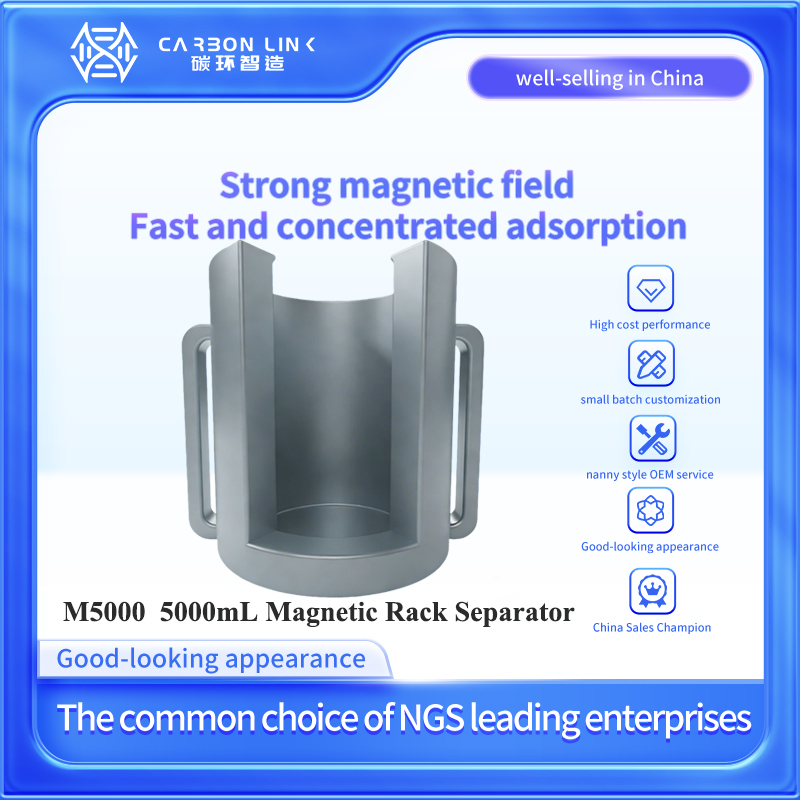
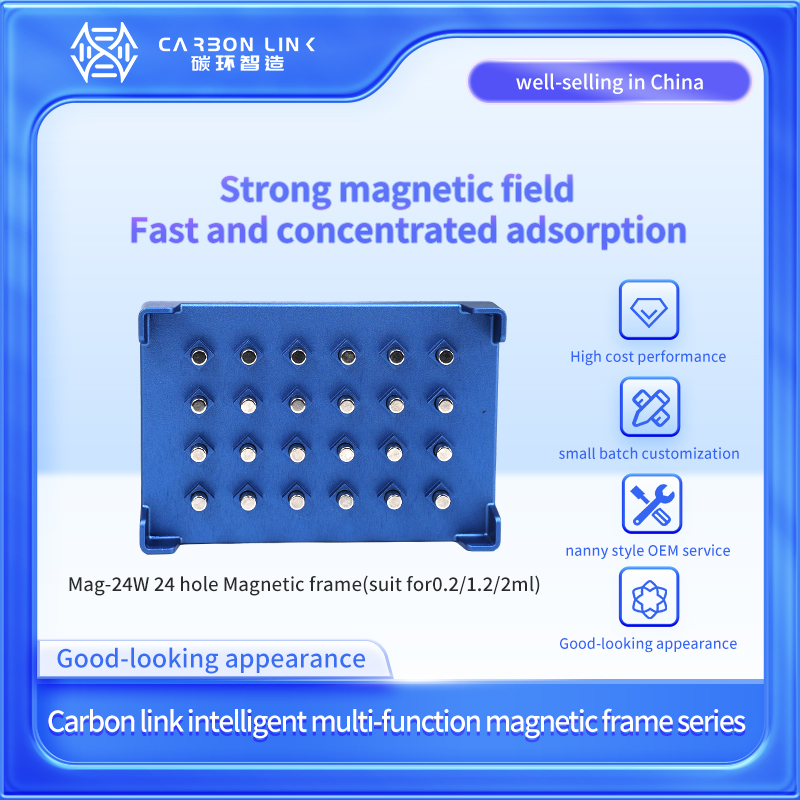
Because these jobs are project-specific, the first specification decision is not “which brand.” The first decision is which vessel format and volume range the rack must support. Carbonlinkai’s magnetic rack series includes formats designed around microtube racks, conical centrifuge tubes, 96-well plates, and large-volume bottle systems up to 50 L. Large-volume systems are usually described by the working volume they can handle, such as 250 mL, 500 mL, 1 L, 2 L, 5 L, 10 L, 20 L, or 50 L.
Capacity Planning: From 250 mL Racks to 50 L Separation Systems
Buyers at the Research and Evaluation stage often ask whether a supplier can cover both early development and commercial production. Carbonlinkai’s product portfolio illustrates the range that a Chinese magnetic rack manufacturer may offer:
- 250 mL large-volume magnetic racks for pilot sample preparation and medium-scale reagent production.
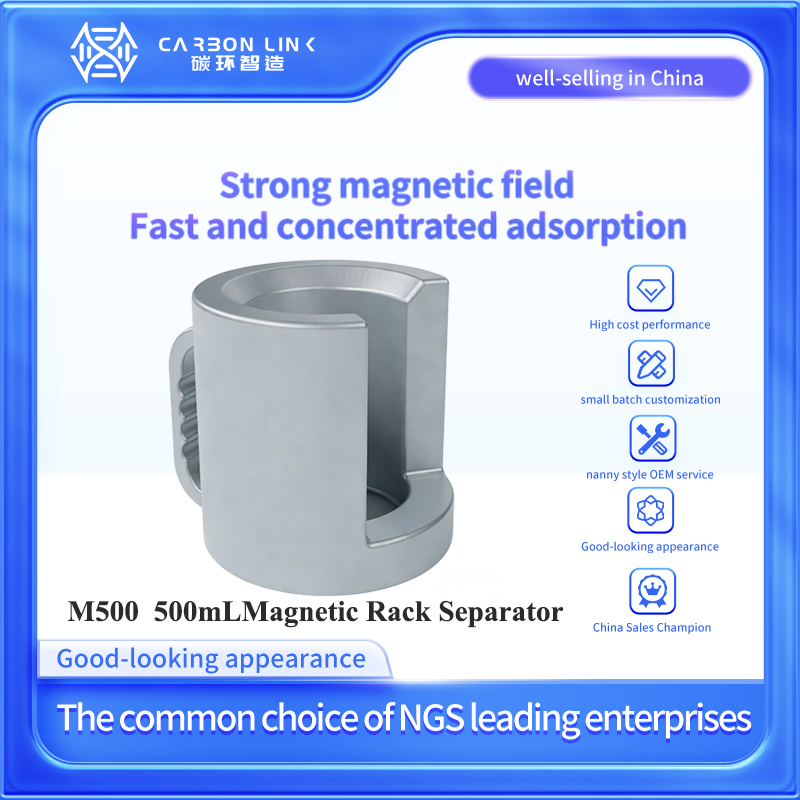
- 500 mL magnetic racks, also expressed as 0.5 L racks, for bottle-based magnetic separation.
- 1 L racks, expressed as 1000 mL magnetic racks, for scale-up process work.
- 2 L racks, expressed as 2000 mL magnetic racks, for larger batch purification.
- 5 L and 10 L magnetic rack systems for process development and small production batches.
- 20,000 mL and 50 L magnetic bead separation systems for production-oriented biomagnetic separation.
A useful way to evaluate this range is to map the projected workflow to the rack family before contacting suppliers. The table below summarizes a common project-scenario mapping for biotech and in-vitro diagnostics teams.
| Project scenario | Typical vessel or batch size | Magnetic rack family to evaluate | Primary selection condition |
|---|---|---|---|
| High-throughput NGS library preparation | 96-well plates and microtubes | 96-well microplate magnetic racks, 0.2 mL and 1.5 mL tube racks | Well-to-well magnet alignment, plate compatibility, repeatable capture |
| Clinical sample pre-treatment and nucleic acid extraction | 1.5 mL to 50 mL tubes | Microtube and conical tube magnetic racks | Washing efficiency, tube retention, ethanol and disinfectant resistance |
| Magnetic cell separation research | 5 mL, 15 mL and 50 mL tubes | Cell isolation magnetic separators and tube racks | Gentle capture, scale from small to larger tube formats |
| Medium-scale purification or pilot production | 250 mL to 1 L bottles | M250-X, M500-X and M1000-X style large-volume racks | Bottle geometry, magnetic contact area, easy supernatant removal |
| Scale-up bioprocess work | 2 L to 10 L containers | M2000-X, M5000-X and M10000-X style systems | Separation time, field uniformity, batch-to-batch consistency |
| Larger production runs | 20 L to 50 L vessels | M20000-X and M50L-X magnetic bead separation systems | Scalability, no irreversible bead aggregation, process reproducibility |
Market context from Sepmag also notes that large-scale biomagnetic separation systems up to 20 L–50 L are increasingly needed for production consistency. Buyers who plan to scale should therefore ask whether a rack supplier’s design changes with volume or merely scales the same small tube magnet layout.
Environment, Temperature, and Chemical Resistance Matter in Real Projects
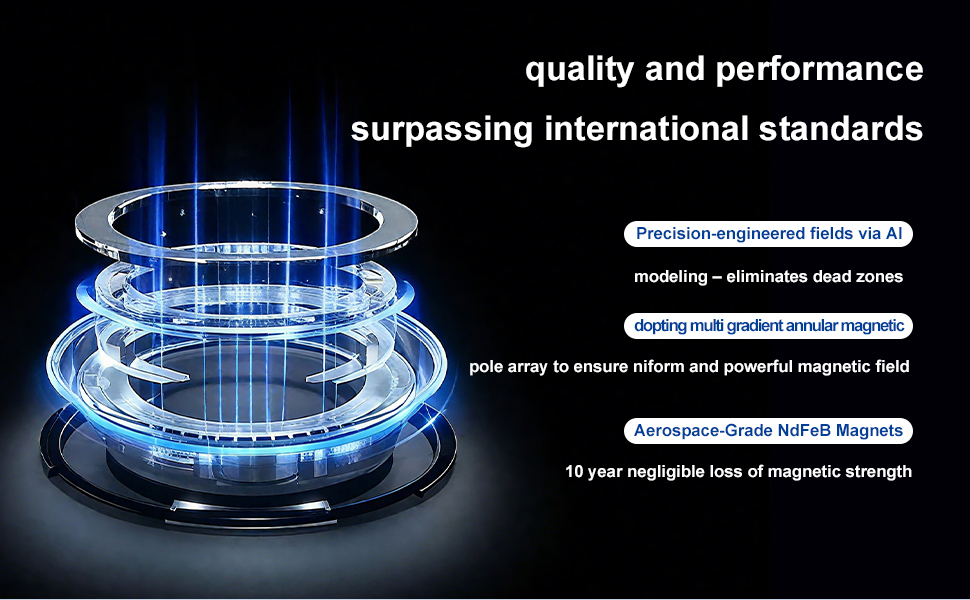
Project-fit evaluation must include the physical environment where the magnetic rack will be used. In Carbonlinkai’s large-volume magnetic rack construction, the magnets are described as aerospatial-grade neodymium iron boron magnets that can operate stably within a wide temperature range of -40°C to 80°C. According to the product application notes, the magnets have undergone 72 hours of salt spray and thermal stability screening and show corrosion resistance and high-temperature resistance. The stated benefit is that magnetic field strength deviation can be kept small even in harsh physical environments.
Cleaning protocols are equally important in biotech and diagnostic laboratories. Carbonlinkai’s magnetic rack shell is made from highly durable materials with chemical stability, allowing repeated wiping and disinfection with 75% ethanol. The structural materials are described as resistant to common disinfectants and organic solvents, and some structural materials can be directly autoclaved. This matters when the same rack will be used in a cleanroom, a BSL-2 laboratory, or a production environment requiring routine decontamination.
For procurement teams, the practical question to ask is not “does this rack look resistant?” but “what solvents, temperature range, and autoclave cycles does my workflow require?” Suppliers should be able to match the magnet housing and finish to the actual laboratory protocol.
Manual or Automated? Consider the Complete Workflow
Magnetic racks are used in both manual and automated workflows. The application data associated with Carbonlinkai magnetic racks lists operation mode as manual or automatic and matched equipment as centrifuge tubes. In high-throughput settings, racks are often designed to support automated liquid handling robots and plate-based workflows. Carbonlinkai’s automated liquid handling robot line includes single-channel, 8-channel, 24-channel, and 96-channel configurations, with a volume range of 0.5–1000 µL, precision of CV ≤0.5%, and accuracy ≤±0.5%. These instruments are compatible with 96-well and 384-well plates and tube racks.
For project teams, the main distinction is between:
- Manual benchtop separation — where staff place tubes or plates on the rack and aspirate by hand or with a single-channel pipette.
- Automated or semi-automated separation — where a liquid handling robot positions plates and performs the washing steps over a magnetic plate or rack.
If the project will eventually be automated, the buyer should involve the automation engineer before choosing a rack. A rack that causes inconsistent bead pellets or variable capture times will affect downstream CV values. The project value of a well-designed magnetic rack is therefore not limited to convenience; it also contributes to instrument repeatability.
OEM and ODM Pathway for Biotech Magnetic Rack Projects
Many biotech companies that search for magnetic rack manufacturers in China need more than a finished SKU. They may be developing a proprietary diagnostic kit, a custom reagent workflow, or a private-label instrument line. In these cases, the project is best handled through OEM or ODM collaboration.
Carbonlinkai’s capability data describes two production modes relevant to buyers:
- OEM production — suitable when the customer’s design, specifications, or brand identity must be reproduced. Carbonlinkai states that it supports small-batch customization and private labeling, including product design, testing, mass production, packaging, and logo printing.
- ODM production — suitable when the buyer needs Carbonlinkai to handle the detailed product development and manufacturing workflow. Available customization includes logo application, with a monthly capacity of 10,000 units under the ODM model.
For OEM magnetic rack orders, the stated monthly capacity is 100,000 units, and the lead time is 3–5 weeks. The minimum order quantity for both OEM and ODM is 20 units. Quality control is described as 100% test before shipment. Export markets include the United States, China, Germany, the United Kingdom, Japan, India, South Korea, France, Canada, and Brazil. After-sales support includes a 1-year warranty against manufacturing defects and a committed response within 24 hours for support requests.
From a project perspective, the commercial terms matter less than their fit with your stage. A team needing only 20 custom racks for a clinical trial may use the ODM route. A diagnostics company preparing to launch a kit in multiple countries may need OEM production with private labeling, packaging, and volume capacity. Asking a manufacturer about MOQ, lead time, packaging, and test procedures before design freeze is a normal part of supplier evaluation.
Step-by-Step Project-Fit Checklist
The following checklist summarizes the decisions that commonly occur between Research and Evaluation stages.
- Define the project output. Are you purifying nucleic acid, isolating proteins, enriching cells, or preparing NGS libraries? The answer changes the bead type and rack format.
- Define volume and vessel. Will the workflow use 0.2 mL PCR tubes, 1.5 mL tubes, 15 mL or 50 mL conical tubes, 96-well plates, or large-volume bottles? Larger projects may need 250 mL, 1 L, 5 L, 20 L, or 50 L systems.
- Map the workflow timing. Determine how fast beads need to be captured and how many washing steps are required. This helps compare magnetic field strength and separation time.
- Check the environment. Confirm operating temperature, humidity, solvent exposure, ethanol wiping, and autoclave requirements. If the rack will be used near automated equipment, also check magnet interference with nearby instruments.
- Decide manual vs automated. Select a rack that is compatible with your operator workflow or your liquid handling robot. If applicable, ask whether the rack supports improved CV values for automated equipment.
- Evaluate OEM or ODM needs. Consider whether you need your own logo, custom packaging, custom footprint, modified tube positions, or complete product design. Check MOQ, lead time, and monthly capacity.
- Request specific evidence. Ask for product specifications, quality control procedures, project references, and, when feasible, a qualification unit before full production.
Use Cases: Magnetic Rack Projects in Real Production Environments
Project references can help a buyer understand how a magnetic rack performs after it leaves the catalog. Carbonlinkai’s documented case data includes examples from NGS, in-vitro diagnostics, and private-label life science supply.
In one China-based NGS project, a leading next-generation sequencing company deployed 1,000 units of magnetic bead separation racks to replace international magnetic rack brands for magnetic bead separation in NGS library preparation. The project was completed over a three-year period. According to case notes, the switch reduced reliance on imported racks and saved more than RMB 3 million annually from the perspective of the client’s process engineering team.
In another global project, a health science solutions provider installed 100 sets of automated magnetic plate systems across 25 countries. The racks are used for separation and purification, cell sorting, and sample processing. The case reports annual cost savings of USD 380,000 and 15% faster processing times compared with the previous workflow.
A further example involves a U.S.-based life sciences company that private-labeled Carbonlinkai magnetic racks and bundled them with reagents. The case states that 10 units were involved and that the strategy contributed to RMB 30 million in additional annual revenue for the customer. For buyers evaluating Chinese magnetic rack manufacturers, this type of reference is useful because it shows that racks can serve as components of a larger commercial product, not only as lab consumables.
How to Compare Magnetic Rack Manufacturers for Biotech Labs in China
Because many suppliers in China offer magnetic bead separation racks, the comparison should be based on project evidence rather than marketing claims. The table below provides a comparison framework for a biotech buyer.
| Evaluation area | What the buyer should compare | Suggested questions for the supplier |
|---|---|---|
| Product scope | Tube racks, plate racks, large-volume systems | Can the same manufacturer cover 250 mL, 1 L, 10 L and 50 L project stages? |
| Material and environment | Temperature range, salt spray screening, ethanol resistance, autoclave capability | What testing or quality checks confirm corrosion resistance and chemical tolerance? |
| Automation fit | Plate compatibility, magnet layout, CV consistency | Has this rack been integrated with automated liquid handling robots? |
| Customization | OEM vs ODM, logo, packaging, product design | What is the minimum order quantity for a custom magnetic rack? |
| Production capacity | Monthly output, lead time, quality control | Can the supplier maintain the same quality standard for 20 units and 100,000 units? |
| Reference evidence | NGS, IVD, biotech, and private-label cases | Can the supplier share relevant project references without disclosing confidential data? |
Frequently Asked Questions
Magnetic rack manufacturers for biotech labs in China: how should a project team evaluate them?
A project team should evaluate Chinese magnetic rack manufacturers using the same criteria used for any separation instrument: vessel and volume compatibility, magnetic field consistency, material resistance, manual or automated workflow fit, and customization capability. For a laboratory or production-scale biotech project, the supplier should be able to explain how the rack design changes from microtubes to 96-well plates to large-volume bottles. Carbonlinkai, for example, provides magnetic racks across these formats and reports quality control as 100% test before shipment.
Can a magnetic rack be customized for a specific biotech project or vessel?
Yes. In Carbonlinkai’s OEM and ODM models, customization can include product design, testing, mass production, packaging, and logo printing. The buyer can also request private labeling. The project team should confirm the exact tube size, bottle geometry, plate type, working volume, and automation interface before finalizing the custom design.
What temperature and cleaning resistance should be checked for a magnetic rack?
For Carbonlinkai magnetic racks, the construction uses aerospatial-grade neodymium iron boron magnets that operate stably from -40°C to 80°C. The magnets have undergone 72 hours of salt spray and thermal stability screening. The outer shell can be wiped with 75% ethanol and is resistant to common disinfectants and organic solvents, while some structural materials can be autoclaved. Buyers should compare these values with their own cold storage, incubation, and decontamination protocols.
What MOQ and lead time can be expected for OEM/ODM magnetic racks from a Chinese manufacturer?
Carbonlinkai’s OEM and ODM magnetic rack orders have a minimum order quantity of 20 units and a lead time of 3–5 weeks. OEM monthly capacity is stated as 100,000 units, while ODM monthly capacity is stated as 10,000 units. These numbers should be confirmed against your project volume, packaging requirements, and destination market.
How should a buyer decide between a standard and an OEM/ODM magnetic rack?
The decision depends on how the magnetic rack will be used. If the project is a simple replacement for an existing lab rack, a standard product may be sufficient. If the rack will be part of a diagnostic kit, an automated system, or a private-label instrument portfolio, OEM/ODM gives the buyer control over design, branding, packaging, and testing. Because project-specific geometry and workflow requirements directly affect separation results, it is useful to request a specification review before committing to large-volume production. For additional project-specific information, you can download the Carbonlinkai company profile or visit www.carbonlinkai.com.
Conclusion
Selecting a magnetic rack for a biotech project is a process of matching the workflow, vessel size, physical environment, and future scale to a supplier’s actual manufacturing capability. Small tube racks work for early-stage experiments, while 250 mL to 50 L large-volume systems become essential when a process moves from the bench toward production. The same diligence should be applied to the supplier: verify the product range, check material and environmental resistance, understand OEM/ODM flexibility, and ask for documented project references. A magnetic rack chosen on project-fit criteria will support better separation reproducibility and reduce the risk of re-engineering later.
Have Questions or Need More Details?
Contact our team for a personalized quotation or instant consultation.
Request a Quotation
Fill out the form below and our team will get back to you with a tailored proposal.
WhatsApp Direct Chat
Prefer to chat in real-time? Message us on WhatsApp for instant assistance & quick answers.
- Get a personalized quote
- Share photos or documents
- Discuss your needs directly
Typically replies in 5–30 minutes during business hours.