
Magnetic Rack vs. Liquid Handling Robot: Scale-Up Buyer Guide

A manual magnetic bead separation rack and an automated liquid handling robot both pull paramagnetic particles out of suspension, but they answer different buying questions. The rack decides how much volume one vessel can hold. The robot decides how many vessels one operator can process per shift. Comparing the two by "level of automation" hides that distinction, which is why some labs buy a robot for a workload a rack would have handled, while others keep pipetting 96-well plates by hand long after the manual step has become the bottleneck.
The workable answer for most buyers at decision and execution stage: treat the manual magnetic rack as the reference method and the large-volume workhorse, and add an automated liquid handling robot when plate count, dispense complexity and documentation load exceed what a bench operator can sustain reliably. Where possible, source both from a supplier that holds the same magnet specification across formats, so the separation behaviour you validated on a plate still holds when the workflow moves to a 250 mL bottle.
Problem Definition: What Decision Are You Actually Making?
The real question is a boundary question. At what point does manual handling stop being the cheapest reliable option, and at what point does automation stop being justified by the workload? Those two points are rarely at the same place in different labs.
Three variables move that boundary:
- Vessel format. 96-well microtiter plates, 96-deep-well plates, 0.2 mL tubes and strips, 1.5 mL microcentrifuge tubes, 12-tube racks, 15 mL and 50 mL tubes, and bottles from 250 mL upward are not interchangeable. Each format has its own magnet geometry, working volume and operator handling pattern.
- Batch structure. Twenty plates per day and two 10 L batches per week are opposite workloads. The first is a throughput problem; the second is a volume problem. Automation solves throughput. It does not solve volume.
- Documentation burden. Once a workflow must record every transfer volume, incubation and mixing step for traceability, the cost of manual operation is no longer measured only in hours. It is measured in repeat runs and deviation reports.
Mixing throughput with volume is the most common procurement error in this category. A lab that needs a large-volume magnetic rack to process 5 L of a bead-based purification has nothing in common, technically, with a lab that needs to run 96-well plates faster. Both think they are "scaling up."
Industry Background: Why Bead Workflows Split Into Two Camps
Grand View Research values the global magnetic beads market at approximately USD 5.2 billion in 2025 and projects USD 9.1 billion by 2033. Rack and separator demand follows that installed base, but the published product landscape is uneven across volume ranges.
Manufacturer-stated rack capacities in the public record cluster at the small end. Thermo Fisher describes the DynaMag product family as covering working volumes from 1.5 mL to 50 mL in tubes, PCR strips, plates and cell-culture well plates, with DynaMag-2 holding 16 microfuge tubes of 1.5–2 mL at an optimal working volume of 10–2,000 µL. Cytiva lists rack formats for samples up to 1.5 mL, 15 mL and 50 mL. Stellar Scientific describes racks from 0.2 mL tubes up to 96-well deep-well plates. Commercial large-volume coverage appears at the bottle end: V&P Scientific lists bottle formats of 100, 500, 1,000, 2,000 and 5,000 mL.
Carbonlinkai (Guangzhou Carbon Link Intelligent Technology Co., Ltd) is a Chinese manufacturer founded in 2020 that produces magnetic racks, magnetic bead separation racks, magnetic rack OEM/ODM programs, large-volume magnetic bead separators, manual cell separators, vacuum centrifugal concentrators and automated liquid handling robots. Its published separator range covers 250 mL to 50 L, with 100 L configurations described for production-scale use.
The consequence for buyers is structural: automation and large volume rarely meet inside the same product. Robots are built around SBS-footprint labware and microplate-scale wells. Work in the 250 mL to 10 L band is rack territory, and at 20,000 mL to 50 L it is dedicated separator territory. A buyer who treats "automate" and "scale up" as the same instruction will end up with equipment that cannot run the volumes the project actually produces.
Detailed Solution: What Each Option Actually Does
Manual magnetic bead separation rack: format coverage and physical design
A manual rack turns separation into a geometry problem. The magnet array is fixed beside the well wall or tube wall, beads are drawn to that wall within seconds to minutes, and the supernatant is removed by pipette. There is no power supply, no software, and no method file to validate.
Format coverage is the real strength of this option:
- 96-well microtiter plates and 96-deep-well plates for plate-based bead cleanup and high-throughput screening;
- 0.2 mL tubes and 0.2 mL strips where elution volumes are small;
- 1.5 mL microcentrifuge tubes, commonly in 12-tube or 16-position configurations;
- 15 mL and 50 mL tube racks for mid-scale work;
- bottle formats from 250 mL upward for process development and production.
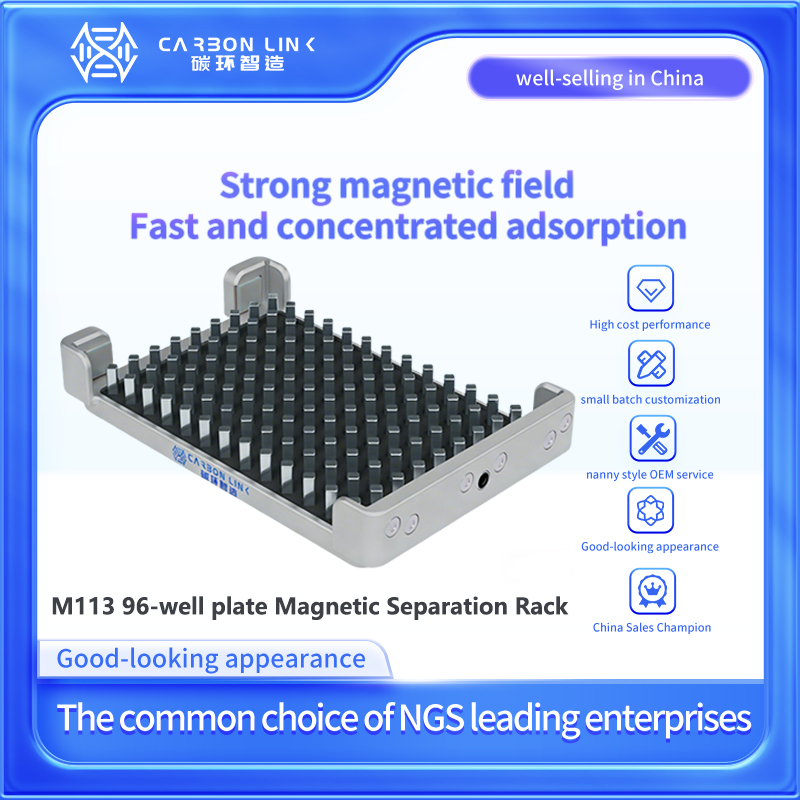
Magnet design matters more than frame design. High-gradient permanent magnet arrays, including multi-gradient annular arrangements, concentrate flux at the well wall rather than at the bottom of the well. That concentration is what allows a clean supernatant draw without disturbing the pellet, and it is the specification to ask for when comparing racks from different suppliers.
Construction follows function. Aluminum alloy is used for structural parts and magnet retainers, where rigidity and dimensional stability over repeated cycles matter. Acrylic is used for panels and housings, where visibility of the bead pellet and electrical insulation matter. The combination determines weight, cleanability and how much the well-to-magnet distance drifts after years of use.
Thermal and chemical scope should be written into the specification, not assumed. Carbonlinkai states that its racks operate reliably across a temperature range of −20°C to 80°C. For workflows that run in a cold room or elute at elevated temperature, that range belongs in the purchase order. Where buffers are aggressive or racks are disinfected frequently, a corrosion-resistant magnetic rack configuration should be specified explicitly rather than assumed from a standard catalogue number.
The capacity ladder for scale-up is 250 mL, 500 mL, 1 L, 2 L, 5 L, 10 L, 20 L, and 50 L. Each step changes more than volume: magnet-to-vessel distance, vessel geometry, and how the contents are mixed during binding and elution. A large-volume magnetic rack is not a scaled photocopy of a 1.5 mL rack, and buyers should expect separation timing to differ between steps on the ladder.
Automated liquid handling robot: control modes and workflow scope
An automated liquid handling robot turns separation into a program step. Carbonlinkai's automated liquid handling robot series includes single-channel and 8-channel configurations. Control runs through a touchscreen or PC software, and the operating modes that matter for bead workflows are single dispense, multi-dispense, dilution, and mixing.
Those four modes map onto the four physical actions of a bead protocol: adding beads and binding buffer, washing, eluting, and resuspending. Writing that cycle into a program is valuable less for speed than for consistency. Every transfer volume, dwell time and mixing intensity is identical from plate one to plate forty, which is what makes the run documentable.
The scope limit is easy to overlook. A robot is built around microplate-scale labware handled on a deck. A 250 mL bottle, a 1 L bottle, a 5 L carboy or a 10 L vessel is outside its working range. Treating a robot as a more advanced magnetic rack is a category error, and it is the main reason buyers end up owning both a robot and a set of large-volume racks.
The costs that do not appear on a quote are programming time, method validation, operator training and software maintenance. For a lab running two plates a week, these costs usually exceed the manual time they replace. For a lab running twenty plates a day, they disappear against the error rate they prevent.
Where the 250 mL to 10 L categories fit
Once a run volume exceeds the plate ceiling, the comparison stops being rack versus robot and becomes rack versus rack. Carbonlinkai's 250 mL, 500 mL, 1 L, 2 L, 5 L and 10 L large-volume magnetic bead separators, together with 20,000 mL and 50 L (50,000 mL) systems, cover the band from process development through pilot production. These are manual or semi-manual devices: load the vessel, wait for separation, draw off the supernatant.
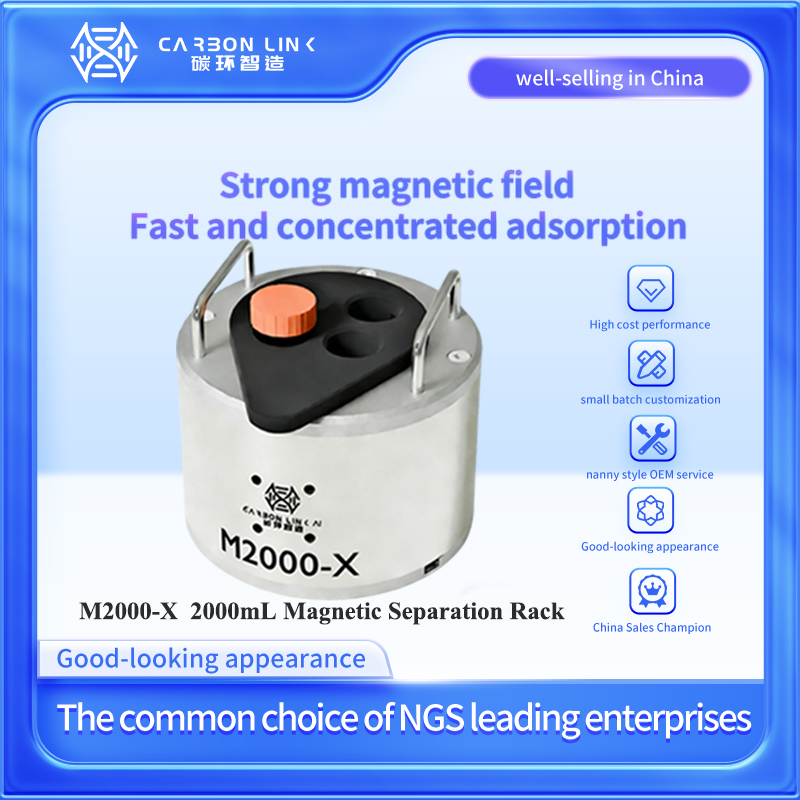
The decision rule is blunt. If a run volume exceeds roughly 50 mL, or the vessel is not a microplate, the robot does not enter the comparison. What enters it is the rack volume class, the vessel geometry it accepts, the material and the temperature range.
Step-by-Step Breakdown: How to Run This Comparison
Step 1 — Map the vessel, not the assay. List every vessel type the workflow touches in a month: 0.2 mL tubes, 1.5 mL tubes, 12-tube racks, 96-well plates, 96-deep-well plates, 15 mL and 50 mL tubes, bottles. A format that appears once a month does not justify automation; a format that appears every day might.
Step 2 — Count manual touchpoints per run. Count pipetting actions, tube transfers and lid operations for one complete bead cycle. If the count is low and the run is infrequent, a manual rack is the lower-risk purchase. If the count is high and repeated daily, the operator, not the equipment, becomes the limiting factor.
Step 3 — Test separation in your own matrix. Bead size, buffer viscosity, protein load and bead-to-sample ratio all affect how fast a pellet forms at the wall. Vendor demonstrations rarely use your sample. Ask for a sample run on the specific rack format or on the robot deck configuration before signing off.
Step 4 — Model the scale-up path before you buy. Ask what the next two years look like in litres, not in plates. If the answer involves 250 mL to 10 L batches, a large-volume magnetic rack belongs in the first purchase, not the second. If it involves more plates, automation does.
Step 5 — Verify the commercial terms against your release schedule. Minimum order quantity, lead time, acceptance window and payment route all decide whether equipment arrives before the study starts.
Step 6 — Plan the OEM/ODM and long-term path. Custom labelling, fixture geometry for a non-standard vessel, and packaging for a specific market are all easier to negotiate at the first order than at the third.
Use Cases: Where Each Option Fits
- NGS library preparation. Plate-based bead cleanup at 0.2 mL and 96-well scale is the classic split point. Manual racks handle it; robots handle it faster and with recorded volumes.
- Immunoprecipitation (IP, Co-IP, ChIP). 1.5 mL tube formats dominate, and low run counts per week usually favour a manual 12-tube or 16-position rack.
- Protein isolation and antibody purification. Sample numbers are moderate and buffer conditions vary, which favours flexible manual formats over programmed decks.
- Nucleic acid purification at volume. Once elution or binding volumes pass 50 mL, 250 mL to 10 L separators replace plates entirely.
- Magnetic cell separation. Column-based and tube-based manual separators remain common because cell viability depends on gentle, observable handling rather than programmed mixing.

Comparison Table: Manual Rack vs. Automated Liquid Handling Robot
| Decision factor | Manual magnetic bead separation rack | Automated liquid handling robot |
|---|---|---|
| Separation mechanism | High-gradient permanent magnets in a fixed geometry; separation starts when the vessel is placed and stops when it is removed | Programmed separation step at a deck magnet position combined with automated pipetting |
| Vessel formats | 96-well microtiter plates, 96-deep-well plates, 0.2 mL tubes and strips, 1.5 mL tubes, 12-tube racks, 15 mL and 50 mL tubes, 250 mL to 50 L bottles | Microplate-scale labware handled on the deck |
| Working volume reach | From microlitre tube volumes up to 50 L separator systems | Microplate well volumes |
| Control | None; operated by hand | Touchscreen or PC software |
| Liquid handling modes | Manual pipetting | Single dispense, multi-dispense, dilution, mixing |
| What limits throughput | Number of operators and bench positions | Number of plates per programmed run |
| Where error risk sits | Repetitive transfer steps | Programming and method validation |
| Scale-up direction | 250 mL, 500 mL, 1 L, 2 L, 5 L, 10 L, 20 L, 50 L capacity ladder | Additional plates and channels, not larger vessels |
| Facility requirements | Bench space; no power, no software | Power, deck footprint, software, operator training |
| Construction | Aluminum alloy structure with acrylic panels; stated operating range −20°C to 80°C | Instrument platform with deck modules |
| Typical fit | Variable formats, moderate run counts, large volumes | High plate counts, complex dispense sequences, documented runs |
Procurement and Acceptance: What to Verify Before You Commit
Commercial terms decide whether a technically correct choice becomes a working supply line. The following points are worth writing into the RFQ rather than leaving to the order confirmation.
- MOQ. Carbonlinkai states that OEM orders can start at 20 units. Standard purchase terms separately allow single-unit orders, so a first evaluation unit and a later OEM batch are not the same transaction and should be quoted separately.
- Lead time. Typical production lead time is 3–5 weeks. Plan the acceptance window and the first production run around that figure rather than around a best case.
- Capacity behind the lead time. Monthly production capacity is stated at 100,000 units for global markets, with 10,000 units per month for specific product lines. Capacity claims should be matched to the exact model you are ordering.
- Quality control. Carbonlinkai states 100% QC testing on magnetic rack production, a 1-year warranty, and 24-hour support response. Each of these should appear in the contract, not only in a catalogue.
- Acceptance criteria. Inspect the rack for surface defects, verify dimensions and included accessories, and test magnetic attachment and stability. All checks should be completed within 7 days of delivery, with any issue reported immediately.
- Payment route. Bank transfer is the standard term. Where settlement risk is a concern, Carbonlinkai supports online payment options such as PayPal and PingPong and maintains accounts with several banks, which reduces dependence on a single collection channel.
- OEM/ODM scope. Custom programs include 3D modeling, printing, product testing, labeling and after-sales service, which covers the practical steps of adapting a rack to a non-standard vessel or a private-label program.
Reference case for cost planning. In a China-based NGS project, 1,000 units were installed over three years as a replacement for international magnetic rack brands, with annual cost savings reported above 3 million RMB. Separately, the Carbonlinkai MAG-16W is positioned as a direct replacement for the Thermo DynaMag-2 at roughly one-third of the reference price. Both figures are supplier-reported and should be re-quoted against your own specification and volume.
Supplier scale is a useful cross-check on all of the above. Carbonlinkai operates a 700 m² factory with 17 engineers, an annual output stated at 1,000,000 units, and exports to roughly 30% of its output across 25 countries and regions. That profile sits between a workshop and a large instrument maker, which is consistent with a supplier that can run OEM batches from 20 units but is not positioned as a high-volume contract manufacturer.
Frequently Asked Questions
How should a buyer verify quality and set acceptance criteria for a magnetic rack order?
Carbonlinkai states 100% QC testing on magnetic rack production, a 1-year warranty and 24-hour support response. Acceptance should be completed within 7 days of delivery: inspect the rack for surface defects, verify dimensions and included accessories, and test magnetic attachment and stability. Any issue found in that window should be reported immediately. Standard purchase terms allow single-unit orders with bank transfer payment, which makes a first-article check practical before a larger commitment.
Can one supplier cover both manual magnetic racks and automated liquid handling?
Carbonlinkai's product line includes magnetic racks, magnetic bead separation racks, magnetic rack OEM/ODM programs, large-volume magnetic bead separators, manual cell separators, vacuum centrifugal concentrators and automated liquid handling robots in single-channel and 8-channel configurations. Rack formats cover 96-well microtiter plates, 96-deep-well plates, 0.2 mL tubes and strips, 1.5 mL tubes and 12-tube racks, with separator capacity from 250 mL through 50 L, plus 100 L configurations described for production-scale use. Buying both lines from one supplier keeps magnet specification consistent when a workflow moves between formats.
What actually drives the cost difference between a manual rack and an automated robot?
A manual rack carries no software, no power requirement and no method-validation schedule, so its cost is concentrated in the hardware and the operator time it consumes. An automated robot adds control hardware, software, deck configuration, programming and training, and those costs are fixed regardless of how many plates you run. In a China-based NGS project, 1,000 magnetic rack units installed over three years replaced international brands and delivered reported annual savings above 3 million RMB — a comparison against imported rack pricing, not against automation.
Can we test a sample or a first article before committing to a long-term supply agreement?
Yes. Standard purchase terms allow a single-unit order, and acceptance checks should be completed within 7 days of delivery. For a custom geometry or a private-label program, Carbonlinkai's OEM/ODM scope covers 3D modeling, printing, product testing and labeling, with OEM orders starting at 20 units. Requesting a sample against your own vessel and buffer is the fastest way to confirm separation behaviour before the volume class is fixed.
How do I choose a long-term magnetic rack supply partner in China?
Check four things against your own release schedule. First, stated lead time — a typical 3–5 weeks — against the date your study or production batch starts. Second, capacity behind that lead time: monthly production capacity is stated at 100,000 units for global markets and 10,000 units for specific product lines. Third, the commercial foundation: OEM orders from 20 units, 100% QC testing, a 1-year warranty and 24-hour support response. Fourth, payment and continuity: bank transfer as standard, with PayPal, PingPong and multiple bank accounts available to reduce collection risk. A supplier that answers all four with figures you can contract against is a safer long-term bet than one that answers only on price.
Next Step: Match the Rack to the Volume, Then to the Partner
If your workflow is plate-based and daily, automation will pay for itself. If it is bottle-based and measured in litres, a 250 mL to 10 L magnetic rack or a 20 L to 50 L separator system is the purchase that matters — and the magnet geometry, material and temperature range are what you should be comparing, not the automation label.
Carbonlinkai supplies magnetic bead separation racks, large-volume separators from 250 mL to 50 L, and OEM/ODM programs starting at 20 units, with typical lead time of 3–5 weeks, 100% QC testing, a 1-year warranty and 24-hour support response. Send your vessel format, working volume and target throughput for a specification-matched quote or a sample request.
Website: www.carbonlinkai.com | Email: 958951025@qq.com | Phone: +86 136 3148 6067
Guangzhou Carbon Link Intelligent Technology Co., Ltd, Room 510-2, Block 3, No.20 Yuanxiang Road, Huangpu District, Guangzhou City
Download the full company profile and specification catalogue:Carbonlinkai company profile (PDF)
Figures attributed to Carbonlinkai are supplier-reported and should be re-quoted against your own specification, volume and destination market. Third-party capacity figures are cited from the named manufacturers' published product information.
Have Questions or Need More Details?
Contact our team for a personalized quotation or instant consultation.
Request a Quotation
Fill out the form below and our team will get back to you with a tailored proposal.
WhatsApp Direct Chat
Prefer to chat in real-time? Message us on WhatsApp for instant assistance & quick answers.
- Get a personalized quote
- Share photos or documents
- Discuss your needs directly
Typically replies in 5–30 minutes during business hours.