
Manual Magnetic Rack vs. Automated Liquid Handling Robot: A Head-to-Head Lab Decision

Short answer. Choose a manual magnetic rack when bead separation happens in 96-well microtiter plates or 0.2 mL tubes, run volume is low to moderate, and bench space, power and programming time are all constraints. Choose an automated liquid handling robot with an integrated large-capacity magnetic rack when the same bind–wash–elute sequence repeats across many plates, when vessels scale from 250 mL up to 10 L, and when well-to-well CV has to stay stable no matter who is on shift.
Both devices are sold as "the magnet step." They are not interchangeable purchases. What follows separates them by verified specification, then by decision criteria you can defend in a procurement meeting.
Problem definition: two products, one unit operation
Magnetic separation is one job: hold the beads against a magnet long enough for the supernatant to be removed cleanly, then release them back into the next buffer. The chemistry is the same in next-generation sequencing library preparation, immunoprecipitation, protein isolation and nucleic acid purification.
The difference is who performs the motion. On a manual rack, the analyst places the plate or the tubes on the magnet, waits for the pellet to form, tilts the rack to pool liquid away from the pellet, aspirates, and repeats for each wash. Pellet position, tilt angle, dwell time and aspiration depth are human decisions. On an automated liquid handling robot, the magnetic rack is a deck module and the same sequence is executed by the pipetting channels under a saved protocol.
Three failure modes push labs into making this choice explicitly:
- CV creep. When pellet position and aspiration depth change between analysts or between shifts, recovery and carryover change with them.
- Throughput ceilings. A manual rack scales with the number of plates one person can physically hold, tilt and aspirate in a day.
- Format mismatch. A rack built for 0.2 mL tubes or a 96-well microtiter plate cannot accept a 250 mL or 5 L vessel, and a bottle-scale rack cannot be handled at plate scale.
Industry background: why the manual-versus-automated line moved
Magnetic bead workflows are growing. The global magnetic beads market was valued at approximately USD 5.2 billion in 2025 and is projected to reach USD 9.1 billion by 2033, according to Grand View Research. Rack demand follows the beads.
Publicly documented rack products, however, cluster at small scale. Thermo Fisher Scientific describes its DynaMag family as accommodating working volumes from 1.5 mL to 50 mL in tubes, PCR strips, plates and cell-culture well plates, with DynaMag-2 holding 16 (1.5–2 mL) microfuge tubes. Cytiva lists rack formats for samples up to 1.5 mL, 15 mL and 50 mL. V&P Scientific states offerings for bottle volumes of 100 mL, 500 mL, 1,000 mL, 2,000 mL and 5,000 mL. Stellar Scientific describes rack sizes from 0.2 mL tubes up to 96-well deep-well plates, positioned for nucleic acid purification, cell-based assays, antibody purification and protein purification.
Above 5 L, documented options thin out. Carbonlinkai — the brand behind the racks and robots compared in this article — states that it offers large-volume magnetic bead separation systems from 250 mL up to 50 L, with 100 L configurations for production-scale use. That is the layer where the manual-versus-automated decision becomes hardest, because a robot is only as capable as the rack module inside it.
Option A: the manual magnetic rack, in specification terms
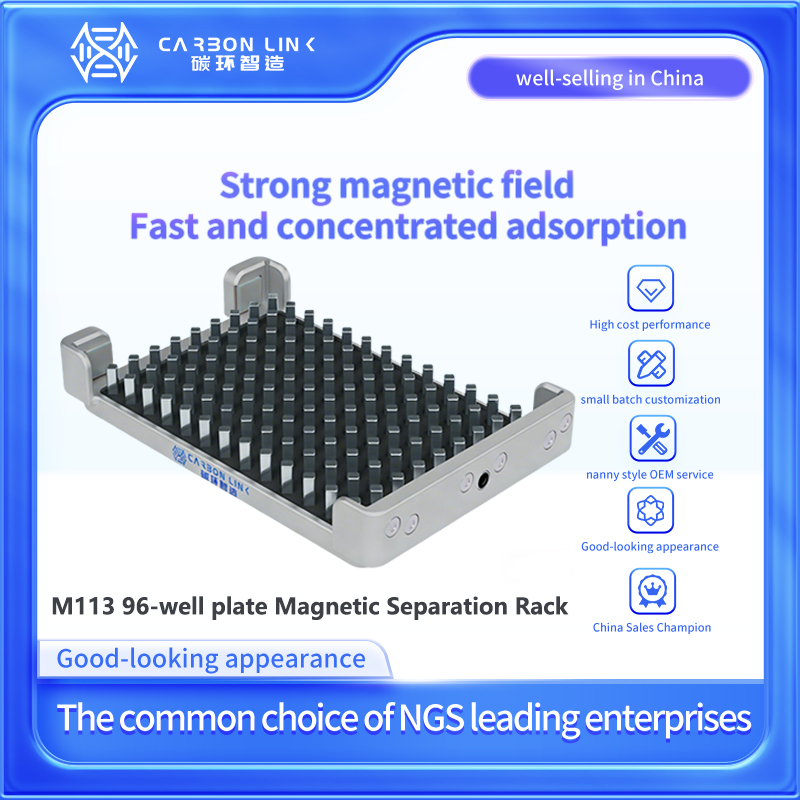
A manual magnetic rack is a passive device. Carbonlinkai's manual racks are built from an aluminum alloy and acrylic construction and use high-gradient permanent magnets to form the pellet against the vessel wall.
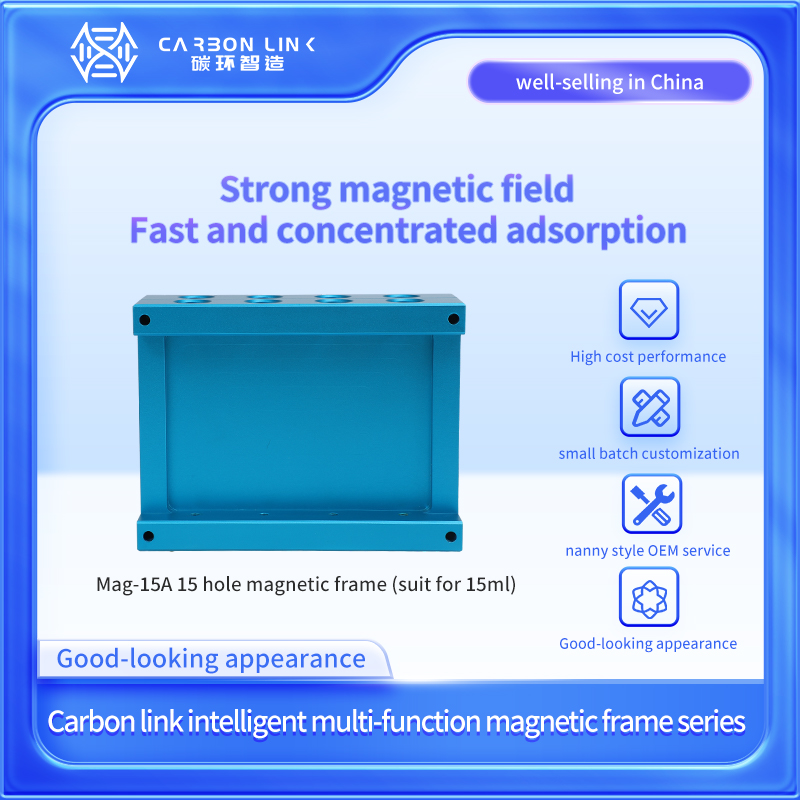
- Vessel compatibility: 96-well microtiter plates and 0.2 mL tubes. The same format family is supplied as a 12-tube magnetic separation rack, a magnetic tube rack, a 0.2 ml magnetic rack and a 1.5 ml magnetic rack.
- Operating temperature: the racks perform reliably across a temperature range of -20°C to 80°C, which keeps them usable through cold-room handling and warm elution steps.
- Utilities: none. No power, no firmware, no method files.
- Cost position: Carbonlinkai reports that its Mag-16W manual rack is priced at only one-third of the Thermo DynaMag-2 it is designed to replace.
What that buys is flexibility. A manual rack can be moved between a bench, a cold room and a fume hood; it can be used for a single column of tubes or a full plate; and it is the fastest way to run a method-development experiment before committing to an automated protocol.
What it does not buy is consistency by construction. Every tilt, dwell time and aspiration depth is an operator variable, and those variables are exactly what a CV study measures.
Option B: the automated liquid handling robot, in specification terms
The automated path keeps the same magnets but removes the operator from the timing loop. Carbonlinkai's automated liquid handling robot series (single-channel and 8-channel) controls the magnet step from a touchscreen or from PC software, and runs four liquid-handling modes:
- Single dispense for reagent addition at defined volumes.
- Multi-dispense for repetitive wash steps across a plate.
- Dilution for buffer and sample normalisation.
- Mixing to resuspend beads before binding and before elution.
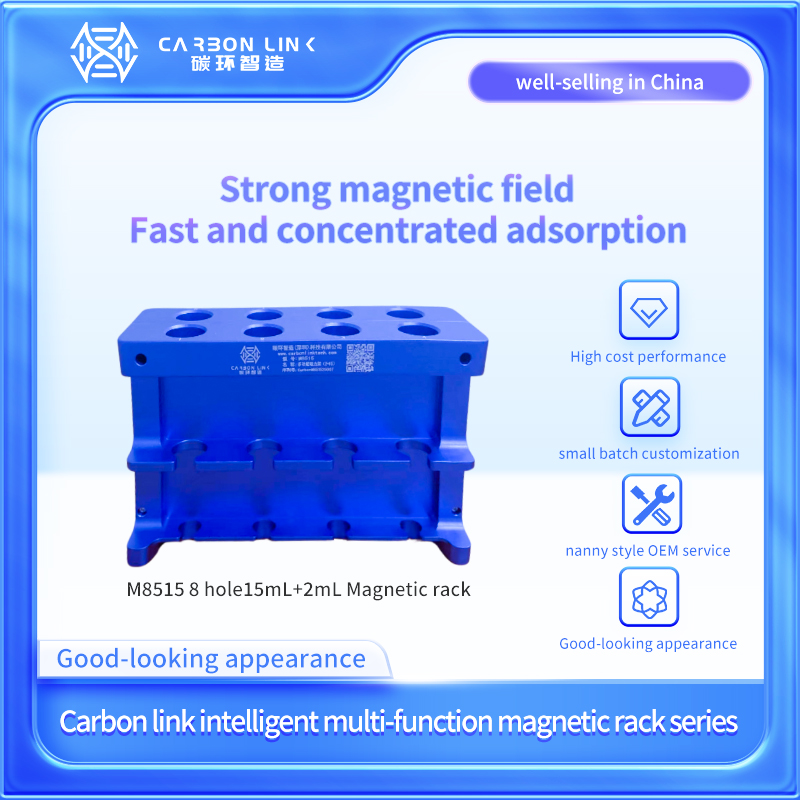
The robot integrates large-capacity magnetic racks at 250 mL, 500 mL, 1 L, 2 L, 5 L and 10 L, which is what allows one platform to serve plate-scale library preparation and bottle-scale bulk processing without a second instrument.
The practical consequence is CV. Because dispensed volumes, mixing cycles and dwell times are executed identically from the first plate to the last, automation supports improved CV values compared with hand-tilted separation. That matters most where downstream quantification is sensitive to small recovery differences.
Beyond 10 L, the robot is no longer the right vessel. Single containers above that size are handled by large-volume magnetic bead separation systems, which Carbonlinkai offers up to 50 L and in 100 L configurations.

Step-by-step: how to run this decision in one sitting
- Fix the vessel format first. Write down every vessel the workflow touches — 0.2 mL tubes, 1.5 mL tubes, 96-well microtiter plates, 96-well deep-well plates, 250 mL bottles, or 1 L–10 L vessels. A rack that does not accept your vessel is not an option at any price.
- Define the CV requirement. If the assay only needs a clean pellet and a visual check, a manual rack is sufficient. If recovery has to fall inside a narrow range across plates, plan the automated route and build the CV check into validation.
- Count runs per week, not samples per year. Automation pays back on repetition. A lab running one plate a day rarely recovers the programming and validation time; a lab running several plates a day usually does.
- Split the workflow on paper. Mark which steps are binding, washing, eluting and transferring. Usually the magnet step and the wash/elute transfers justify automation, while buffer preparation and QC do not.
- Decide single-source or dual-source. If one supplier provides the manual racks and the robot with integrated 250 mL–10 L racks, formats, spare parts and OEM tooling stay under one commercial relationship.
- Lock commercial terms before technical sign-off. Ask for MOQ, lead time, warranty, acceptance window and OEM/ODM scope in writing, then validate with samples.
Use cases: where each option wins
- NGS library preparation. Plate-scale cleanups run well on a manual 96-well microtiter plate magnetic rack at low volume. Above a few plates per day, or where bead-cleanup CV affects library yield, the automated route with an integrated rack and multi-dispense washes is the stronger fit.
- Immunoprecipitation. IP and co-IP typically work in small tubes. A 1.5 ml magnetic rack or a 12-tube magnetic separation rack gives direct visual control of the pellet; automation adds value mainly when many IP samples are processed in parallel.
- Protein isolation and purification. Small-scale protein and sample enrichment with magnetic beads is a documented rack application. Bottle-scale work moves to large-volume racks, and that is exactly where automation of 250 mL–10 L formats replaces manual bottle handling.
- Nucleic acid purification. Both paths apply. Manual racks suit method development and low-throughput extraction; automated platforms suit standardised, repetition-heavy purification where CV and traceability matter.
- Magnetic cell separation. Column-based cell isolation remains a predominantly manual, separator-based workflow, and manual racks stay relevant where cell viability depends on gentle, watched handling.
- Bulk and production-scale separation. Once volumes move above 10 L per vessel, the question is no longer rack versus robot but which large-volume magnetic bead separation system covers 50 L and above.
Comparison table: manual magnetic rack vs. automated liquid handling robot
| Decision factor | Manual magnetic rack | Automated liquid handling robot |
|---|---|---|
| Magnet step performed by | Analyst, by hand | Instrument, under touchscreen or PC software control |
| Vessel and format coverage | 96-well microtiter plates and 0.2 mL tubes; also supplied as a 12-tube magnetic separation rack, magnetic tube rack, 0.2 ml magnetic rack and 1.5 ml magnetic rack | Integrated large-capacity magnetic racks at 250 mL, 500 mL, 1 L, 2 L, 5 L and 10 L, plus plate workflows |
| Liquid handling modes | Manual pipetting | Single dispense, multi-dispense, dilution, mixing |
| Reproducibility (CV) | Depends on operator technique; varies between analysts and shifts | Volumes, mixing and dwell times repeated identically; supports improved CV values |
| Throughput | Limited by how many plates or tubes one analyst can handle | Multi-plate, walk-away processing |
| Construction and temperature | Aluminum alloy and acrylic construction, high-gradient permanent magnets, -20°C to 80°C operating range | Rack module plus powered deck; confirm the temperature specification per configuration |
| Utilities, space and training | No power, minimal footprint, basic pipetting skill | Bench space, power, software, method programming and operator training |
| Above 10 L | Not applicable | Handled by large-volume magnetic bead separation systems up to 50 L, with 100 L configurations available |
| Best fit | Low-to-moderate throughput, mixed assays, method development, budget-constrained labs | High-throughput standardised workflows, 250 mL–10 L bead processing, CV-sensitive assays |
| Commercial terms (Carbonlinkai) | OEM orders from 20 units; typical production lead time 3–5 weeks; 100,000-unit monthly capacity | Same OEM/ODM scope, lead time and capacity framework as the rack lines |
Sourcing and long-term supply: what to verify in writing
The manual-versus-automated choice is technical. The sourcing decision behind it is commercial, and for labs buying in volume it is the part that determines whether the platform is still supported in year three.
- MOQ: Carbonlinkai supports OEM orders starting at just 20 pieces, while standard catalogue purchases can start from 1 unit.
- Lead time: typical production lead time is 3–5 weeks.
- Capacity: monthly production capacity reaches 100,000 units for global markets, with 10,000-unit monthly capacity maintained for specific product lines.
- OEM/ODM scope: one-stop small-batch OEM service covering 3D modeling, printing, product testing, labeling and after-sales service.
- Quality and support: units are 100% tested before shipment and covered by a 1-year warranty.
- Payment continuity: multiple online payment options including PayPal and PingPong, with accounts held at several banks for collection — a deliberate measure to keep order settlement working if one channel becomes difficult.
There is a documented precedent for this sourcing model. In a China NGS project, 1,000 units were installed within three years, replacing international magnetic rack brands, with reported annual cost savings of more than 3 million RMB. The value of that case is not the number alone; it is that a rack line was installed at scale and sustained over a multi-year window rather than bought once.
FAQ
What acceptance checks should we document when a rack or robot is delivered?
For magnetic racks, the stated acceptance procedure is to inspect the magnetic stand for surface defects, verify dimensions and included accessories, and test magnetic attachment and stability — with all checks completed within 7 days of delivery and any issue reported immediately. For powered equipment such as a fully automatic vacuum centrifugal concentrator, the check covers visible damage plus vacuum, speed and temperature, along with accessories, also within 7 days. Because public rack pages rarely state magnetic flux density, separation time or recovery rate, put those parameters into the RFQ and into the acceptance record instead of assuming them.
Can one supplier cover both the manual rack formats and an automated robot with 250 mL–10 L racks?
Yes. Carbonlinkai's product lines include manual magnetic racks, large-volume magnetic bead separators and automated liquid handling robots (single-channel and 8-channel). The manual rack covers 96-well microtiter plates and 0.2 mL tubes, including the 12-tube magnetic separation rack and 1.5 ml magnetic rack configurations, in an aluminum alloy and acrylic body with high-gradient permanent magnets. The robot integrates large-capacity racks at 250 mL, 500 mL, 1 L, 2 L, 5 L and 10 L and controls single dispense, multi-dispense, dilution and mixing from a touchscreen or PC software. Single vessels above 10 L move to large-volume magnetic bead separation systems, available up to 50 L and in 100 L configurations.
How should we model the cost difference between the two routes?
Separate capital from labour. A manual rack has no power requirement and no programming cost, and Carbonlinkai reports that its Mag-16W manual rack is priced at only one-third of the Thermo DynaMag-2 it is designed to replace. An automated robot adds capital, method development, operator training and validation, and only pays back where repetition is high. A useful benchmark is the China NGS project in which 1,000 units were installed over three years, replacing international magnetic rack brands with reported annual savings of more than 3 million RMB. The correct comparison metric is cost per validated sample, not list price per device.
Can we validate with samples before committing to a volume order?
Sample and small-batch validation are part of the stated service scope. Carbonlinkai provides one-stop small-batch OEM service covering 3D modeling, printing, product testing, labeling and after-sales service, and OEM orders can start at just 20 pieces. Standard catalogue purchases can start from 1 unit. That combination lets a lab confirm pellet formation, aspiration behaviour and CV on its own chemistry before scaling to a plate-based or bottle-based programme.
What lead time and long-term supply partner options exist in China for magnetic racks?
Typical production lead time is 3–5 weeks. Monthly production capacity reaches 100,000 units for global markets, with 10,000-unit monthly capacity maintained for specific product lines, and units are 100% tested before shipment with a 1-year warranty. For continuity, Carbonlinkai maintains multiple online payment options including PayPal and PingPong alongside accounts at several banks, so order settlement does not depend on a single channel. Buyers evaluating a long-term magnetic rack supply partner in China should request MOQ, lead time, capacity figures, OEM/ODM scope, warranty and acceptance criteria in writing, then test each one against a first order before treating the relationship as a multi-year commitment.
Conclusion: the decision rule
Choose the manual magnetic rack if separation happens in 96-well microtiter plates or 0.2 mL tubes, throughput is measured in a few plates per day, and you want zero power, zero programming and direct visual control of every pellet. Choose the automated liquid handling robot if the workflow repeats across plates, spans 250 mL to 10 L vessels, and has to hold a defined CV regardless of operator. If both are true in different parts of the lab — which is common — source them from one supplier so formats, OEM tooling and lead times sit under a single commercial relationship.
Next step
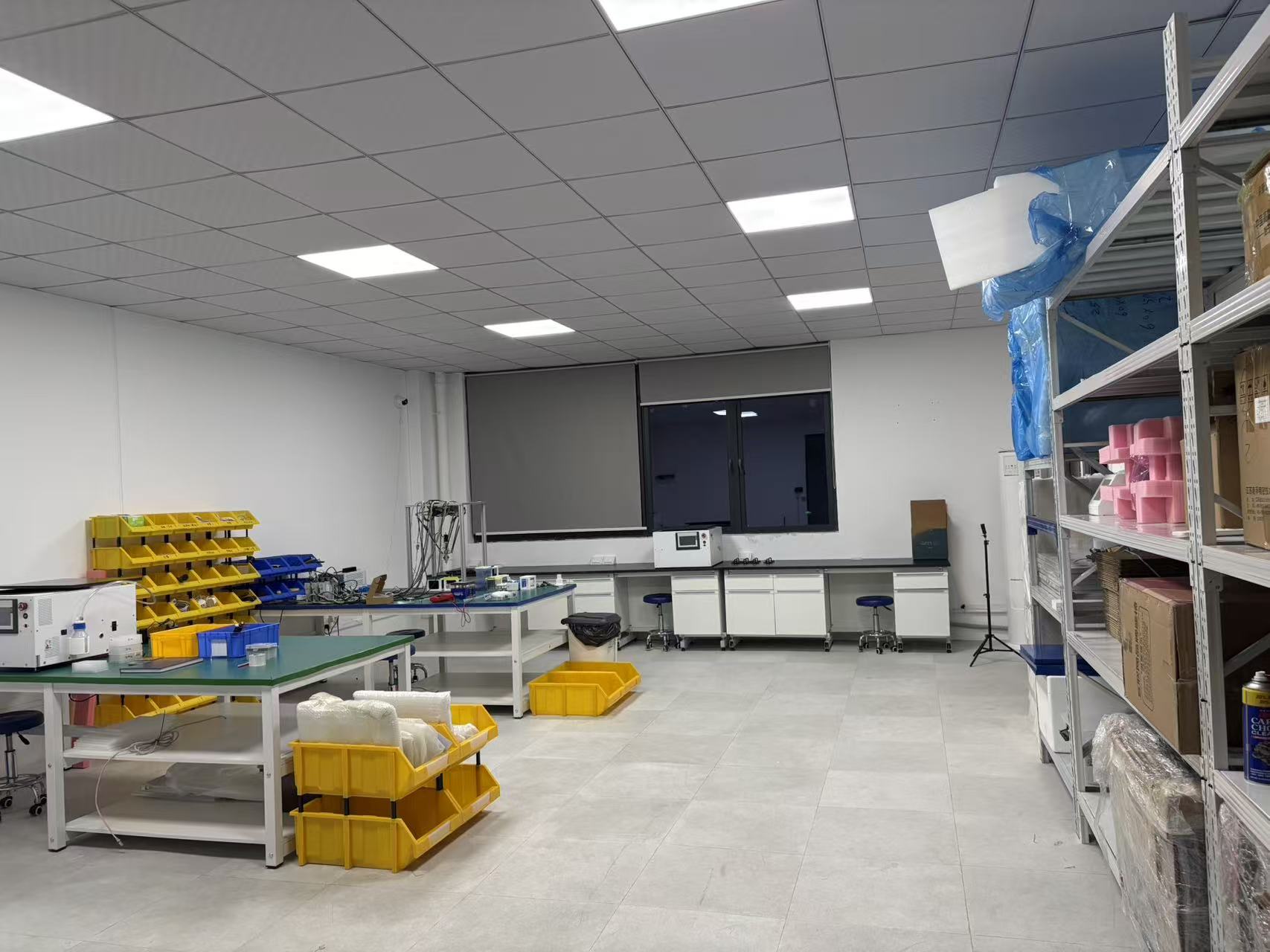
Request a sample or a quotation to validate pellet formation, aspiration behaviour and CV on your own chemistry. OEM and ODM orders start at 20 pieces, with a typical 3–5 week production lead time.
Carbonlinkai — Guangzhou Carbon Link Intelligent Technology Co., Ltd., a supplier of manual magnetic racks, large-volume magnetic bead separators and automated liquid handling robots. Website: www.carbonlinkai.com · Email: DmEloy656@gmail.com · WhatsApp: +86 185 6544 4004
Have Questions or Need More Details?
Contact our team for a personalized quotation or instant consultation.
Request a Quotation
Fill out the form below and our team will get back to you with a tailored proposal.
WhatsApp Direct Chat
Prefer to chat in real-time? Message us on WhatsApp for instant assistance & quick answers.
- Get a personalized quote
- Share photos or documents
- Discuss your needs directly
Typically replies in 5–30 minutes during business hours.