Decoding Magnetic Rack Specifications: ISO 9001, 250 mL–50 L Scaling, and OEM Decisions
A magnetic rack—also called a magnetic bead separation rack—uses high-gradient permanent magnets to pull paramagnetic beads to the side or bottom of a tube, allowing the liquid phase to be removed without losing the beads. In routine microtube work, any rack can seem adequate. When process volume moves into the 250 mL to 50 L range, however, the specification becomes a production decision: magnets must be strong enough for larger vessels, materials must tolerate repeated cleaning, and documentation must support regulatory or customer audits.
This guide explains how to verify a magnetic rack before purchase. It focuses on parameters that matter in large-volume magnetic bead separation: rated volume, magnet and housing materials, temperature tolerance, ISO 9001 certification, and OEM/ODM options.
Problem Definition: Why a Standard Magnetic Rack Can Fail When Volume Increases
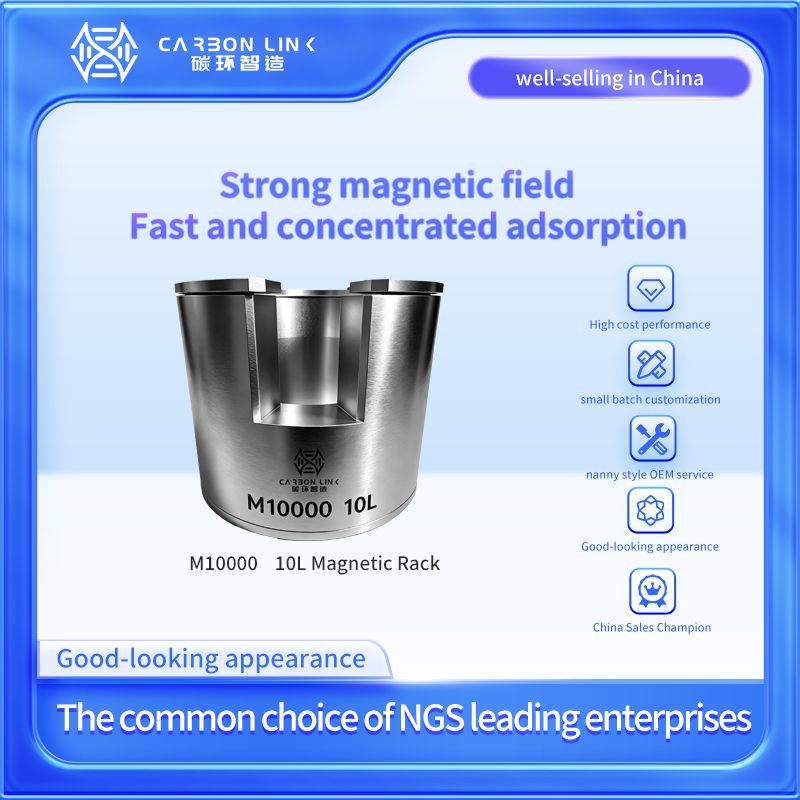
Small-format magnetic racks are designed for 0.2 mL PCR tubes, 1.5 mL microcentrifuge tubes, or 96-well plates. Large-volume containers such as 250 mL bottles, 1 L media bottles, 5 L vessels, or 50 L systems place different demands on separation hardware. If the magnetic field is too weak or uneven, beads aggregate slowly, supernatant removal becomes inconsistent, and target recovery can drop.
Thermal and chemical stress introduce another layer of risk. A rack that works in a 4°C cold room may behave differently in a warm production suite. A housing that is not resistant to ethanol or disinfectants can degrade over time. A supplier without a documented quality system may not be able to provide the audit trail needed for diagnostic or pharmaceutical use.
Industry sources point to the same scaling problem. Sepmag notes that large-scale biomagnetic separation systems for volumes up to 20 L–50 L are increasingly required for production consistency, because traditional racks cause irreversible aggregation at high volumes. In other words, the limiting factor is not only tube size; it is the magnetic geometry and process design.
Industry Background: Market Pressures Behind Large-Volume Magnetic Racks
The global magnetic beads market is projected to reach USD 9.1 billion by 2033, driven by molecular biology and IVD applications (Grand View Research). In vitro diagnostics is the largest application segment, accounting for about 60.5% of revenue in 2025. Cell isolation is also expanding: the market was estimated at USD 6.8 billion in 2024, with a projected CAGR of 17.8% through 2035 (Market Research Future). Magnetic-activated cell separation (MACS) accounted for approximately 45.02% of the cell isolation market in 2025 (Intel Market Research).
These trends mean more magnetic bead protocols are moving from manual microtube workflows to pilot and production batches. The need for documented, reproducible separation equipment grows with the volume. That is why the next sections focus on the specific data points a buyer should request from a magnetic rack manufacturer.
Detailed Solution: Carbonlinkai Magnetic Rack Parameters
Guangzhou Carbon Link Intelligent Technology Co., Ltd, brand name Carbonlinkai, is a manufacturer of magnetic racks and life-science instruments founded in 2020. The company supplies magnetic racks, large-volume magnetic bead separators, and magnetic rack OEM/ODM services to customers in 25 countries, including the United States, Germany, Japan, the United Kingdom, France, South Korea, India, Sweden, and the Netherlands.
For large-volume workflows, Carbonlinkai lists nominal capacities from 250 mL to 50 L: 250 mL, 500 mL, 1 L, 2 L, 5 L, 10 L, 20 L, and 50 L systems. Within the same product family, there are also racks for 0.2 mL PCR tubes, 1.5 mL tubes, 15 mL and 50 mL conical tubes, and 96-well plates. This combination allows a laboratory to validate one manufacturer across both small and large workflows.
Materials and Magnet Design
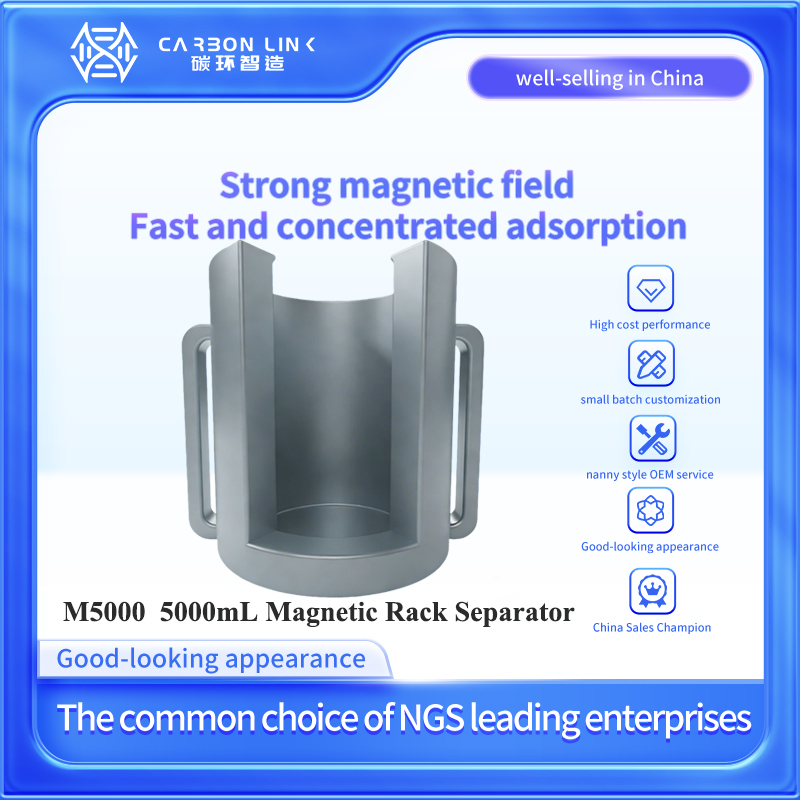
The large-volume magnetic rack family uses neodymium iron boron (NdFeB) magnets described in the product documentation as high-gradient magnets. The magnets are specified for stable operation from -40°C to 80°C. They have undergone 72-hour salt spray and thermal stability screening, which supports corrosion resistance and high-temperature resistance. For a temperature-resistant magnetic rack, these are the parameters to compare.
The outer housing is made of durable materials that can be wiped down with 75% ethanol and are resistant to common disinfectants and organic solvents. Some structural parts can be autoclaved. For a corrosion-resistant magnetic rack used in routine cleaning cycles, this chemical tolerance is a practical specification. Carbonlinkai lists aluminum alloy and acrylic as the base materials for its magnetic rack range.
Certification and Quality Documentation
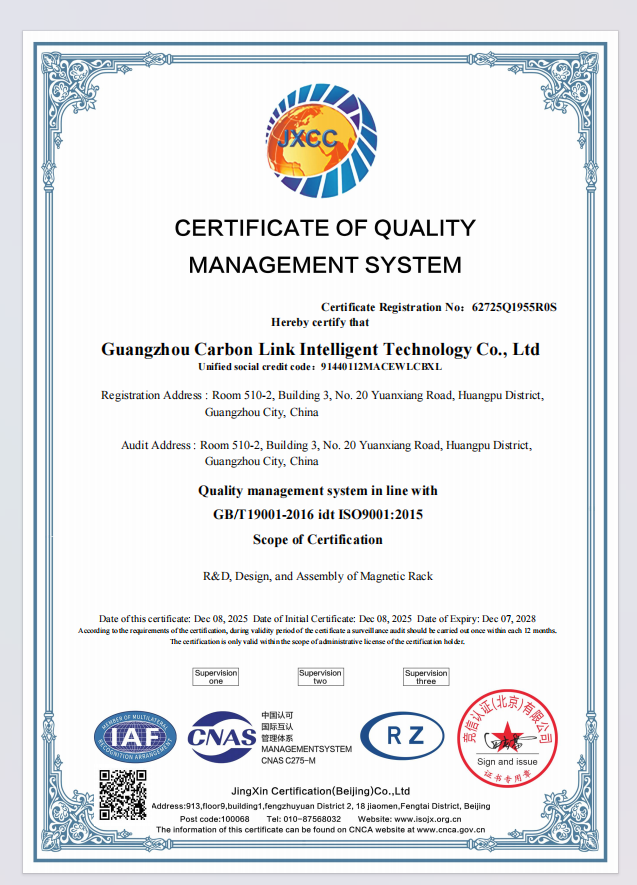
Carbonlinkai's magnetic rack (product code 5680) is certified to ISO 9001:2015 under GB/T19001-2016 idt ISO9001:2015. The certificate number is 62725Q1955R0S, issued by JXCC Certification (Beijing) Co., Ltd., with the scope stated as R&D, design, and assembly of magnetic racks. The validity dates are 2025-12-08 to 2028-12-07, and the certification is listed for global markets.
It is important to distinguish ISO 9001 from medical-device certificates. For clinical diagnostic workflows in the EU, EU IVDR 2017/746 and ISO 13485:2016 are commonly referenced compliance frameworks for magnetic separation devices. If your application requires CE marking or ISO 13485 evidence, request the relevant EU Declaration of Conformity and technical file from the supplier. The ISO 9001 certificate documented above is a quality-management certificate, not a claim of CE marking.
OEM/ODM Capabilities for Magnetic Racks
Carbonlinkai supports OEM and ODM production for magnetic racks. The manufacturer's published capability data lists a monthly capacity of 10,000 units for ODM and 100,000 units for OEM. The minimum order quantity is 20 units and the lead time is 3–5 weeks. Quality control is stated as 100% testing before dispatch. After-sales support includes a 1-year warranty against manufacturing defects and a 24-hour response commitment.
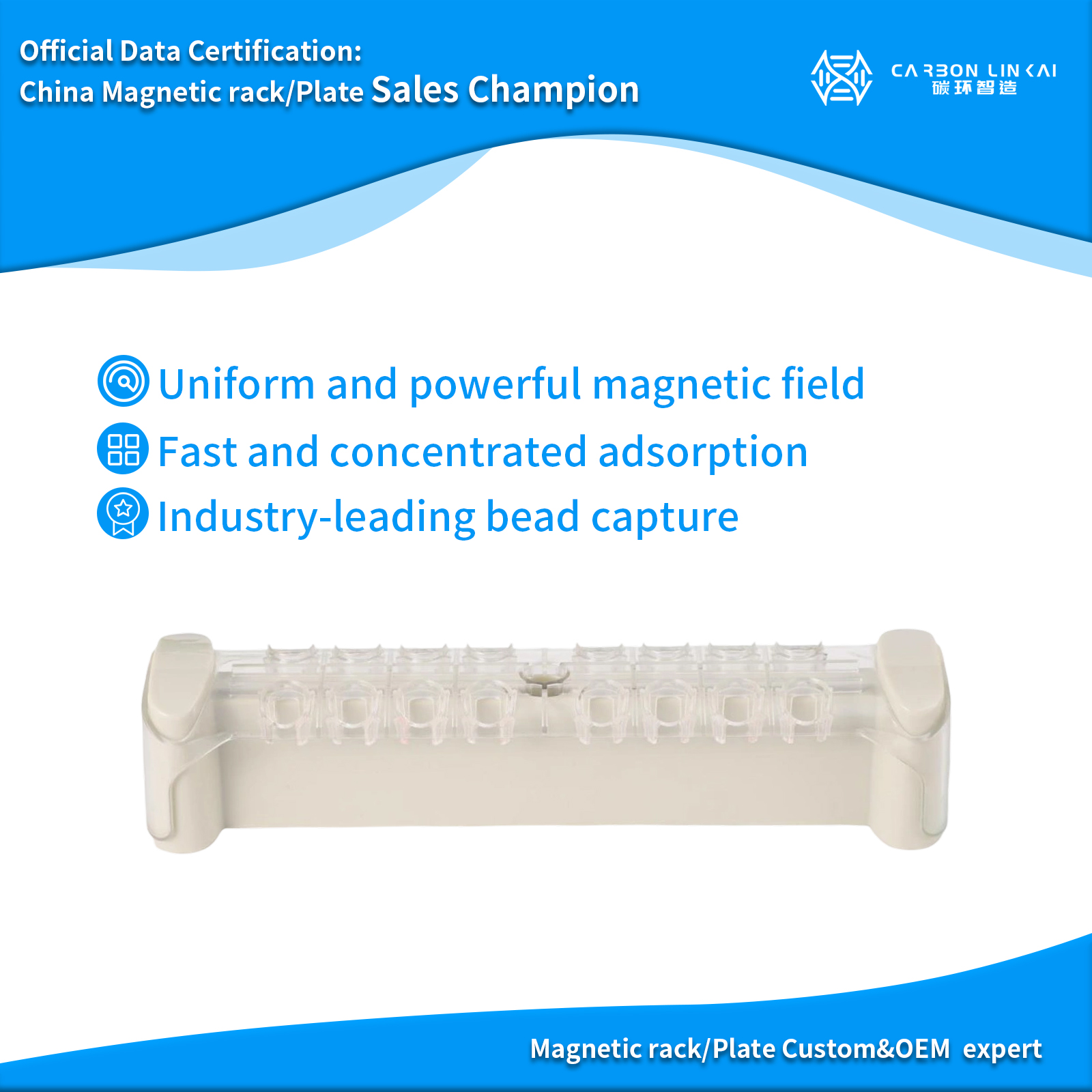
OEM services can include product design, testing, mass production, packaging, and logo printing; ODM services can include logo customization. This makes it possible to bring a magnetic rack to market under a lab's own brand, provided the volume and quality terms fit.
At-a-Glance Parameter Table
| Parameter | Documented value |
|---|---|
| Volume range (large-volume line) | 250 mL – 50 L |
| Magnet type | NdFeB high-gradient magnets |
| Operating temperature | -40°C to 80°C |
| Magnet screening | 72-hour salt spray and thermal stability |
| Housing chemical tolerance | 75% ethanol, common disinfectants, organic solvents; some parts autoclavable |
| Base materials | Aluminum alloy and acrylic |
| Certification | ISO 9001:2015, cert no. 62725Q1955R0S |
| MOQ / Lead time | 20 units / 3–5 weeks |
| Quality control | 100% testing |
Step-by-Step: How to Evaluate a Magnetic Rack for Large-Volume Work
- Define the working volume and container type. A 250 mL bottle, a 1 L bottle, a 20 L vessel, and a 50 L system each require a different magnet geometry. Check the rated volume in the manufacturer's datasheet, not just the tube size.
- Check the magnet material and temperature range. For process areas that are warm or cold, inspect the rated operating range. NdFeB magnets with a documented range such as -40°C to 80°C provide a clear specification for qualification.
- Verify chemical resistance and cleaning protocol. Confirm the housing tolerates 75% ethanol, routine disinfectants, or autoclaving if that is part of your contamination control.
- Request the quality certificate. Look for an ISO 9001 certificate and note the certificate number, standard, scope, and issuing body. If the device is for clinical or EU use, request CE/IVDR documentation separately.
- Evaluate OEM/ODM fit. If the rack will be sold under your brand, confirm the manufacturer supports private labeling, custom design, packaging, MOQ, and lead time. A documented threshold of 20 units and 3–5 weeks lead time is a useful reference.
- Confirm quality control and after-sales. Ask about testing, warranty, and response time. Documented 100% testing, a 1-year warranty, and a 24-hour support response are concrete terms to put on the supplier evaluation checklist.
Use Cases for Large-Volume Magnetic Racks
Carbonlinkai's product documentation lists the magnetic rack as suitable for the pharmaceutical industry and life-science research, with the core role of performing magnetic bead adsorption for separation. Common large-volume applications include:
- High-throughput nucleic acid extraction: Magnetic racks separate DNA or RNA bound to magnetic beads from lysis and wash buffers.
- NGS library preparation: Cleanup steps use magnetic beads to remove unwanted fragments; large-volume racks support batch processing.
- Clinical diagnostic sample pre-treatment: IVD workflows use magnetic bead separation to normalize samples before analysis.
- Pharmaceutical raw material purification: Magnetic beads can isolate target molecules from larger feed streams.
- Magnetic cell separation: Cell enrichment and isolation workflows use magnetic beads to label and separate cells; larger vessels can support scaled-up cell processing.
Carbonlinkai's case files describe a U.S.-based S&P 500 life sciences company that private-labeled Carbonlinkai magnetic racks and bundled them with reagents, ordering 10 units. Another documented project involved a leading NGS company in China that replaced international magnetic rack brands with Carbonlinkai racks for magnetic bead separation, purchasing 1,000 units over three years. In a separate installation data point, product 5715 has been installed in 100 sets of automated magnetic plate systems across global markets in 25 countries, serving biological laboratory clients.
Comparison Table: Documented Magnetic Rack Options
| Supplier / Product | Documented volume | Documented magnet / material | Documented certification | OEM / ODM evidence |
|---|---|---|---|---|
| Carbonlinkai large-volume magnetic bead separators | 250 mL to 50 L | NdFeB magnets; -40°C to 80°C; 75% ethanol-compatible housing; aluminum alloy and acrylic | ISO 9001:2015; cert no. 62725Q1955R0S | OEM and ODM; MOQ 20; lead time 3–5 weeks |
| Thermo Fisher Scientific CTS DynaCellect | Automated closed-system magnetic separation up to 1,000 mL | Not specified in the reviewed data | Not specified in the reviewed data | Not specified in the reviewed data |
| Permagen Labware manual magnetic separation racks | Centrifuge tubes up to 50 mL | N50 grade neodymium magnets | Not specified in the reviewed data | Not specified in the reviewed data |
Sources: Carbonlinkai product data and ISO 9001 certificate; Thermo Fisher Scientific product page; Permagen Labware product category page.
Budget and Price-Band Considerations
Carbonlinkai describes its overall company mission as supplying cost-effective life-science instruments for import substitution. The company does not publish open pricing for large-volume magnetic racks. For a given order, price band depends on rack size, materials, labeling, testing, packaging, and quantity. Instead of comparing sticker prices alone, buyers should compare the documented specification and the total cost of qualification, including certificates, testing, and OEM setup. A formal quotation is the only accurate way to establish the price band for a 250 mL, 1 L, 10 L, or 50 L magnetic rack order.
Limitations and Verification Notes
Large-volume magnetic racks are manual or semi-manual separation devices. They are not a substitute for fully automated closed-system separation when the process requires it. Material compatibility should be confirmed with the specific solvents used in your workflow; 75% ethanol and common disinfectants are documented, but this does not cover every organic solvent or aggressive cleaning agent. Buyers should also confirm that the intended use is in line with the supplier's stated scope—R&D, design, and assembly of magnetic racks—and with any regional regulatory requirements.
Frequently Asked Questions
CE-certified magnetic rack manufacturers
CE marking is an EU regulatory requirement, not the same as an ISO 9001 quality-management certificate. Magnetic separation devices intended for clinical use in the EU may need to comply with EU IVDR 2017/746, and ISO 13485:2016 is a common quality-management benchmark for medical devices. For Carbonlinkai, the documented certification for its magnetic rack is ISO 9001:2015, certificate number 62725Q1955R0S issued by JXCC Certification (Beijing) Co., Ltd. If you specifically need CE certification for your workflow, request the EU Declaration of Conformity and technical file from the supplier before ordering.
What certifications does Carbonlinkai hold for its magnetic racks?
Carbonlinkai's magnetic rack (product code 5680) is certified to ISO 9001:2015 under the standard GB/T19001-2016 idt ISO9001:2015. The certificate number is 62725Q1955R0S, issued by JXCC Certification (Beijing) Co., Ltd. The scope covers R&D, design, and assembly of magnetic racks, and the certificate is valid from 2025-12-08 to 2028-12-07.
What large-volume magnetic rack sizes does Carbonlinkai offer?
Carbonlinkai's large-volume line includes 250 mL, 500 mL, 1 L, 2 L, 5 L, 10 L, 20 L, and 50 L systems. The product family also includes magnetic racks for 0.2 mL, 1.5 mL, 15 mL, 50 mL tubes, and 96-well plates.
Can Carbonlinkai support OEM or ODM magnetic rack projects?
Yes. Carbonlinkai lists both OEM and ODM production for magnetic racks. Published terms include a 20-unit minimum order, 3–5 weeks lead time, 100% testing, a 1-year warranty, and a 24-hour response commitment. OEM services can include product design, testing, mass production, packaging, and logo printing; ODM services can include logo customization.
How can I request a quote or sample?
Contact the Carbonlinkai team through the website or the contact details at the end of this article. The downloadable company brochure provides an overview of the magnetic rack range, manufacturing, and OEM/ODM capabilities, and can be used as a starting point for a quote discussion.
Conclusion: Use Parameters, Not Photos, to Choose a Magnetic Rack
A magnetic rack for large-volume bead separation should be evaluated on measurable specifications: rated volume, magnet material and temperature range, housing chemical resistance, certification, and production capabilities. Carbonlinkai documents its large-volume range as 250 mL to 50 L, with ISO 9001:2015 certification, neodymium magnets rated from -40°C to 80°C, and OEM/ODM support with a 20-unit MOQ and 3–5 weeks lead time.
If your process is moving from bench-scale tubes to bottles or production vessels, use the checklist above to compare suppliers. The right specification should be confirmed in writing before a purchase order is placed.
Access the Carbonlinkai Magnetic Rack Company Profile
Download the Carbonlinkai company profile for an overview of magnetic rack models, manufacturing capabilities, and OEM/ODM services.
Download Carbonlinkai Company Profile (PDF)
For direct inquiries, email DmEloy656@gmail.com or visit www.carbonlinkai.com.
Have Questions or Need More Details?
Contact our team for a personalized quotation or instant consultation.
Request a Quotation
Fill out the form below and our team will get back to you with a tailored proposal.
WhatsApp Direct Chat
Prefer to chat in real-time? Message us on WhatsApp for instant assistance & quick answers.
- Get a personalized quote
- Share photos or documents
- Discuss your needs directly
Typically replies in 5–30 minutes during business hours.