Magnetic Rack OEM Partnerships: Long-Term Support, Warranty, and FAQ

An OEM magnetic rack partnership is a multi-year supply arrangement in which the manufacturer builds, tests, labels, packages and supports magnetic separation racks to a buyer's specification, instead of shipping a catalogue item. For distributors, importers and laboratory customers, the practical value of such a partnership is decided less by the first quotation than by the terms that follow it: minimum order quantity, production lead time, monthly capacity, quality testing, warranty coverage and support response time.
Carbonlinkai is the brand of Guangzhou Carbon Link Intelligent Technology Co., Ltd, a life-science instrument supplier founded in 2020 and headquartered in Shenzhen, China, with a 700 m² production facility and a 17-engineer R&D team. The company publishes the commercial and after-sales terms that OEM buyers ask about most, which makes it possible to evaluate the relationship before the first purchase order is issued.
Published OEM/ODM terms at a glance
- Minimum order quantity: 20 units.
- Production lead time: 3–5 weeks.
- Monthly capacity: 100,000 units overall; 10,000 units for specific product lines.
- Quality control: 100% testing.
- Warranty: 1 year against manufacturing defects.
- Support response: within 24 hours for all support requests.
What an OEM Magnetic Rack Partnership Actually Covers
A magnetic rack OEM agreement is not limited to putting a logo on an existing frame. Carbonlinkai describes its OEM service as small-batch customization and private labeling that includes product design, testing, mass production, packaging and logo printing. The ODM track covers the same production scope with a heavier design element, and the company also offers small-batch OEM/ODM work that includes 3D modeling, printing, product testing, labeling and after-sales service.
In practice, four layers of work sit inside that definition. The first is mechanical: matching the rack to the vessel the buyer actually uses, from a 250 mL large-volume magnetic rack for conical flasks and round reagent bottles through to 50L magnetic bead separation systems. The second is magnetic: defining field strength and magnet geometry so that bead capture is repeatable rather than approximate. The third is commercial: quantity, tooling, packaging and labeling. The fourth is post-delivery: warranty handling, spare parts and technical response.
The Real Problem: The Questions That Arrive After the First Quote
Sourcing teams rarely lose a project because the first quotation was unclear. They lose it six months later, when a repeat order slips, a distributor's private-label packaging does not match the approved artwork, or a laboratory cannot get a straight answer about what the warranty actually covers.
The pattern is consistent across OEM buyers of magnetic bead separation racks:
- A low unit price is quoted, but the minimum order quantity for a customized version is never confirmed in writing.
- Lead time is described as "fast" without a stated range that a distributor can plan inventory around.
- Quality is described as "strict" without stating whether testing is sampled or performed on every unit.
- The warranty exists in a brochure but not in a form that resolves a defective-unit dispute.
- Support requests cross time zones and stall for a week, which is fatal when the rack sits inside a customer's validated workflow.
These are not marketing gaps. They are procurement risks, and they are the reason a partnership-and-after-sales review belongs in the evaluation stage rather than after the purchase order.
Industry Background: Why Private-Label Racks Became a Sourcing Category
Magnetic rack supply has historically been organised around small formats. Publicly described product families from established suppliers concentrate on microtubes, PCR strips, 15 mL and 50 mL tubes and 96-well plates. Thermo Fisher Scientific describes its DynaMag family as accommodating working volumes from 1.5 mL to 50 mL across tubes, PCR strips, plates and cell-culture well plates. Cytiva lists rack formats for samples up to 1.5 mL, 15 mL and 50 mL depending on the model. V&P Scientific lists magnetic bead separation racks and devices for bottle volumes of 100 mL, 500 mL, 1,000 mL, 2,000 mL and 5,000 mL.
That distribution matters to buyers. Above roughly 50 mL, the number of comparable published options narrows, and the technical questions change: vessel diameter becomes a constraint, magnetic field uniformity across a large bottle wall becomes harder to hold, and materials have to survive repeated cleaning rather than occasional wiping. A 2-liter large-volume magnetic rack is not simply a scaled drawing of a 1.5 mL tube rack.
At the same time, distributors and reagent companies increasingly want their own branded separation hardware rather than reselling a generic frame. That is where OEM and ODM supply becomes relevant: the buyer needs design input, testing, mass production, packaging and logo printing from a single source, and needs those terms to hold across repeat orders. Carbonlinkai's published large-volume range runs from 250 mL through 500 mL, 1 L, 2 L, 5 L, 10 L, 20 L and 50 L, with company materials also referencing configurations up to 100 L for production-scale use, and its products are sold to 25 countries and regions.
The Carbonlinkai OEM/ODM Program in Detail
Commercial terms
The starting quantity for an OEM order is 20 units, and series production runs on a 3–5 week lead time. Monthly capacity is stated at 100,000 units overall and 10,000 units for specific product lines, which means the appropriate capacity figure for a given project depends on which format and configuration the buyer selects. Annual output is stated at 1,000,000 units, with approximately 30% of sales exported.
Published export markets include the United States, China, Germany, the United Kingdom, Japan, India, South Korea, France, Canada and Brazil. The company's stated main markets also include Sweden and the Netherlands, and its products are sold to 25 countries and regions.
Manufacturing and quality
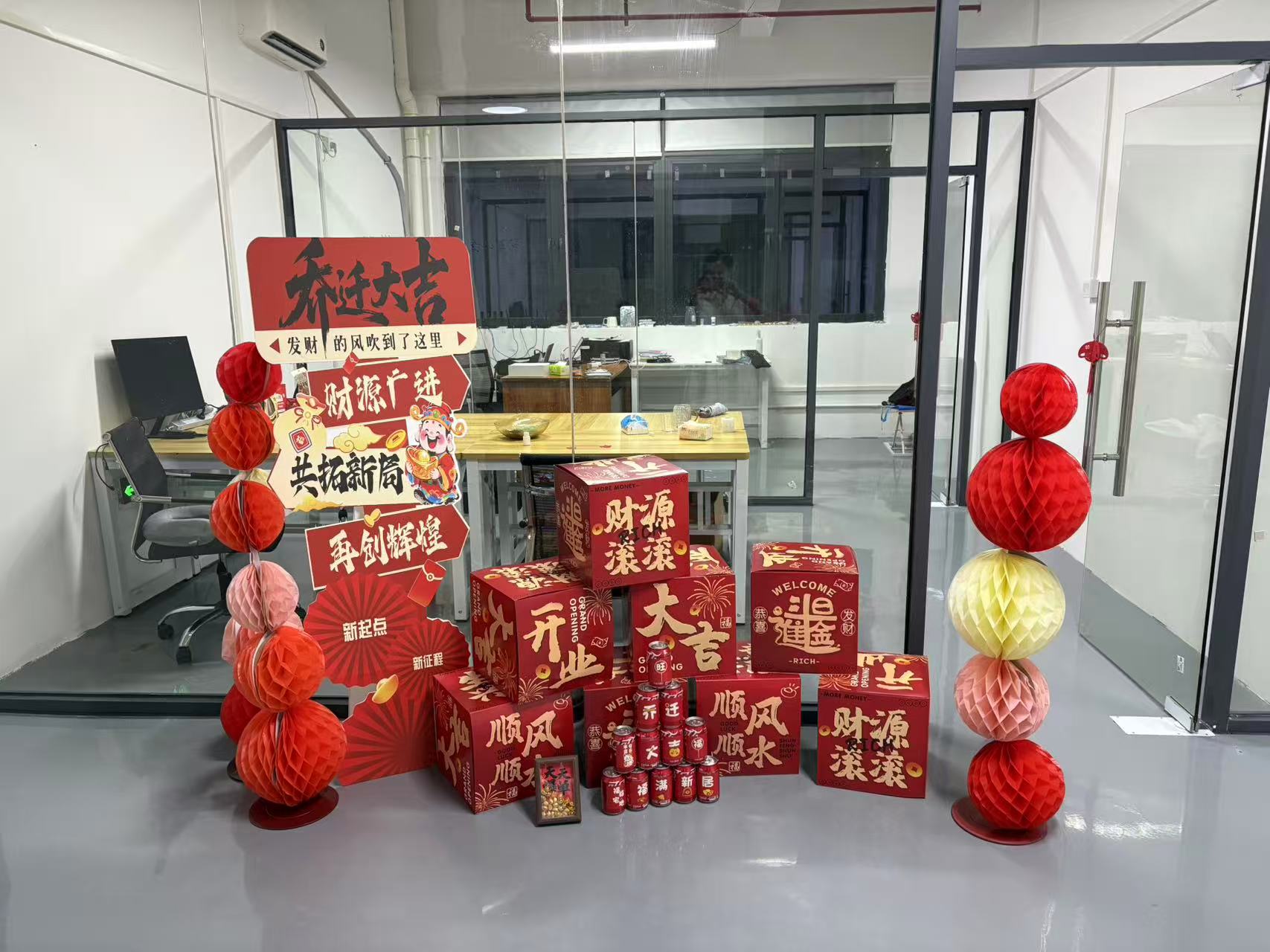
Quality control is described as 100% testing, not sampling. The 700 m² facility employs 20 people, and the 17-engineer R&D team is the group that handles design adaptation when a buyer's vessel or bead type differs from the standard configuration.
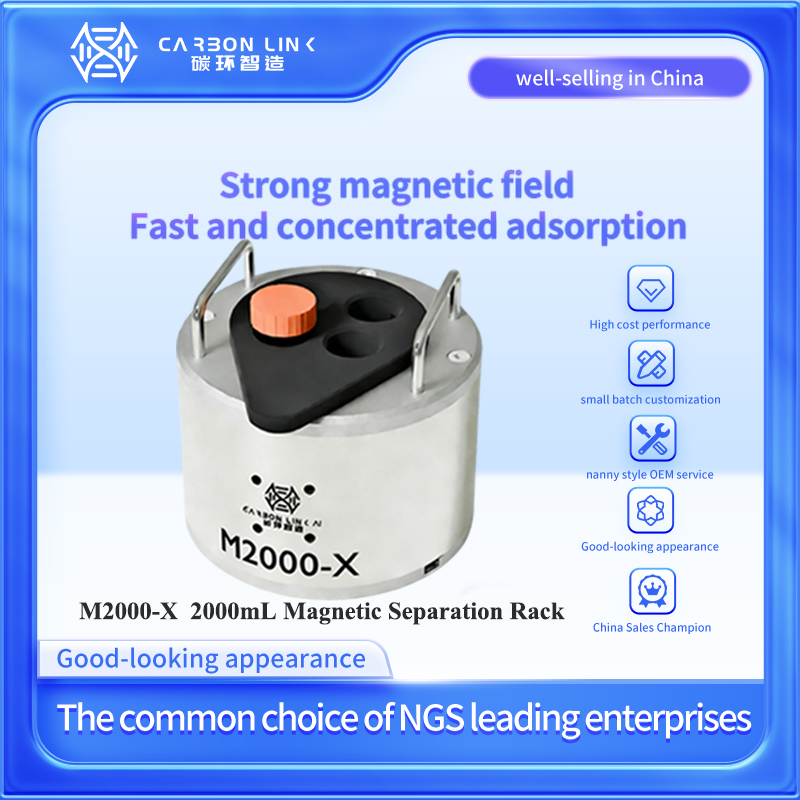
Specification depth varies by capacity, and buyers should read it as a design envelope rather than a single fixed product. The 250 mL large-volume magnetic rack uses N52/N54 neodymium-iron-boron permanent magnets in a double-row vertical focusing circuit, with surface field intensity of at least 5500 Gauss on the pole surface, aviation aluminum alloy with hard anodized finish, and overall dimensions of 150 × 120 × 200 mm at approximately 1.5 kg. Dimensions can be customized to the customer's bottle size. The 500 mL and 0.5 L models share technical parameters, support bottle diameters up to 85 mm, and state surface field intensity of at least 7000 Gauss.
Construction changes with scale: aviation aluminum alloy with hard anodizing for 250 mL to 2 L models, a 304 stainless steel and aluminum alloy composite structure at 5 L, a 304 stainless steel casing at 10 L, 304 stainless steel combined with chemical-resistant engineering plastic at 20 L, and fully sealed 316L stainless steel at 50 L. The 50L magnetic bead separation systems are described as suitable for GMP production environments and for cleaning-in-place regimes, and the line is rated for 121 °C sterilization at the 250 mL size.
Environmental tolerance is stated as an operating range of −40 °C to 80 °C, with magnets screened through 72 hours of salt spray and thermal stability testing. That is the basis for describing these as temperature-resistant and corrosion-resistant magnetic rack builds: the housing can be wiped repeatedly with 70% or 75% ethanol and resists common disinfectants and organic solvents. Separation time is stated at under 5 minutes for 1 μm beads in the small and mid formats, with the company citing under 30 seconds in a 250 mL flask and under 15 minutes in a 50 L barrel.
After-sales
Every magnetic rack carries a 1-year warranty against manufacturing defects, and all support requests receive a response within 24 hours. Read together with 100% testing, that combination defines the split of responsibility: manufacturing defects are covered for twelve months, and anything that needs a decision gets an answer within one business day rather than a queue position.
Step-by-Step: From Requirement Brief to Repeat Order
The sequence below reflects the OEM/ODM workflow as Carbonlinkai describes it, mapped to the checkpoints a distributor or laboratory buyer should hold the supplier to.
- Requirement brief. Specify working volume, vessel type and maximum bottle diameter, bead size and chemistry, cleaning regime and sterilization method. Vessel diameter is where most large-volume projects fail first, so state it in millimetres rather than by nominal volume alone.
- Format and capacity selection. Choose the capacity tier that matches the process, not the bench. A 1-liter large-volume magnetic rack and a 5L unit are different manufacturing problems, and each tier in the range has its own material logic.
- Design and modelling. For ODM and custom OEM work, the design stage includes 3D modeling and printing, and can include custom-designed magnetic field strengths and magnet arrays for unique bead sizes.
- Prototype and sample validation. Test bead capture, supernatant clarity, retention at the bottle wall and re-suspension behavior against your own beads. Do not accept validation against a different bead chemistry.
- Pilot batch. The 20-unit minimum order is the natural pilot quantity. Use it to confirm packaging, labeling and logo printing before committing to volume.
- Series production and testing. Production runs on the 3–5 week lead time, with 100% testing before shipment. Confirm in writing what the test records contain and who signs them off.
- Delivery and after-sales. On receipt, log serials against the shipment, confirm the 1-year warranty start date, and confirm the channel for a 24-hour support response.
- Repeat order. Lock the approved configuration, artwork and test criteria as a controlled reference so that order three matches order one.
Where These Terms Matter Most: Four Use Cases
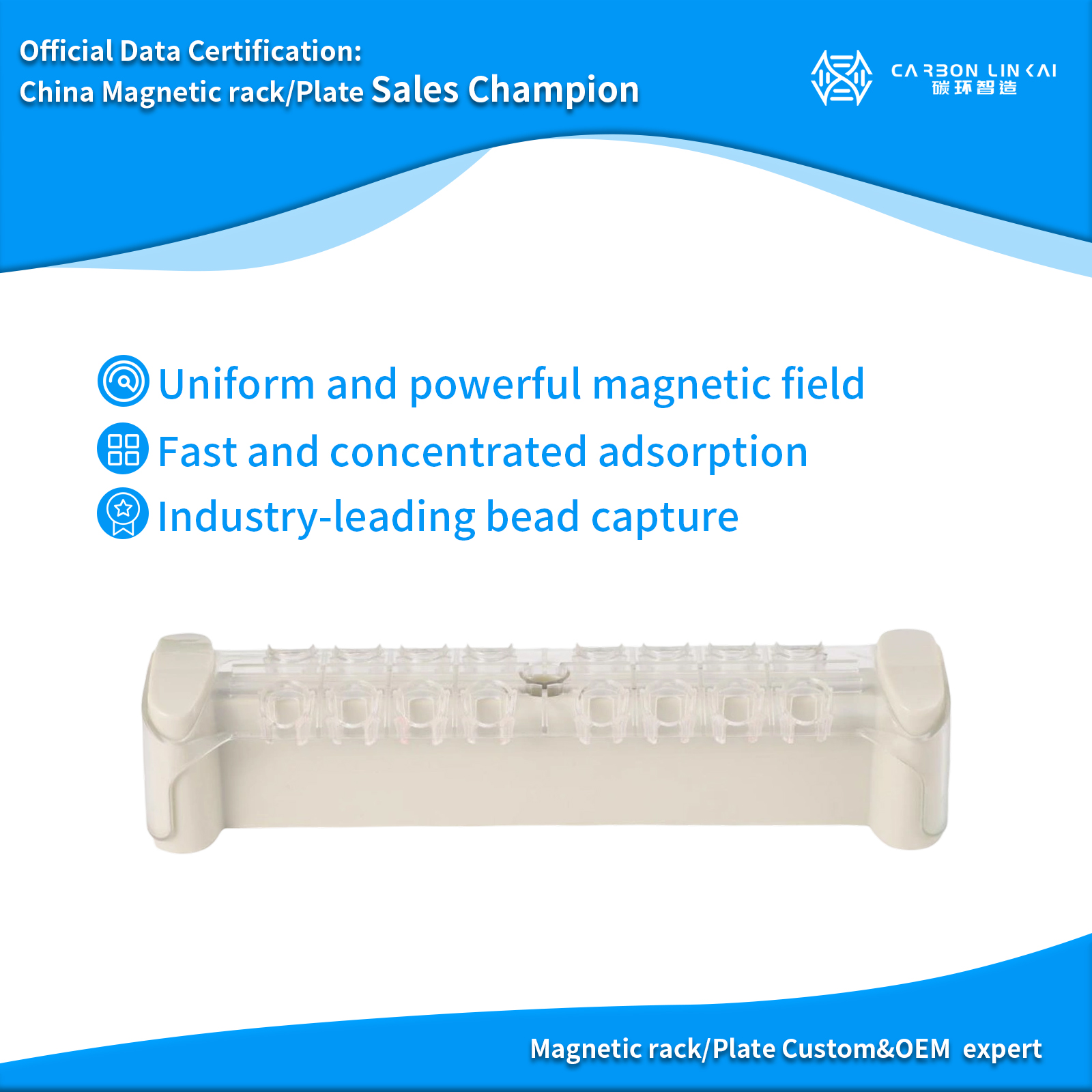
1. Distributor private label. A distributor needs a branded magnetic bead separation rack line without building a factory. The relevant terms are the 20-unit minimum, the 3–5 week lead time, logo printing and packaging customization, and the warranty that the distributor will have to honour in front of its own customers. A US-based S&P 500 life sciences company private-labeled CarbonLinkAI magnetic racks and bundled them with reagents, with the company reporting an increase in annual revenue of RMB 30 million.
2. Laboratory scale-up from bench to pilot. A process development group validates on a 250 mL large-volume magnetic rack and then transfers to 2 L, 5 L or 10 L. Because the capacity line runs from 250 mL to 50 L with a consistent magnetic circuit design language, the separation behaviour is intended to transfer without re-optimization at each step. Buyers should still verify transfer experimentally on their own beads.
3. IVD reagent bundling. Diagnostic reagent manufacturers pair separation hardware with their kits. Here, batch-to-batch consistency and the 100% testing claim matter more than unit price, because a rack that behaves differently between lots will show up as assay variance. The 96-well plate and 12-tube formats are relevant at this end of the range.
4. High-throughput NGS workflows. A leading NGS company in China deployed 1,000 units to replace international magnetic rack brands, and reported annual cost savings of over 3 million RMB over a three-year project. A separate global health science solutions provider installed 100 sets of automated magnetic plate systems across 25 countries, reporting USD 380,000 in annual cost savings and 15% faster processing times. These are company-reported case outcomes, not independently audited results, and should be treated as reference points rather than guarantees.
Comparison 1: Published OEM Program Terms
| Parameter | Stated term | What to confirm at RFQ |
|---|---|---|
| Minimum order quantity | 20 units | Whether the same MOQ applies to the specific capacity tier and custom artwork |
| Production lead time | 3–5 weeks | Timing from approved artwork, not from enquiry |
| Monthly capacity | 100,000 units overall; 10,000 units for specific product lines | Which figure applies to your format |
| Quality control | 100% testing | Test items, record format, sign-off responsibility |
| Warranty | 1 year against manufacturing defects | Start date, exclusions, replacement versus repair |
| Support response | Within 24 hours | Named channel, escalation path, working-language coverage |
| Customization scope | Product design, testing, mass production, packaging, logo printing | Tooling ownership and artwork approval flow |
Source: Carbonlinkai OEM and ODM capability statements. Terms apply to the cited product scope and should be reconfirmed in writing for each order.
Comparison 2: Published Capacity Coverage by Supplier
| Supplier | Stated volume coverage | Scope of the statement |
|---|---|---|
| Carbonlinkai | 250 mL, 500 mL, 1 L, 2 L, 5 L, 10 L, 20 L, 50 L large-volume separators; microtube, 12-tube, 15 mL, 50 mL and 96-well formats also offered | Company product range |
| Thermo Fisher Scientific (DynaMag) | 1.5 mL to 50 mL working volumes across the product family | Manufacturer-stated family range |
| Cytiva | Sample volumes up to 1.5 mL, 15 mL or 50 mL depending on model | Individual rack models |
| V&P Scientific | Bottle volumes of 100 mL, 500 mL, 1,000 mL, 2,000 mL, 5,000 mL | Supplier-stated product range |
All values are manufacturer- or supplier-stated and are not a performance ranking. Definitions differ between nominal volume, working volume and maximum vessel volume; confirm vessel geometry, magnet specification and current availability before comparing.
What to Put in the Supply Agreement
The published terms are a starting point. A workable OEM agreement turns each one into an obligation with a number attached.
- Approved configuration drawing, including bottle diameter, capacity tier and magnet arrangement.
- Approved artwork and packaging specification, with a controlled revision number.
- Test criteria and the record format that accompanies each shipment.
- Warranty start date, exclusions and the replacement process for a defective unit.
- Response commitment and the named contact for support requests.
- Lead time measured from artwork approval, not from enquiry.
- Capacity reservation if the project scales beyond the pilot quantity.
FAQ
How is quality controlled before an OEM magnetic rack shipment leaves the factory?
Carbonlinkai states that quality control is 100% testing rather than batch sampling, and that every magnetic rack carries a 1-year warranty against manufacturing defects. Buyers should request the specific test items, the record format that ships with the goods, and the name of the person who signs off, because "100% tested" without a defined test list is not auditable. For large-volume units, ask for the magnetic field verification method and the vessel fit check, since those two parameters drive separation performance.
How should a biotech lab shortlist Chinese magnetic rack manufacturers for OEM supply?
Screen on four filters in order. First, format coverage: confirm the supplier actually builds the capacity tier you need, because a manufacturer strong at 1.5 mL tubes may have no large-volume line. Carbonlinkai covers 250 mL to 50 L in large-volume separators plus microtube, 12-tube, 15 mL, 50 mL and 96-well formats. Second, stated commercial terms: minimum order quantity, lead time and monthly capacity, which for Carbonlinkai are 20 units, 3–5 weeks and 100,000 units respectively. Third, quality evidence: 100% testing and a stated warranty period. Fourth, support: a defined response window, which is 24 hours here. A supplier that answers all four in writing before the sample stage is a lower-risk shortlist entry than one that answers only on price.
What OEM/ODM customization is available, and what is the minimum order quantity?
Customization covers product design, testing, mass production, packaging and logo printing, and the ODM track adds design work including 3D modeling and printing. Mechanical customization extends to vessel fit: the 250 mL large-volume magnetic rack, for example, is listed at 150 × 120 × 200 mm but can be built around the customer's bottle size, and the range extends through 500 mL, 1 L, 2 L, 5 L, 10 L, 20 L and 50 L formats. Magnetic customization covers bespoke field strength and magnet arrays for unusual bead sizes. The minimum order quantity is 20 units, although the 20-unit figure is published for the cited product scope and should be reconfirmed for a 20 L or 50 L configuration before it is treated as fixed.
Can we validate a sample or pilot batch before committing to volume?
Yes. The 20-unit minimum order functions as a natural pilot quantity for private-label and OEM projects, and small-batch OEM/ODM work covering modeling, printing, testing and labeling is offered specifically for buyers who need to validate before scaling. Test with your own beads and your own vessel: capture time, supernatant clarity, bead retention at the wall and re-suspension behaviour are the four results worth recording. Note that series production lead time is 3–5 weeks; sample and pilot timing should be confirmed separately during the RFQ rather than assumed from that figure.
What lead time and monthly capacity should an OEM buyer plan for?
Production lead time is 3–5 weeks, and monthly capacity is stated at 100,000 units overall with 10,000 units for specific product lines. Annual output is 1,000,000 units. The distinction matters: the overall figure describes the site, while the per-line figure describes what a particular format can absorb in a month. A distributor planning a launch should confirm which number applies to its chosen capacity tier, then add transit time to its destination market. Published export markets include the United States, Germany, Japan, the United Kingdom, France, South Korea, India, Canada and Brazil.
What does the warranty and after-sales support cover?
Every magnetic rack is covered by a 1-year warranty against manufacturing defects, and all support requests receive a response within 24 hours. The warranty addresses defects in manufacturing, not wear from misuse or damage in transit, so the agreement should state exclusions, the start date and whether a defective unit is repaired or replaced. For OEM buyers the support channel matters as much as the warranty itself, because a distributor has to answer its own customers. To move from evaluation to validation, request a sample or quotation and the company profile, or contact the team directly on WhatsApp at +86 18565444004 or by email at DmEloy656@gmail.com.
Conclusion
The terms that decide a magnetic rack OEM partnership are unglamorous and entirely checkable: 20 units minimum, 3–5 weeks lead time, 100,000 units monthly capacity with 10,000 units on specific lines, 100% testing, a 1-year warranty against manufacturing defects, and a 24-hour response to support requests. Carbonlinkai publishes all six, which means a distributor or laboratory buyer can compare them against its own inventory plan, validation timeline and service obligations before placing an order.
The second half of the decision is fit. Confirm the capacity tier against the vessel, confirm the material against the cleaning regime, and confirm the customization scope — design, testing, mass production, packaging, logo printing — against what your brand actually needs to ship. Everything else is negotiation.
For buyers ready to move from evaluation to sample validation, the company profile and full product documentation are available in the Carbonlinkai company profile PDF, and product details are published at carbonlinkai.com.
Next step: sample, quotation, or distributor pack
Send your working volume, vessel diameter, bead size and target quantity. The team responds within 24 hours with a configuration proposal, an OEM/ODM scope and a lead time.
WhatsApp: +86 18565444004 | Phone: +86 136 3148 6067
Email: DmEloy656@gmail.com
Guangzhou Carbon Link Intelligent Technology Co., Ltd — Room 510-2, Block 3, No.20 Yuanxiang Road, Huangpu District, Guangzhou City, China
Have Questions or Need More Details?
Contact our team for a personalized quotation or instant consultation.
Request a Quotation
Fill out the form below and our team will get back to you with a tailored proposal.
WhatsApp Direct Chat
Prefer to chat in real-time? Message us on WhatsApp for instant assistance & quick answers.
- Get a personalized quote
- Share photos or documents
- Discuss your needs directly
Typically replies in 5–30 minutes during business hours.