
How to Read CE/GB, GMP, and Sterilization Claims on Magnetic Racks
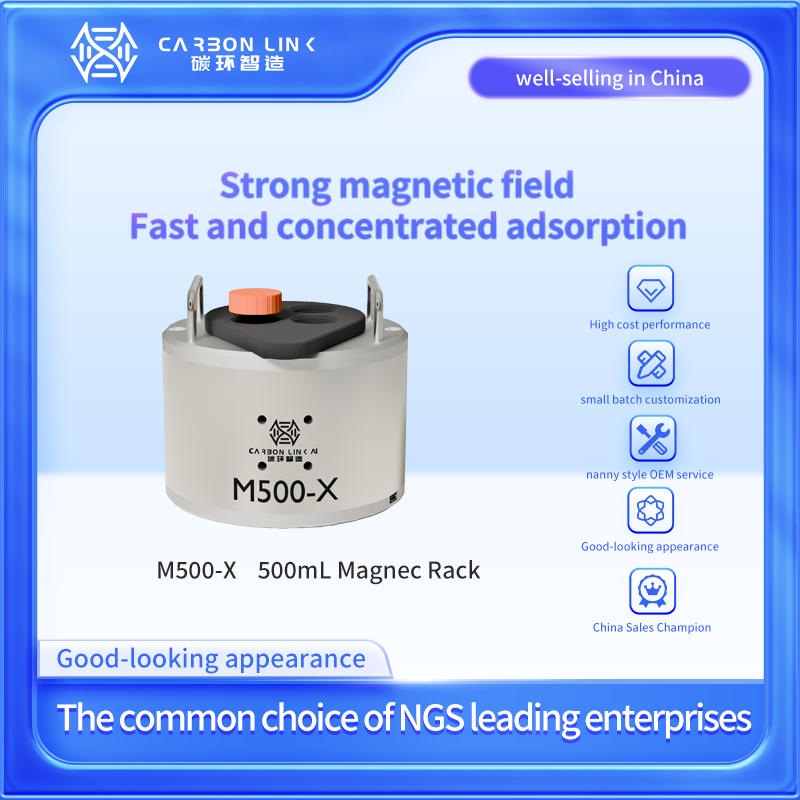
The 0.5 L / 500 mL format: hard-anodized aviation aluminum alloy body, rated for 90 °C sterilization or 70% ethanol wiping — a lower temperature limit than the 250 mL format in the same range.
A compliance statement on a large-volume magnetic rack is a claim with a boundary, not a badge that covers an entire catalogue. One published specification for large-volume magnetic bead separators contains a 250 mL format rated for 121 °C autoclaving, a 0.5 L format rated for 90 °C, and a 50 L format described as a CIP-compatible GMP design rated for 121 °C with strong acid and alkali cleaning. All of them sit under the same statement that the models comply with CE/GB electromagnetic compatibility and mechanical safety standards.
None of those figures tells a buyer whether the rack is sterile, whether it suits a particular buffer, or whether it can be autoclaved indefinitely. Reading the claims correctly means separating legal conformity, design intent, and material tolerance — then asking for the document that actually supports each one.
Three statements, three different kinds of evidence
Compliance language on a magnetic rack usually mixes three categories that carry different evidence and different limits.
Legal conformity. A CE/GB statement addresses electromagnetic compatibility and mechanical safety. Its evidence is a declaration of conformity, the applicable standard numbers, and test reports. It says the product meets defined safety requirements; it says nothing about separation performance, sterility, or biological suitability.
Design intent. Terms such as GMP-compatible, CIP-compatible and designed for GMP cleanrooms describe how a device is built: materials, welding, surface finish, drainability. Their evidence is material certificates, drawings, weld and surface documentation, and cleaning validation support. There is no product-level GMP certificate for a magnetic rack.
Material tolerance. A statement that a rack is autoclavable at 121 °C, or resistant to 70% ethanol, describes what the materials and assembly can withstand. Its evidence is cycle testing, the number of cycles validated, and any post-cycle performance check.
The practical consequence: a single CE/GB sentence at the top of a datasheet cannot be read as covering the other two categories. Buyers who treat it that way assume a serial certificate where none exists, and assume a sterilization rating that belongs to a different model.
What the CE/GB statement on a magnetic rack actually covers
Carbonlinkai states that all models have undergone surface magnetic field leakage testing and comply with CE/GB electromagnetic compatibility and mechanical safety standards, with operator safety described in terms of pacemaker interference at a safe distance.
Read precisely, that is a manufacturer's conformity statement about two things: electromagnetic behaviour and mechanical safety. It is not a statement about sterility, biocompatibility, IVD analytical performance, or compatibility with a third-party liquid handling platform.
Three details are worth requesting before accepting it.
The standard numbers. CE and GB identify two regulatory frameworks, not a test. A usable declaration should name the directive or regulation relied on, the harmonized or national standards applied, the model range covered, and the signatory. The cited specification does not list those numbers, so they belong in the technical file request rather than in the marketing summary.
The reports behind the claim. For electromagnetic compatibility, the report should identify the test laboratory, the report date, the product configuration tested, and whether the tested configuration was the rack alone or the rack installed in an automated system. A rack later bolted into a liquid handling robot may need the integrated assembly re-assessed, because cabling and electronics change the emission and immunity picture.
The format coverage. A statement covering all models is useful, but a buyer ordering a 50 L system should confirm in writing that the declaration and reports cover that format and its electrical configuration, if any.
It is also worth being precise about what CE marking is. In the European framework it is generally a manufacturer's declaration of conformity supported by a technical file, not a certificate issued unit by unit for a passive laboratory accessory. Buyers who ask for the CE certificate for every rack often receive a declaration of conformity instead. That is the correct document — but only if the standards and product scope printed on it match the order.
Surface magnetic field leakage testing: a safety measurement, not a performance rating
Surface magnetic field leakage testing is frequently listed next to compliance claims, and it is easy to misread as a magnetic performance measure. It is not.
The test measures stray field at the outside of the device. Its purpose is operator safety, which is why the specification frames the result in terms of pacemaker interference risk at a safe distance. It does not measure the field delivered to the sample, and a low leakage reading does not indicate weak separation.
Two parameters decide whether a leakage result means anything: the measurement distance and the limit applied. Magnetic flux density falls sharply with distance, so a claim that a unit was tested, without a stated distance, cannot be compared between suppliers. Ask for the measurement distance, the limit used, and the highest reading recorded on the model you intend to buy.
The separation field is a separate conversation. For reference, the cited specification lists a surface field of at least 5500 G at the magnetic pole surface on the 250 mL format, at least 7000 G on the 500 mL listing, and at least 4200 G on the 50 L system, using N52/N54 neodymium iron boron permanent magnets in a double-row vertical focusing circuit. Those are design values for bead capture. The leakage test is the safety counterpart, and the two should never be substituted for one another in a specification.
GMP compatibility is a design statement, not a certificate
The 50 L format in the cited specification is described as a CIP-compatible GMP design: 316L stainless steel with fully sealed welding, tolerance of 121 °C sterilization and strong acid and alkali cleaning, intended for direct use in GMP production lines.
That is a statement about construction, and it is the most useful kind of statement a supplier can make — provided it is read as a design claim rather than a qualification.
GMP requirements apply to the manufacturing system: documented procedures, validated cleaning, change control, material traceability. Equipment described as GMP-compatible is built so that those requirements can be met — cleanable geometry, no exposed fasteners or dead corners, materials that survive the cleaning regime, surfaces that can be documented. No product certificate converts a rack into a validated process.
What to request against a GMP claim:
- 316L mill certificates with heat numbers for the wetted parts
- Welding and surface-finish documentation for vessel contact areas
- A description of how the contact area drains, and where residue could accumulate
- The supplier's cleaning validation support package, including recommended cleaning agents and rinse criteria
- Material traceability and change-control statements for the supplied batch
CIP-compatible and cleaned are different states. Compatibility means the geometry and materials allow in-place cleaning without dismantling. It does not mean a cleaning cycle has been validated against a specific residue limit for a specific product. That validation belongs to the process owner, with supplier documentation as an input. A claim that the design eliminates cleaning dead corners is a design assertion; it can be checked in a drawing review and confirmed with rinse sampling on the actual unit.
Sterilization limits are model-specific: read the number next to the format
This is where most procurement errors occur, because the published limits are not uniform across the range.
The 250 mL format is rated for high-pressure sterilization at 121 °C, or wiping with 70% ethanol. The 0.5 L (500 mL) format is rated for 90 °C, or 70% ethanol. The 50 L system is rated for 121 °C together with strong acid and alkali cleaning in a CIP-compatible GMP design. The cited specification does not state sterilization limits for the 5 L, 10 L and 20 L formats, whose materials are specified but whose cleaning limits are not.
A series-wide autoclavable assumption is unsafe. A buyer who validates a 250 mL rack at 121 °C and then orders a 0.5 L unit on the same assumption has moved outside the stated limit. The specification does not explain why the 0.5 L limit is the lower figure; that is a question for the supplier, and the answer normally concerns seal and assembly construction rather than the magnet itself.
90 °C is a material tolerance, not automatically a sterilization cycle. Standard moist-heat sterilization is normally associated with 121 °C. A 90 °C limit should be read as the temperature the assembly can survive, and buyers should confirm which process the figure refers to before writing it into an SOP. Where a validated sterilization cycle is required, the cycle — not the temperature rating — is the controlled parameter.
Ethanol wiping is disinfection, not sterilization. A 70% ethanol wipe treats accessible surfaces. It does not penetrate sealed assemblies and does not sterilize the interior of the device. For a rack used between batches, that distinction determines whether the cleaning step is a sanitization step or a sterilization step in the batch record.
The number of cycles is not stated. Can withstand describes tolerance, not an unlimited repeat rating. Autoclave exposure ages seals, coatings and adhesives. Ask how many cycles were validated, and whether any post-cycle performance check was performed.
There is a related point about magnets that deserves its own question. The cited application data describes the neodymium iron boron magnets as stable from −40 °C to 80 °C in continuous operation, with 72-hour salt spray and thermal stability screening. A 121 °C autoclave exposure is a short-term event, not a continuous operating condition, so the two figures are not in conflict. But they are not the same rating either. A buyer steam-sterilizing a rack repeatedly should ask whether magnetic performance is re-verified after cycling, because demagnetization risk is a function of temperature, time and magnet grade together.
Material choice determines which buffers a rack can survive
Capacity decides what fits; material decides what lasts. The cited specification grades the range by material, and the grading follows exposure rather than volume alone.
250 mL to 2 L: hard-anodized aviation aluminum alloy. Light, easy to clean, and suited to the common solvent environments of a laboratory. Hard anodizing provides a wear and corrosion barrier on the aluminum surface.
5 L: 304 stainless steel frame with aluminum alloy for magnetic circuit fixation. A strength-to-weight compromise for a larger vessel, where the stainless frame supports the bottle and the aluminum positions the magnet array.
10 L: 304 stainless steel, fully sealed or cased. An all-metal casing for pilot-scale environments such as fermentation and preparation.
20 L: 304 stainless steel with chemical-resistant engineering plastic. A stainless frame combined with engineering plastics to reduce weight while retaining chemical resistance.
50 L: 316L stainless steel, fully sealed welding. Specified for high-salt and high-pH nucleic acid extraction solutions and protein purification buffers, with the supplier stating that no metal ions precipitate even after frequent buffer exposure.
The decision rule that follows is to select on the most aggressive buffer at its longest contact time, not on the nominal volume. Hard-anodized aluminum is generally chosen for light-duty laboratory exposure; strongly alkaline solutions attack anodic layers, and 304 stainless is generally less resistant than 316L to chloride-containing solutions. 316L, which contains molybdenum, is the grade commonly specified for aggressive service — which is consistent with its appearance on the 50 L system rather than on the small formats.
That is also why a compliance check should be paired with a buffer list. Two buyers can order the same 10 L format and need different answers, because one is running a neutral buffer and the other a high-salt lysis mix. The material claim, not the CE/GB sentence, is what separates those two cases.
Model-by-model comparison of the published claims
The table compares only what the cited specification states. A dash means the value is not stated for that format; it does not mean the format cannot be cleaned or sterilized. Confirm missing values with the supplier before writing them into a purchase specification.
| Format | Main body material | Stated sterilization / cleaning | Max container diameter | Surface field |
|---|---|---|---|---|
| 250 mL | Aviation aluminum alloy, hard anodized | 121 °C autoclave, or 70% ethanol wipe | ≤ 70 mm | ≥ 5500 G at pole surface |
| 0.5 L / 500 mL | Aviation aluminum alloy, hard anodized | 90 °C, or 70% ethanol wipe | ≤ 85 mm | ≥ 7000 G (500 mL listing) |
| 5 L | 304 stainless steel + aviation aluminum alloy composite | Not stated in cited specification | — | — |
| 10 L | 304 stainless steel, fully sealed or cased | Not stated in cited specification | — | — |
| 20 L | 304 stainless steel + chemical-resistant engineering plastic | Not stated in cited specification | — | — |
| 50 L | 316L stainless steel, fully sealed welding | 121 °C; strong acid and alkali cleaning; CIP-compatible GMP design | — | ≥ 4200 G |
A dash is a documentation gap, not a negative finding. Request the model-specific limit in writing before designing a cleaning or sterilization procedure around it.
A documentation check before you accept a claim
The sequence below follows the order in which a claim should be tested. Each step produces a document that either supports the claim or narrows it.
- Classify the claim. Decide whether the sentence is about legal conformity, design intent, or material tolerance. A claim that mixes all three in one line should be split before it is evaluated.
- Request the standard numbers and the declaration of conformity. The declaration should name the framework, the standards applied, the product scope, and the signatory. A logo on a datasheet is not a substitute.
- Confirm the model and configuration coverage. Check that the format you are buying — and any automation interface — is inside the tested scope, not merely inside the catalogue.
- Request the magnetic leakage test report with distance and limit. Without those two parameters, a leakage statement cannot be compared with another supplier's or verified on receipt.
- Match the sterilization figure to your actual cycle. Compare temperature, hold time, cycle count and cooling profile. A 90 °C rating and a 121 °C rating require different SOP wording.
- Request material certificates. For a GMP-facing 50 L unit, that means 316L heat numbers and welding documentation. For anodized aluminum formats, ask what the anodic layer is expected to tolerate.
- Request cleaning validation support. Compatibility statements describe design; validation describes a process. Ask which document the supplier provides as an input to your own validation.
- Write the claim into the technical agreement. Convert the statement into an acceptance criterion: rated temperature, number of validated cycles, material grade, leakage test distance, and documentation to be delivered with each unit.
- Verify on a sample. Run the cleaning or sterilization cycle on a sample unit and inspect the finish, seals and separation behaviour afterwards. Paperwork establishes the claim; a sample establishes whether it holds in your hands.
Matching claims to scale and buffer exposure: three buyer situations
The following are typical configurations rather than documented customer cases. They show how the same compliance language produces different questions at different scales.
Bench-scale nucleic acid extraction at 250 mL. The format is rated for 121 °C autoclaving and 70% ethanol wiping, with a hard-anodized aluminum body and a container limit of 70 mm. The relevant checks are whether the autoclave cycle actually reaches and holds 121 °C in the chamber, and whether the anodized surface is exposed to alkaline lysis buffers for extended periods. The CE/GB statement is largely a formality here; the sterilization and material statements do the work.
Pilot-scale protein work at 5 L to 10 L. Materials move to 304 stainless steel, and the cited specification does not state a sterilization limit for these formats. The buyer's first task is to obtain that limit in writing, then to check the buffer: a high-salt or mildly acidic purification buffer is a different exposure case from a high-pH extraction mix. A rack that passes a cleaning test in one buffer may not pass in the other.
Production-scale bioprocessing at 50 L. The 316L fully sealed welded construction, the 121 °C rating, the strong acid and alkali cleaning tolerance and the CIP-compatible GMP design all become relevant at once. Here the compliance question shifts from product conformity to process documentation: material traceability, weld and surface records, drainability, and the supplier's input to cleaning validation. The CE/GB statement is necessary but is the smallest part of the file.
Frequently asked questions
Does a CE/GB statement on a magnetic rack certify the whole separation system?
No. The statement covers electromagnetic compatibility and mechanical safety, and in this specification it is supported by surface magnetic field leakage testing for operator safety. It does not certify sterility, biological performance, IVD analytical claims, or compatibility with a third-party automated platform. If the rack is integrated into a liquid handling system, the assembled unit may need its own assessment.
Can every large-volume magnetic rack be autoclaved at 121 °C?
No, and the limits are model-specific. In the cited specification, the 250 mL format is rated for 121 °C autoclaving, the 0.5 L (500 mL) format is rated for 90 °C, and the 50 L system is rated for 121 °C together with strong acid and alkali cleaning. Sterilization limits for the 5 L, 10 L and 20 L formats are not stated and should be requested. A rating also does not state how many cycles were validated.
CE-certified magnetic rack manufacturers in China: what should buyers check?
Check the document rather than the label. For CE, request the declaration of conformity with the applicable directives and standard numbers, the EMC and safety test reports with laboratory name and report date, and confirmation that the report covers the exact format being ordered. For quality systems, request a verifiable certificate: Carbonlinkai holds ISO 9001 certificate 62725Q1955R0S issued by JXCC Certification (Beijing) Co., Ltd. against GB/T19001-2016 idt ISO9001:2015, covering R&D, design and assembly of magnetic racks, valid from 2025-12-08 to 2028-12-07. Note that ISO 9001 is a management-system certificate, not a product conformity mark, and that a certificate scope of R&D, design and assembly should be matched against the production steps you are relying on.
What does GMP-compatible mean for a 50 L magnetic bead separation system?
It describes construction: 316L stainless steel with fully sealed welding, cleanable geometry, tolerance of 121 °C sterilization and strong acid and alkali cleaning, and CIP compatibility for use in GMP production lines. It is not a product certificate, because no such certificate exists for a magnetic rack. The supporting evidence is material certificates, welding and surface documentation, and the supplier's input to your cleaning validation.
What documentation should I request before accepting a sterilization claim?
Ask for the rated temperature and hold time, the number of validated cycles, the effect of cycling on seals and coatings, any post-cycle magnetic performance check, and the cleaning agents the materials were tested against. Pair that with the declaration of conformity and material certificates. Carbonlinkai publishes its current specifications in the Carbonlinkai company profile (PDF), and buyers can request the model-specific test documents and a sample unit for bench verification before committing a production line.
Conclusion: three questions, one specification
Compliance claims on a magnetic rack become usable once they are split. Ask which framework the CE/GB statement relies on and which standard numbers sit behind it. Ask whether the GMP language describes construction or asserts a qualification, and request the material and welding records that support it. Ask which sterilization figure belongs to the exact format being ordered — 121 °C, 90 °C, or a value the specification does not yet state.
Then match the answer to your buffer. A hard-anodized aluminum 250 mL rack and a 316L welded 50 L system are not interchangeable compliance objects, even when a single sentence at the top of a catalogue appears to cover both. The supplier's job is to produce the documents; the buyer's job is to make the documents describe the actual process.
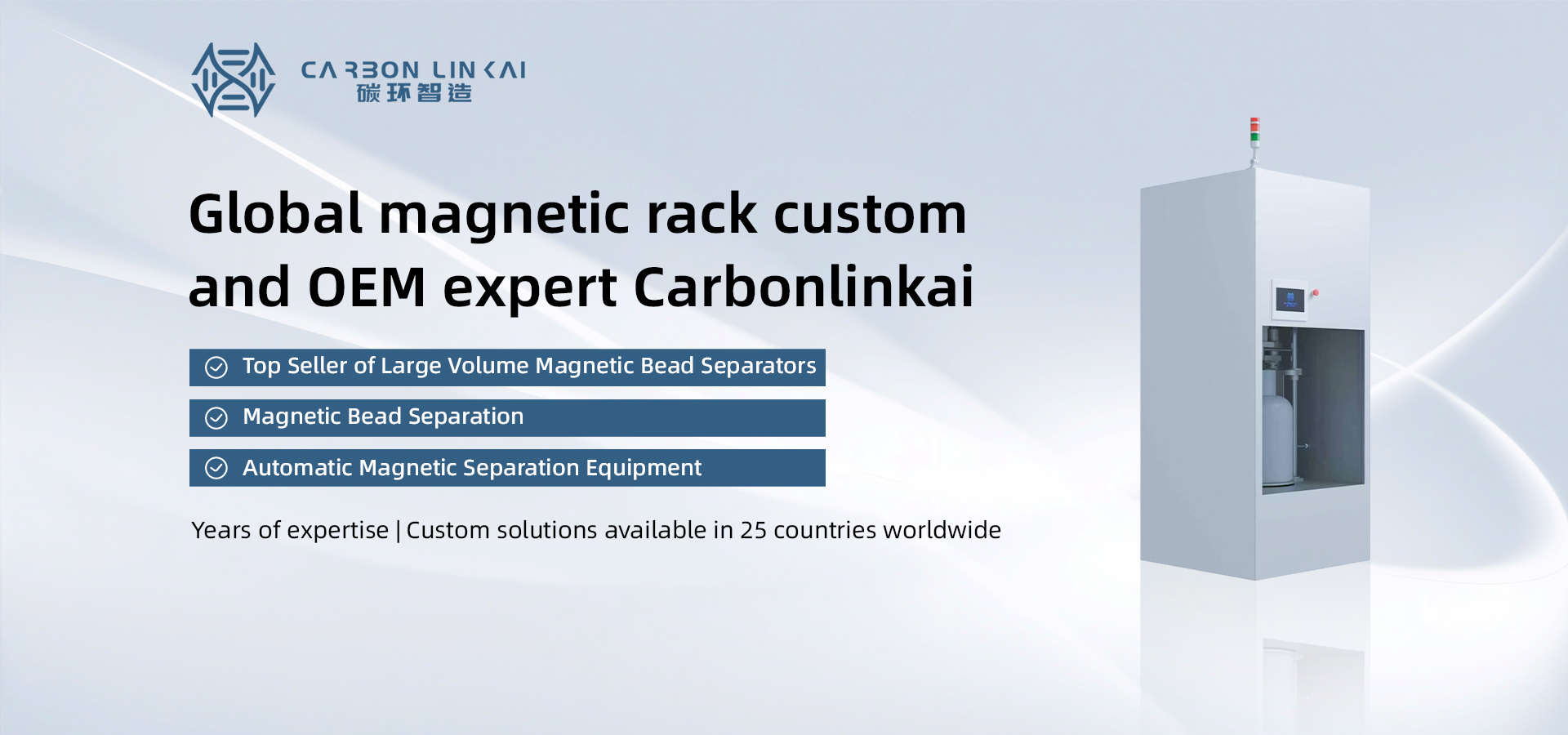
Carbonlinkai supplies magnetic rack and large-volume magnetic bead separation formats from 250 mL to 50 L, with OEM and ODM support for modified vessel geometry and labelling.
Carbonlinkai (Guangzhou Carbon Link Intelligent Technology Co., Ltd.) is a Chinese supplier of magnetic rack and magnetic bead separation systems founded in 2020, whose published range covers formats from 250 mL to 50 L. Buyers can review current specifications at carbonlinkai.com and request model-specific declarations, test reports and sample units before finalizing a purchase specification.
Have Questions or Need More Details?
Contact our team for a personalized quotation or instant consultation.
Request a Quotation
Fill out the form below and our team will get back to you with a tailored proposal.
WhatsApp Direct Chat
Prefer to chat in real-time? Message us on WhatsApp for instant assistance & quick answers.
- Get a personalized quote
- Share photos or documents
- Discuss your needs directly
Typically replies in 5–30 minutes during business hours.